Home · Cleaning · Glass and windows
Best window and glass cleaners: six compared, and not one of them is fragrance free
Glass needs a surfactant and something volatile to carry it off. It does not need perfume, dye or ammonia. We read the label of every one of these, and where there was no full label we went to the safety data sheet, which is where one EU Ecolabel certified, Royal Warrant holding, alcohol free glass cleaner turned out to contain the exact solvent this article warns you about.
By Mrs House · Updated 9 September 2026 · 13 minute read
Mrs House is independent. Nobody pays for a place in a ranking here, and no brand saw this page before it went live.
The short answer
Buy the Method Glass and Surface Cleaner. It is ammonia free and glycol ether free, roughly 45p per 100ml at Sainsbury's, and the trigger throws a fine mist rather than a jet, which is half the battle.
- Best overall: Method Glass and Surface, Mint, £3.75 for 828ml. 45p per 100ml.
- Closest to clean: Bio-D Glass and Mirror, £3.52 for 500ml. No synthetic parfum, ammonia, glycol ether, alcohol, dye, quats or isothiazolinones, with sweet orange oil as its only scent.
- Cheapest: Astonish Window and Glass, £1 for 750ml. 13p per 100ml, and it does not declare whether it contains ammonia or glycol ether.
A dense microfibre cloth and warm water costs nothing per clean and is genuinely what glass wants.
How we assessed these
Six glass cleaners, one method, and a rule we set before we started: every ingredient list here is copied from the brand’s own product page, its safety data sheet, or a retailer listing that reproduces the label. Where no full list exists in public, we say so rather than guessing.
That last point turned out to be a finding in itself. UK household cleaners are labelled under the Detergents Regulation rather than under cosmetics rules, and that regulation only forces disclosure of ingredient classes above set thresholds. Which is why several products here legally say nothing more than less than 5 per cent non ionic surfactants, perfume, and that is the whole list you are entitled to.
We looked for four things specifically. Ammonia, which is a respiratory irritant and a genuine problem in an enclosed bathroom. Glycol ethers, particularly 2-butoxyethanol. Synthetic fragrance and dye, neither of which cleans glass. And any CLP hazard pictogram or precautionary statement on the back, because that tells you what the manufacturer had to declare rather than what the front of the bottle chose to say.
Then we read the reviews, verbatim, at Robert Dyas, Big Green Smile, HG’s own site, Sainsbury’s and Morrisons, including the bad ones. Prices were checked in September 2026.
The ranking, at a glance
| Cleaner | Size and price | Per 100ml | Ammonia or glycol ether | Fragrance | Score | |
|---|---|---|---|---|---|---|
| 1 | Method Glass + Surface, Mint | 828ml, £3.75 | 45p | Neither | Parfum and colorant | 4.6 / 5 |
| 2 | Bio-D Glass & Mirror | 500ml, £3.52 | 70p | Neither | Sweet orange oil only | 4.5 / 5 |
| 3 | HG Glass and Mirror Cleaner | 500ml, £3.99 | 80p | Not declared | Perfumes | 4.3 / 5 |
| 4 | Ecover Window & Glass | 500ml, about £3.00 | 60p | Neither | Parfum, linalool, limonene | 4.1 / 5 |
| 5 | Astonish Window & Glass | 750ml, £1.00 | 13p | Not declared | Perfume, lemon oil | 4.0 / 5 |
| 6 | Sainsbury’s Green Care Home | 750ml, £2.10 | 28p | Not declared | Lavender and rosemary | 3.7 / 5 |
The two we would actually buy
Best overall
Our winner

Method Glass + Surface Cleaner, Mint
★★★★★ 4.6 / 5
The full label list is short enough to print, which is already unusual in this category: aqua, alcohol denat., sodium carbonate, caprylyl and capryl glucoside, parfum, potassium hydroxide, colorant. No ammonia, which Method make a point of, and no glycol ether. The alcohol is denatured ethanol, corn derived, and it is the reason this dries clear without you having to buff it hard.
Across seventy two reviews at one retailer, averaging 4.5, the streak free finish is the single most repeated point. What we found more interesting is who is buying it and why. One reviewer bought it specifically because a new shower screen had a coating that would not tolerate strong chemicals. Another said they liked being able to avoid harsh chemicals around their family. A third, in a hard water area where most products struggle with white marks on shower glass, said this one did a good job.
The trigger deserves a mention because it is genuinely part of why it works. Several reviewers note that it distributes a fine even mist rather than a jet, and over application is the most common cause of streaks in this whole category. Less product, evenly spread, is the answer.
Two ingredients on that list do nothing for your glass. Parfum is declared with no breakdown and no allergen list on the UK pack, and it is the thing customers argue about most: one wrote that it smells exactly like mouthwash, another that it does not smell of mint at all but of chemicals. And colorant is in there purely so the liquid looks like something. If you clean a small bathroom with the door shut and somebody in the house is asthmatic, that fragrance load is the only exposure here worth thinking about, and it is entirely avoidable in a formula.
Practical notes. Sodium carbonate plus potassium hydroxide makes this alkaline, which is why it cuts grease well and why we would keep it off polished aluminium and untreated stone. It is Leaping Bunny certified and the bottle is 100 per cent post consumer recycled plastic. We could not verify a UK refill for the glass line despite one reviewer mentioning one, so do not buy it expecting to refill.
Pros
- No ammonia and no glycol ether, and the full label list is short and published
- A fine mist trigger, which is genuinely why fewer people get streaks with it
- Reviewers with coated shower screens and hard water both rate it
- Leaping Bunny certified, in a 100 per cent recycled bottle
- Around 45p per 100ml at Sainsbury’s, which is mid market rather than premium
Cons
- Parfum is declared with no breakdown and no allergen list, and it is the top complaint
- It contains a colorant, which does nothing except make the liquid look green
- A minority get streaks regardless of cloth or technique
- Alkaline, so keep it off polished aluminium and untreated stone
- Several buyers received part empty bottles after it leaked in transit
Buy it if you want one bottle that does every mirror and window in the house and you are fine with a mint scent. Skip it if fragrance is the reason you are reading this page.
Cleanest formula
Our clean pick

Bio-D Glass & Mirror Cleaner
★★★★★ 4.5 / 5
On paper this is the cleanest formula in the comparison and it is not close. Bio-D’s own list is: under 5 per cent acetic acid, anionic surfactant, amphoteric surfactant, sodium chloride, citric acid, lactic acid, and Citrus Sinensis oil. No ammonia. No glycol ether. No isopropyl alcohol, and in fact no volatile alcohol at all, which is unusual for a glass cleaner. No dye. No quats. And Bio-D state across their whole range that there is no MI, MIT or BIT, the isothiazolinone preservatives that are among the most common contact allergens in household products.
Because there is no alcohol, it works a different way. It is acidic, at around pH 3, and it cleans through acid plus surfactant rather than through a fast evaporating solvent. Two consequences. It clears limescale film on shower glass better than a neutral spray will. And it needs a proper dry buff at the end, because there is nothing volatile doing that job for you.
Twenty seven verified reviews average 4.5, and the useful quotes are the ones that would not occur to a marketing department. One buyer wrote that it works really well with no noxious fumes. Another, fifteen years into using it, said a bottle lasts a long time so it is very economical. Two separate reviewers said it matches or beats the big brands. Several use it on taps and shower screens as well as glass.
Two honest qualifications. It is scented, just naturally. Sweet orange oil is high in d-limonene, which is a declarable fragrance allergen and which oxidises in air into more sensitising compounds, and it can react with indoor ozone to form formaldehyde and ultrafine particles. So this is free of synthetic fragrance rather than fragrance free, and you should still ventilate. And the surfactants are declared only as anionic and amphoteric classes rather than by name, which is a real transparency gap and we are not going to pretend the list is complete.
The recurring complaint is the bottle rather than the liquid: leaking triggers come up more than once. It is also roughly two and a half times the price per 100ml of the Astonish, though the 5 litre refill brings it down to around 41p per 100ml and it is widely available in zero waste refill shops, which is the cheapest way to buy it. Made in Hull in a solar powered factory, B Corp certified, Vegan Society registered, Leaping Bunny approved, septic tank safe.
Pros
- No synthetic fragrance, no ammonia, no glycol ether, no alcohol, no dye, no quats
- No MI, MIT or BIT preservatives, which is stated across the whole Bio-D range
- Acidic, so it clears limescale film on shower glass better than a neutral spray
- A 5L refill takes it down to about 41p per 100ml, and refill shops stock it
- B Corp, Vegan Society, Leaping Bunny, made in Hull, septic tank safe
Cons
- It is scented, with sweet orange oil, so it is not fragrance free
- Surfactants are declared by class rather than by name, so the list is not complete
- No volatile alcohol, so it needs a proper dry buff or it will smear
- Leaking triggers are the recurring complaint in the reviews
- At £3.52 for 500ml the bottle price per 100ml is high unless you refill
Buy it if your rule is no synthetic fragrance, and you will buy the 5 litre refill. Skip it if you need it completely unscented, or you will not buff it dry.
The wool one, and the one for a child’s bed
Best on filthy glass
Trade favourite
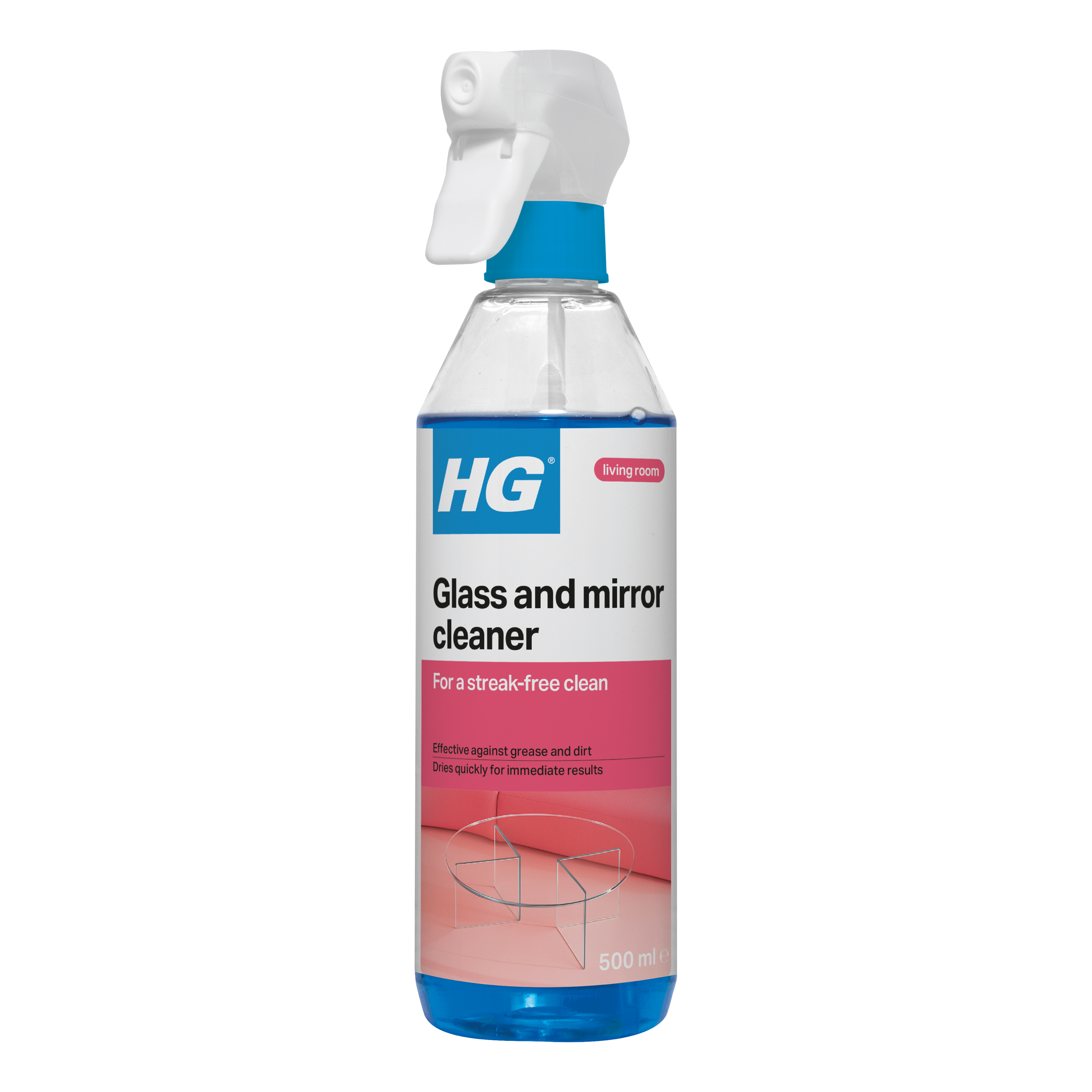
HG Glass and Mirror Cleaner
★★★★☆ 4.3 / 5
This is the one professional cleaners keep buying. One reviewer said flatly that it is the only window cleaner they will use for their cleaning business, and the pattern across the review pool is that it handles glass that is genuinely dirty rather than glass that needs a touch up. A buyer whose windows had not been cleaned inside for three years got all of it off. Another with a balcony beside a busy London railway line said it really did get to work.
It also shifts limescale film on bathroom mirrors, which most straight surfactant sprays will not touch, and it works on awkward things like glass light fittings that leave other products smeary.
You need very little of it. Reviewers say so and HG’s own product manager says so, that too much glass cleaner can actually leave streaks. HG also tell you not to clean glass in strong direct sunlight because the product dries too quickly and streaks, which is a good sign of a manufacturer being straight with you.
Now the ingredient problem, and it is the reason this sits third rather than higher despite performing best on dirt. HG do not publish a full ingredient list. The only public disclosure is on the label PDF linked from their own product page, and it says, in full: contains among others, preservation agents, 2-bromo-2-nitropropane-1,3-diol, perfumes. Plus P101 and P102, the two mildest precautionary statements there are. So there is no declared ammonia and no declared glycol ether, and we cannot rule either out, because the list is partial by design and legally that is allowed.
The pack claims it dries quickly, which in practice means there is a volatile solvent in it. HG do not say which. And the declared preservative, bromonitropropanediol, is a formaldehyde releasing preservative, which is worth knowing if you avoid those. None of that makes it a bad product and it clearly performs. It makes it a product you cannot fully assess, and that is a different criticism.
One more caveat that will catch people out. HG themselves say on the pack that this is intended mainly for glass and mirrors, and that for larger surfaces such as windows and doors they recommend their window cleaner concentrate instead. If you are buying it as a whole house window cleaner, you are buying the wrong HG product. Also, the trigger throws a wide pattern, so several reviewers spray onto the cloth rather than the surface to avoid spattering the walls.
Pros
- Best in this group on genuinely dirty glass, and the pick of professional cleaners
- Shifts limescale film on mirrors, which most surfactant sprays cannot
- You need very little product, and HG say so themselves
- No declared ammonia and no declared glycol ether
- HG give honest usage advice, including not to use it in direct sunlight
Cons
- No full ingredient list published. The label discloses a preservative and perfumes and nothing else
- The declared preservative is a formaldehyde releaser
- HG say it is for glass and mirrors, and recommend a different product for large windows
- The trigger throws a wide pattern, so it spatters walls unless you spray the cloth
- The review pool is almost entirely positive, which makes it hard to read critically
Buy it if your glass is properly dirty and you want the thing that works on it. Skip it if you want to know what is in the bottle before you spray it in a small bathroom.
The honest middle
Biggest review pool
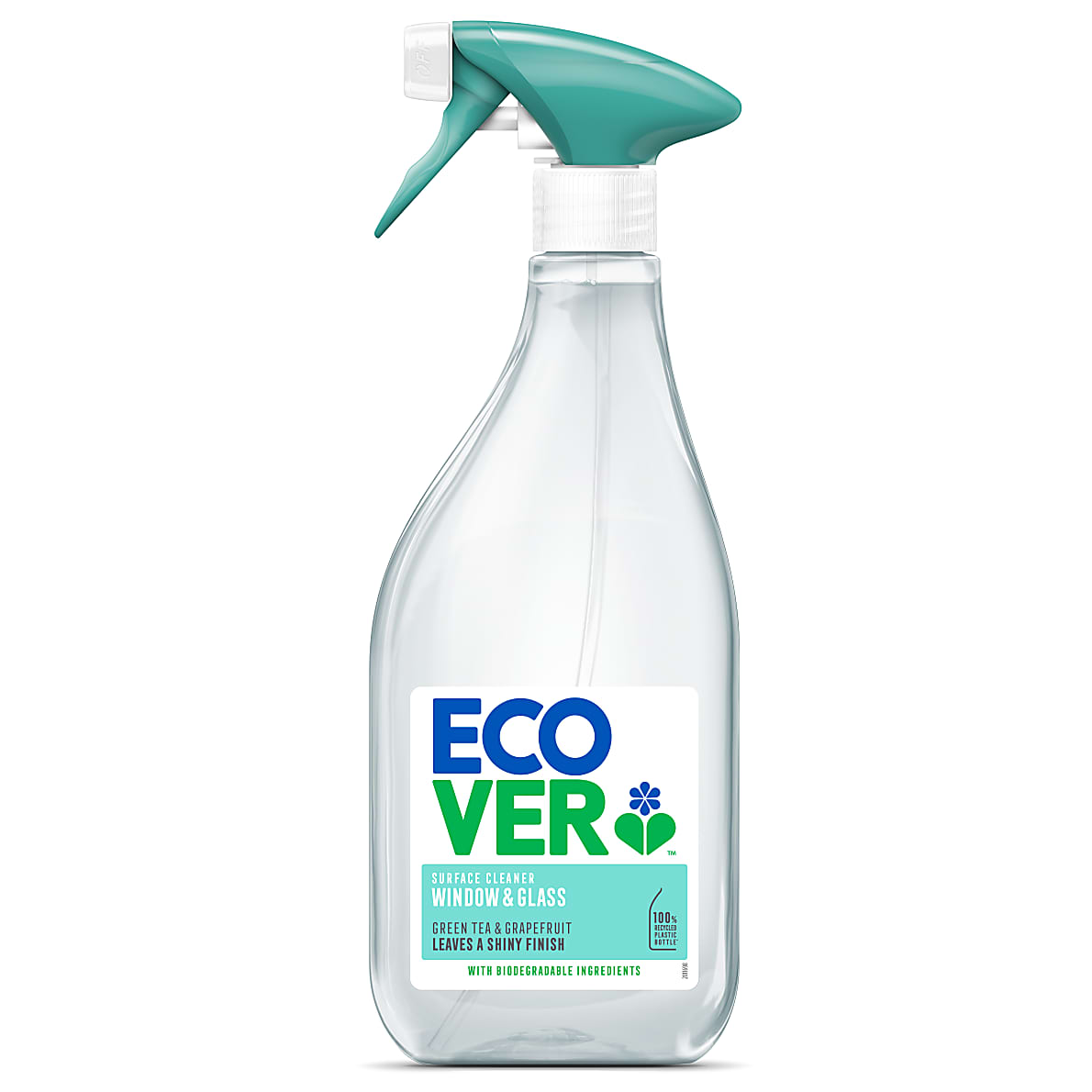
Ecover Window & Glass Cleaner
★★★★☆ 4.1 / 5
A hundred and sixty two verified reviews averaging 4.7, which is the largest genuine pool here, and Ecover publish the full list: aqua, alcohol, sodium citrate, sodium lauryl sulfate, caprylyl and capryl glucoside, a rapeseed oil ferment, tetrasodium glutamate diacetate, parfum, lactic acid, isopropyl alcohol, linalool and limonene.
The quote that matters most for this site came from a customer rather than the brand. One buyer in Edinburgh wrote that it works very well and does not trigger her asthma the way other window cleaners do. That is worth more than any certification logo. Others rate it on curved shower screens, on full height patio doors, and one noted it leaves no nasty taste in the mouth when you are cleaning near your face, which is a real and rarely mentioned test.
It is the only product here that declares isopropyl alcohol by name, and we want to be clear that the IPA is not the problem. It is the bit that makes it dry clear. This is a formula where the entire exposure question is fragrance.
Parfum is declared, and so are linalool and limonene, which are named on the label precisely because they are recognised contact allergens above the disclosure threshold. Both oxidise in air into more sensitising forms. And Ecover’s own customers are the ones raising it. After a reformulation, one long term buyer wrote that the powerful new fragrance is just too strong, that the old product did not fill the house with scent, and asked outright for a Zero variant. Another said the reformulated version leaves smears you do not see until a couple of days later and that they were looking elsewhere for an ethical glass cleaner.
So the picture is genuinely split, and both sides are its own customers. It also contains sodium lauryl sulfate, which is not a health issue in a wipe off glass spray but which readers who avoid SLS will spot. The chelator is GLDA, the biodegradable replacement for EDTA. Bottle is 100 per cent recycled, trigger is 30 per cent, made in a certified zero waste factory, septic tank safe. There is no 5 litre refill for this line despite customers asking for one.
Pros
- A customer volunteers that it does not trigger her asthma, which nothing else here gets
- The full ingredient list is published, including the fragrance allergens
- No ammonia and no glycol ether
- The largest verified review pool in this comparison, at 162
- Recycled bottle and trigger, zero waste factory, septic tank safe
Cons
- Parfum plus two declared allergens, linalool and limonene, both of which sensitise on oxidising
- Long term buyers say the reformulated version smears and the new scent is too strong
- Dose sensitive. Use too much or the wrong cloth and it goes smeary
- Contains SLS, which is harmless here but which some readers avoid
- No 5 litre refill for the glass line, despite repeated customer requests
Buy it if you want a mainstream green brand with the whole ingredient list on the page. Skip it if you are fragrance sensitive, because this is the entry where scent complaints are loudest.
The two we would not buy
Best budget
13p per 100ml

Astonish Window & Glass Cleaner
★★★★☆ 4.0 / 5
A pound for 750ml at Morrisons, which works out at 13p per 100ml and makes it roughly a fifth the price of the Bio-D per millilitre. It is made in Leeds and it is cruelty free, which is not nothing at that price.
It also performs, on the evidence available. One reviewer said they have tried most brands of glass cleaner and this clears mirrors right away, which is the hardest test in the category. Another said it really does clean windows and leaves no smear. Perhaps the most useful endorsement came from a buyer who used it on kitchen cupboard doors because the kitchen manufacturer had recommended it, and reported no streaks or residue.
The problem is that we cannot tell you much about what is in it, and neither can anyone else. The label declaration is: less than 5 per cent non ionic surfactants, perfume. Plus lemon oil on the front. That is the entire legal disclosure and it is all Astonish provide. No ammonia is declared and no glycol ether is declared, and as with the HG we cannot rule either out because the disclosure is a class list rather than an ingredient list.
We also have to be straight about the evidence base. The review pool we could read runs to twenty two reviews, and one of those five star reviews is about light bulbs rather than glass cleaner, while the only three star review consists of the single word perfect. That is not a body of evidence, and Morrisons carry it with no ratings at all. It probably is as good as those reviewers say. We just cannot show you that it is.
Two things on the pack worth passing on. Do not use it on varnished, polished or unsealed wood, and wipe spills up immediately. And condensation may form on cold glass and then clear, which is normal and which generates confused reviews every winter.
Pros
- Thirteen pence per 100ml at Morrisons, which is a fifth the price of the specialists
- Reviewers rate it on mirrors specifically, which is the hardest surface to do well
- Cruelty free, made in Leeds, and sold absolutely everywhere
- No declared ammonia and no declared glycol ether
- A kitchen manufacturer recommended it for cupboard doors, which suggests it is gentle
Cons
- The entire ingredient disclosure is less than 5 per cent non ionic surfactants and perfume
- Only twenty two readable reviews, and one of them is about light bulbs
- No supermarket scale review data to cross check against
- Do not use on varnished, polished or unsealed wood
- Fragranced, with lemon oil on top of an undisclosed perfume
Buy it if you want the cheapest thing that works and the ingredient list is not your priority. Skip it if you want to know what you are spraying.
Supermarket own brand
Read the back
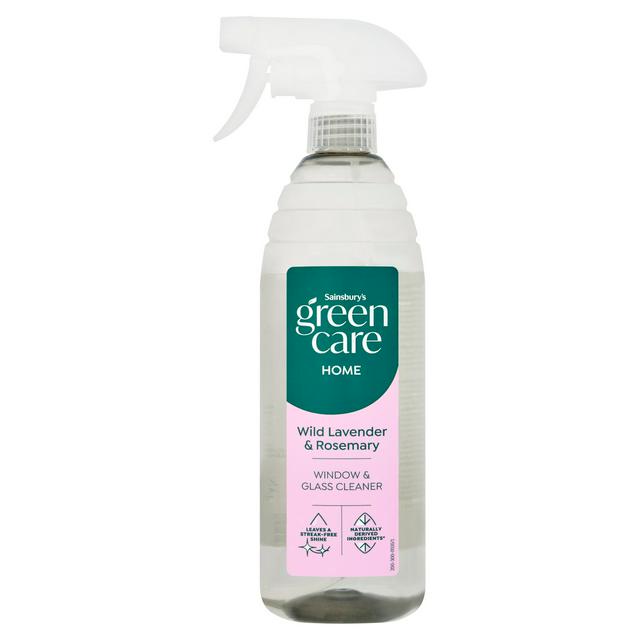
Sainsbury’s Green Care Home Window & Glass Cleaner
★★★★☆ 3.7 / 5
This is the most interesting product on the page for anyone who buys on packaging, and not in a good way. Leaping Bunny certified, vegan friendly, made in the UK, 28p per 100ml, and a front of pack claim of 99.69 per cent natural origin to ISO 16128. Twenty five reviews averaging 4.8, with buyers praising the streak free finish and the smell.
Start with that 99.69 per cent figure, because it is the most quietly misleading number in this whole comparison. ISO 16128 is a real standard and the calculation includes water. Water is roughly 95 per cent of any glass cleaner. So 99.69 per cent natural origin is technically true and tells you very close to nothing about the remaining few per cent, which is the only part that does anything at all.
The ingredient disclosure is the legal minimum: contains among other ingredients, less than 5 per cent non ionic surfactants, perfumes. And then turn the bottle round. This is the only product of the six that carries the full eye safety set on the back: if in eyes, rinse cautiously with water for several minutes, remove contact lenses if present and easy to do, continue rinsing. Plus wash contaminated skin thoroughly after handling.
That combination of precautionary statements is what normally accompanies an eye irritant classification, and no other product in this ranking carries anything close to it. It is not a scandal and Sainsbury’s have declared it properly, which is the system working. It is worth knowing if you have children who help with the cleaning.
And the reason it finishes last is the thing the product is built on. Wild lavender and rosemary is the proposition. The scent is the point, there is no unscented variant in the range, and on glass the fragrance does nothing whatsoever except sit in the air of a small room after you have gone. That is the wrong trade for an asthma or eczema household, and it is what happens when a natural positioning is built around adding a fragrance rather than around taking ingredients out.
Practical note: it is Sainsbury’s only, so if you shop anywhere else you cannot buy it. And 25 reviews with no visible negatives is a small sample, not a verdict.
Pros
- Twenty eight pence per 100ml with Leaping Bunny certification, which is rare at own label prices
- Buyers consistently report a streak free finish with no residue
- Vegan friendly and made in the United Kingdom
- Cheaper than every branded low tox rival here
- Sainsbury’s declare the safety wording properly on the back rather than hiding it
Cons
- The only product here carrying the full eye rinsing precautionary set on the back
- The 99.69 per cent natural origin claim includes water, which is 95 per cent of the bottle
- Built entirely around fragrance, with no unscented variant in the range
- Ingredient disclosure is the legal minimum and nothing more
- Sainsbury’s only, and just 25 reviews with no visible negatives
Buy it if you shop at Sainsbury’s, you like the lavender, and you want cruelty free at own label money. Skip it if anybody in the house is asthmatic, eczema prone or fragrance sensitive.
Prices checked 5 August 2026 and may have changed since.
The clean pick, and the honest catch
Our clean pick
Bio-D Glass & Mirror Cleaner
The closest thing to clean, but not fragrance free
Why it wins on ingredients
✓
No synthetic fragrance at all
✓
No ammonia, no glycol ether, no alcohol
✓
No dye, no quats, and no MI, MIT or BIT
✓
Refillable, and certified by people who check
What you give up
✕
It is not actually fragrance free
✕
The surfactants are not named
✕
No alcohol means you have to buff it
The catch, said plainly, and it is bigger than the product. None of the six is genuinely fragrance free. Every single one declares parfum, perfume, perfumes or a named essential oil, and as far as we can find there is currently no fragrance free glass cleaner on sale in a UK supermarket or high street hardware chain. The only genuinely unscented one we located is Greenscents Organic Glass Cleaner in its Nonscents version at around £7.50 for 500ml, which is four times the price per 100ml of the nearest low tox rival, is sold direct only, has five reviews, and does not publish a full ingredient list either. It is the right answer for a severely fragrance sensitive household and the wrong answer for almost everybody else.
Which brings us to the thing we would actually recommend most readers do, and it is not a purchase. A dense microfibre glass cloth with warm water, or warm water with two or three drops of washing up liquid, finished with a second dry cloth. No fragrance, no solvent, about zero pence a clean. That is not us dodging the question. It is what glass genuinely needs, and the buying guide below explains why.
What to look for when you buy one
Microfibre and water beats most sprays
Glass is one of the least demanding surfaces in the house. It is non porous, so nothing soaks in, and the only things on it are dust, grease from fingers, and hard water minerals. A dense microfibre cloth lifts the first two mechanically without needing a chemical to do it. Warm water, or warm water with two or three drops of washing up liquid, then a second dry cloth to buff. That is the whole method, it costs nothing, and it puts no fragrance into a small room. If you buy nothing else from this page, buy two good glass cloths.
Why it streaks, in order of likelihood
Too much product is the number one cause and it is not close. Even HG’s own product manager says that too much glass cleaner leaves streaks. Second, one cloth doing both jobs, so you are spreading dissolved dirt around rather than removing it. Third, a cloth that is not clean, or worse, one that has been washed with fabric conditioner, which coats the fibres and destroys microfibre completely. Fourth, direct sunlight or hot glass, because the liquid dries before you have finished wiping. Fifth, hard water, if you are cleaning with tap water in a hard water area. Sixth, and only sixth, the product itself.
Use two cloths
One damp cloth with the product, one dry cloth immediately behind it. This single change fixes more streaking complaints than switching brands ever will. Wash microfibre separately from cotton, hot, with no fabric conditioner and no dryer sheets, and it will keep working for years.
Shower glass is a different problem
The white film on shower glass is not dirt, it is limescale, which is calcium and magnesium carbonate left behind when hard water evaporates. Surfactants do nothing to it. You need acid. That is why the Bio-D, at around pH 3, and the HG both clear it when neutral sprays cannot, and it is why a dedicated shower spray or a limescale remover is the right tool if it has built up. Two warnings. Acidic products will etch marble, limestone and travertine, so keep them off natural stone shower trays and sills, and off unsealed grout. And the real answer is a squeegee: thirty seconds after each shower stops the film forming at all, which is cheaper and healthier than any product.
Tinted, coated and treated glass
Coated shower screens, low emissivity glazing, anti glare screens and privacy films all have surface treatments that strong solvents and abrasives will damage. Alkaline products and glycol ethers are the usual culprits. If the glass is coated, use the mildest thing that works and test on a corner first, which is exactly why one reviewer bought the Method for a new coated screen.
Car interiors and screens
The inside of a windscreen collects a film of plasticiser that has off gassed from the dashboard, which is greasy and needs a surfactant rather than water alone. Never use an ammonia based product on a car interior, because ammonia attacks tinting film and some dashboard plastics, and do not use anything on a satnav or infotainment screen that is not specifically made for screens, because the anti glare coating will come off.
Read the safety data sheet, not the front of the bottle
Here is the single best example we found while researching this page, and we want to be clear that nobody has done anything improper. Delphis Eco sell a Glass and Stainless Steel Cleaner that is EU Ecolabel accredited, B Corp certified, holds a Royal Warrant, comes in a 100 per cent recycled bottle and is marketed as alcohol free. Their own published safety data sheet lists 5 to 10 per cent dipropylene glycol methyl ether and 1 to 5 per cent butyl glycol. Butyl glycol is 2-butoxyethanol, which is the exact glycol ether this article has been warning you about.
Delphis disclosed it. They published the safety data sheet on the product page, which is more than most brands do, and the finished mixture falls below classification thresholds so it carries no CLP hazard. The point is not that they hid anything. The point is that the front of the pack and the safety data sheet were telling different stories, and only one of them was the whole story. Alcohol free does not mean solvent free, and an EU Ecolabel is an environmental standard rather than a human exposure one. If a product matters to you, search the brand name plus SDS and read section 3.
What the ingredient labels are and are not telling you
UK household cleaners are labelled under the Detergents Regulation, not under cosmetics rules, which means brands only have to disclose ingredient classes above set thresholds. That is why several products on this page legally say nothing more than less than 5 per cent non ionic surfactants, perfume. It is not evasion, it is the law. But it does mean that a full published ingredient list, as Method, Ecover and Bio-D all provide, is a genuine choice a brand has made, and that is worth rewarding.
What to avoid, and why
Ammonia is a respiratory irritant and the reason old fashioned glass cleaners made your eyes sting. It does clean well, and none of the six here declares it, which reflects a real shift in the category. Never mix an ammonia product with bleach, which produces chloramine gas.
Glycol ethers, and 2-butoxyethanol in particular, are effective solvents that are absorbed through skin as well as inhaled, which is why concentrated forms carry acute toxicity and irritation classifications. In a finished consumer spray the concentration is low enough that the mixture usually carries no hazard label at all, which is why you will only find them by reading a safety data sheet.
Fragrance is the one worth thinking hardest about, because glass needs a surfactant and a volatile carrier and nothing else. Everything else in the bottle is there to make the product feel like a product. In a small bathroom with the door shut, that perfume is the entire exposure, and it bought you no cleaning at all.
Final verdict
Two cloths, and the cheapest bottle you trust
Glass is the easiest surface in the house to clean and the category is sold as if it were the hardest. Two microfibre cloths, one damp and one dry, will do almost everything, and if you only change one thing after reading this, make it that rather than the bottle.
If you want a bottle, Method is the sensible mainstream answer at around 45p per 100ml with no ammonia, no glycol ether and a trigger that mists rather than jets. If fragrance is the reason you are here, Bio-D is the cleanest formula on this page and the 5 litre refill makes it cheap. If your glass is genuinely filthy, HG will shift it, and you can decide whether a partial ingredient list is a price you are willing to pay for that. And if you are counting pennies, the Astonish is a pound for 750ml and it works.
What we would not do is buy on the front of the pack. The greenest looking product here carries the strongest eye safety wording on the back, its headline natural origin figure is mostly water, and the near miss we found while researching this page was an EU Ecolabel certified, Royal Warrant holding, alcohol free cleaner containing 2-butoxyethanol. Turn the bottle round. That is the whole lesson.