Home · Living room · Home fragrance
Best scented candles: six compared, and the £63 one tells you least
Six home fragrance products, from a £12.99 supermarket jar to a £63 French classic, judged on what the maker will actually tell you and on what the published science says about burning them indoors. Two things came out of this that we did not expect. Disclosure gets worse as the price goes up, not better. And the thing that decides what you end up breathing is not the wax you paid for, it is whether the flame is steady or sooting, which is free to fix.
By Mrs House · Updated 27 August 2026 · 14 minute read
Mrs House is independent. Nobody pays for a place in a ranking here.
The short answer
Buy the Earl of East Shinrin-Yoku at £26 if you want a candle whose maker names the wax, names the wick fibre and tells you where both came from.
- Best overall: Earl of East Shinrin-Yoku, £26 for 170ml. Soy with the origin given, 65p to 74p an hour.
- Cheapest to burn: Price’s English Lavender, £12.99 for 510g. 13p an hour, a fifth of what the premium candles cost to run.
- Skip: Diptyque Baies, £63. Names no wax, no wick and not one allergen, at £1.26 an hour.
Buy scent by the hour rather than by the jar, and treat a maker who will not name the wax as having answered the question.
How we assessed these
Six products, one method, applied the same way to all of them. We do not burn candles in a test chamber and we are not going to pretend otherwise. What we can do is read every word the maker publishes, check it against what the retailers say about the same product on the same day, and set both against the independent research on what a burning candle does to the air in a room.
Five things decided the scores.
Disclosure. Does the brand name the wax, name the wick fibre, and name the fragrance sensitisers, or does it leave you guessing. This carried the most weight, because it is the only thing in the category you can actually verify before you buy.
Cost per hour. Worked out from the maker’s own stated burn time and the price we saw on 27 August 2026. A candle is bought by the jar and used by the hour, and the gap between those two numbers is enormous here.
Evidence of how it burns. Taken from independent review corpora where they exist, not from the brand’s own on-site widget. Where a product has no independent reviews at all, we say so rather than filling the gap.
Fragrance load and format. Heavy scenting and glass containers are the two things the soot research points at, so a candle that is both gets marked for it.
Verifiability. Whether a claim comes with a certificate number, a test standard or a source, or whether it is just a nice word on a label.
Prices and burn times move, and the same retailers publish different burn times for the same jar, so we have said where every figure came from.
The ranking, at a glance
| Product | Size | Price | Cost per hour | Wax named? | Score | |
|---|---|---|---|---|---|---|
| 1 | Earl of East Shinrin-Yoku | 170ml | £26.00 | 65p to 74p | Yes, soy, origin given | 3.8 |
| 2 | Price’s English Lavender | 510g | £12.99 | 13p | Yes, two ways at once | 3.3 |
| 3 | Yankee Original Large Jar | 623g | £23.99 | 16p to 22p | Yes, paraffin | 3.2 |
| 4 | Neom Real Luxury Diffuser | 100ml | £55.00 | £4.58 a week | No, solvent unnamed | 3.0 |
| 5 | The White Company Seychelles | 140g | £25.00 | 89p | Retailer only | 2.5 |
| 6 | Diptyque Baies | 190g | £63.00 | £1.26 | No | 2.3 |
The two we would actually buy
Best overall
Names its wick
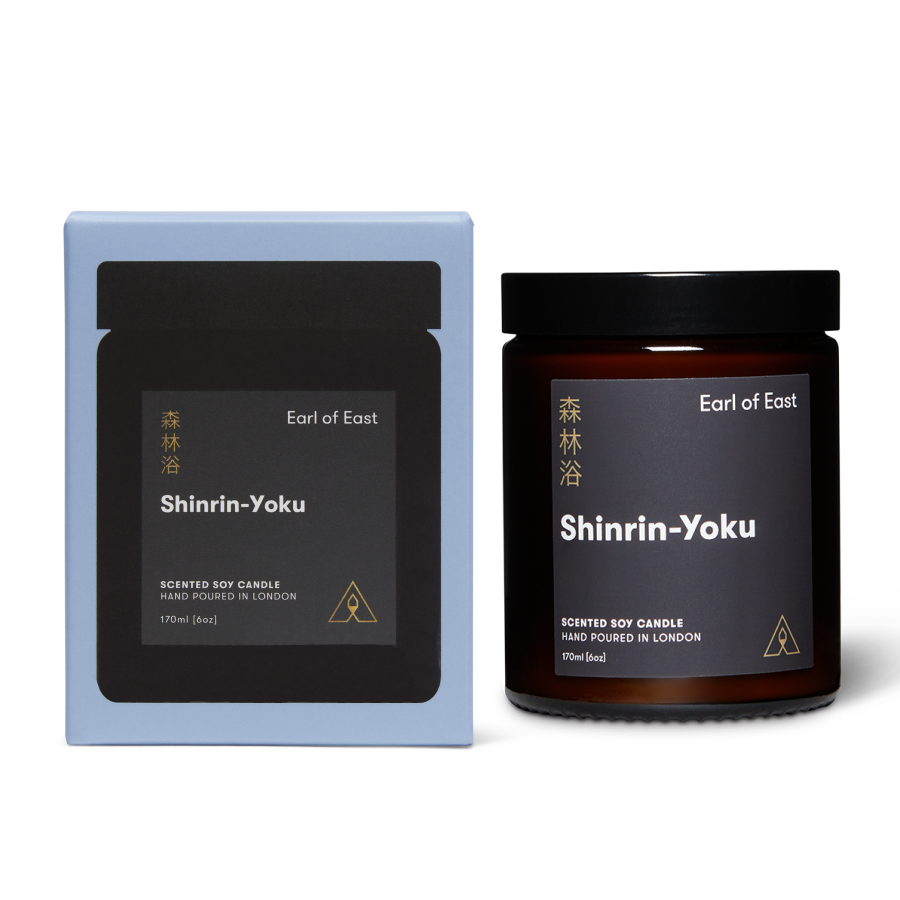
1. Earl of East Shinrin-Yoku Scented Candle, 170ml
★★★★☆ 3.8 / 5
This is the only product in the six that answers all three questions a candle buyer might reasonably ask. What is the wax. What is the wick made of. Where do I find the allergens. Earl of East says soy, non-GMO, grown in the United States and manufactured in the UK, hand poured in East London. It says the wicks are cotton and unbleached linen dipped in vegetable wax, with the cotton certified to OEKO-TEX Standard 100. And rather than pretending the allergen question does not exist, it tells you to read the label on the base of the jar, which is where GB CLP actually requires the information to be.
Set that against a £63 candle that will not name a single one of those things and you have the whole argument of this article in one comparison. It is not the cheapest way to buy scent. At 65p to 74p an hour it is roughly four times the running cost of the Yankee jar, because 170ml only gets you 35 to 40 hours. What you are paying for is a small maker being straight with you.
The honest weakness is that nobody has checked their work. We could not find a single independent review of this candle anywhere: not on the brand site, not at Cult Beauty, not on any review platform. So the transparency is verifiable and the performance is not, which is the exact inverse of the Yankee jar below.
Pros
- The only candle here that names both the wax and the wick fibre, in plain words, on its own website
- Wax origin published: non-GMO soy grown in the US, manufactured and poured in the UK, suppliers RSPO certified
- Wick cotton certified to OEKO-TEX Standard 100, and explicitly cotton and linen rather than a vague “natural fibres”
- Tells you where to find the allergen statement instead of quietly omitting it
- Cheaper per hour than The White Company at a similar shelf price
Cons
- No independent reviews exist for it at all, so there is no evidence of how it actually burns
- Sold by volume, not weight, so you cannot compare it on price per gram with anything else in this list
- Neither certification is published with a licence or certificate number, so you cannot check either one yourself
- 35 to 40 hours is a short run for £26
Buy it if you want to know what you are burning and you are willing to pay roughly 70p an hour for the privilege of being told.
Best value by a mile
13p an hour
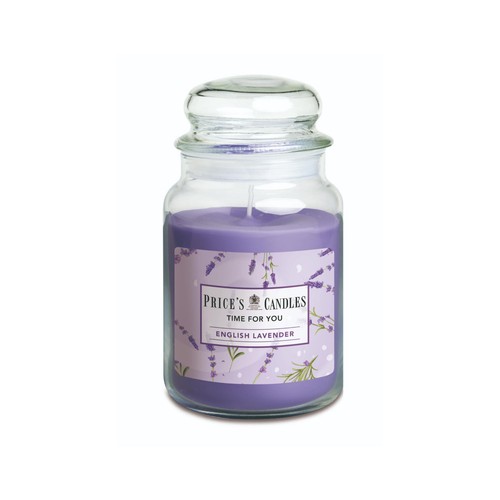
2. Price’s Candles English Lavender Large Jar, 510g
★★★☆☆ 3.3 / 5
£12.99 at Tesco for 510g and up to 100 hours. That is 13p an hour, which makes it the cheapest verified burn here by a distance, and it means you could run this jar for the whole of a winter for less than the price of two hours of the Diptyque.
It also, entirely by accident, produced the single most useful finding in this whole piece. On the same day, Tesco describes it as “100% mineral wax and vegan friendly” and Ocado describes it as “100% fully-refined paraffin wax” blended with vegetable waxes. Same jar, same SKU, two descriptions that read completely differently to a shopper, and both of them lawful, because UK law does not require a candle to declare its wax at all. Once you know that, you know what “mineral wax” means everywhere else on this page, including on a £25 British signature candle.
What it does not have is any evidence base. Two reviews across both supermarkets, no text served for either. That is the honest state of the budget tier: the candles most people actually buy carry almost no review history, because they are sold as groceries or as seasonal lines that never accumulate one.
Pros
- 13p an hour at Tesco and 14p at Ocado, roughly a fifth the running cost of any premium candle here
- 510g and up to 100 hours, the largest quantity of wax per pound in the group at 39g for every £1
- Actually in stock, in a supermarket, all year round, which is more than can be said for most budget candles
- The wax is disclosed, even if the two retailers cannot agree on how to phrase it
Cons
- Sold as “mineral wax” at one retailer and “paraffin” at another, which tells you the labelling is marketing rather than information
- Two reviews in total across Tesco and Ocado, with no review text, so there is no evidence at all of how it burns
- No CLP allergen statement published online at either retailer, so you cannot check it before it arrives
- No wick material published, no count, nothing
- Tesco does not publish the weight, only the box dimensions
Buy it if you want the most hours of scent for the least money and you accept that you are buying on arithmetic rather than on evidence.
The one with all the reviews, and the one that does not burn
Most evidence
Names six sensitisers
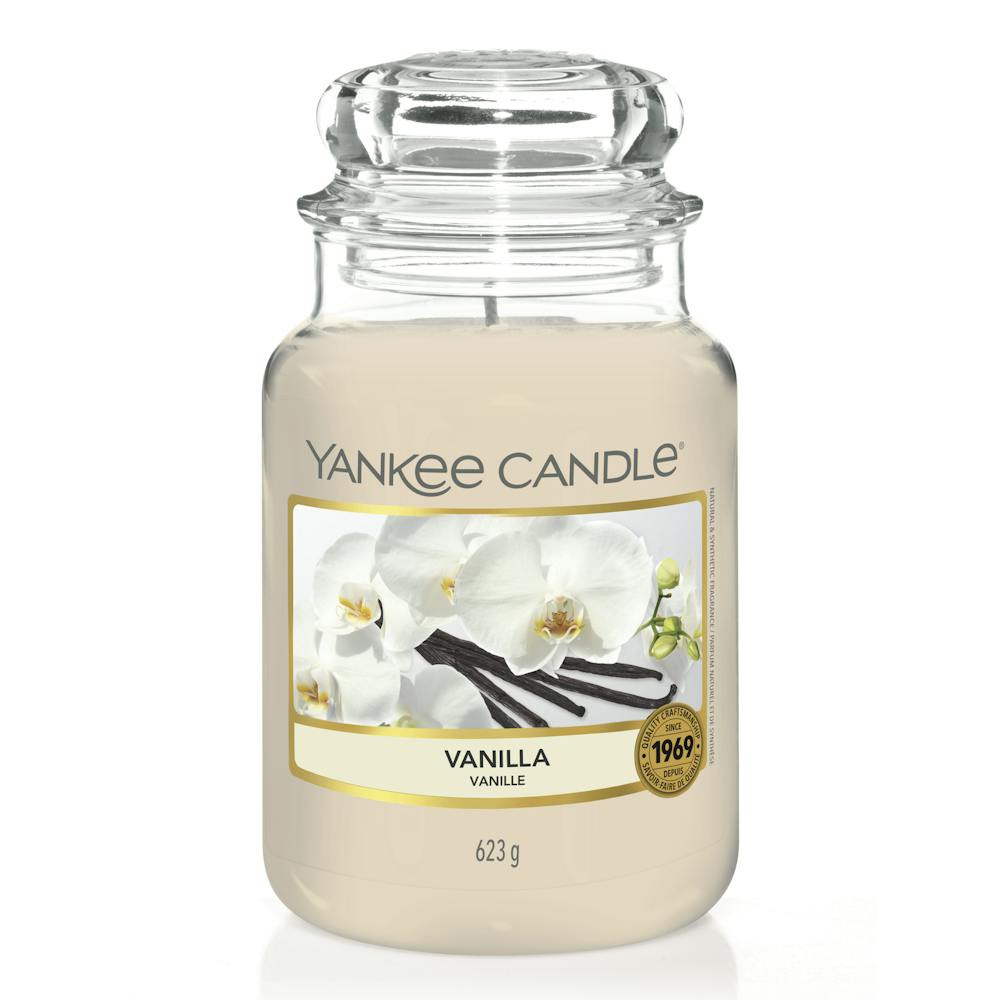
3. Yankee Candle Vanilla Original Large Jar, 623g
★★★☆☆ 3.2 / 5
Yankee gets more credit here than its reputation suggests, and for an unglamorous reason: it tells you things. The product page says “premium-grade paraffin wax” without hedging, and it publishes a CLP allergen line naming hexyl cinnamal, isocyclemone E, linalool, Lilial, octabenzone and Lyral. Six named sensitisers on a £23.99 jar, against zero on a £63 one.
Two of those names deserve a flag rather than a shrug. Lilial was banned in UK and EU cosmetics from March 2022 as a reprotoxicant, and Lyral was banned from August 2021 as a potent sensitiser. Neither ban applies to candles, because a candle is a mixture under GB CLP rather than a cosmetic, so the only duty is to name a sensitiser above threshold, not to remove it. That is not Yankee breaking a rule. It is Yankee following one that stops at the edge of the cosmetics counter, and being open enough about the formula that you can see where the line falls.
The reason it does not rank higher is the review evidence, which is unusually contradictory. Its own site shows 4.5 out of 5 from 113 reviews on this jar. Trustpilot shows 1.3 out of 5 from 270. The complaints that recur in the low scores are consistent enough to take seriously: weak scent throw, tunnelling even when burned for the recommended stretch, and soot. One reviewer scored it one out of five for scent, one for burn, and then five out of five for both black soot and tunnelling, which is about as clear as a review gets.
Pros
- 16p to 22p an hour, the cheapest branded burn here, from 623g and a stated 110 to 150 hours
- Names its wax outright as paraffin rather than hiding behind “mineral wax”
- The fullest allergen disclosure of any candle in this set, with six sensitisers listed on the product page itself
- By far the largest review base, well over 1,700 across three sources, so you are not buying blind
- The positive reviews are consistent about the thing that matters at this price: one jar lasting months
Cons
- Soot and tunnelling are the two recurring themes in the low reviews, and they appear together
- Weak scent throw comes up repeatedly, including on the brand’s own site going back years
- Contains Lilial and Lyral, both banned in UK cosmetics, lawful here only because a candle is not a cosmetic
- The wick fibre is given only as “100% natural fibres”, with no material named and no metal core confirmed or denied
- Its own reviews say 4.5 and Trustpilot says 1.3, and there is no honest way to reconcile those
- No sooting test result or certificate published, despite BS EN 15426 existing for exactly that
Buy it if you want hours of scent for your money and you would rather have a brand that names its paraffin and its allergens than one that names neither.
Nothing burns
Best allergen list

4. Neom Real Luxury Reed Diffuser, 100ml
★★★☆☆ 3.0 / 5
A reed diffuser is in this comparison for one reason. If what worries you about scenting a room is the particles, a diffuser removes that concern entirely, because nothing is burning. No soot, no ultrafine particles, no black marks above the radiator. Neom also publishes the best fragrance allergen list of anything here, naming linalool, d-limonene, eugenol, geraniol and citronellol outright along with nine other declared sensitisers.
And then it does the same thing every other brand in this piece does, just in a different place. A reed diffuser is typically three-quarters carrier solvent and one-quarter fragrance. UK trade suppliers sell the standard base openly as a blend of denatured ethanol and dipropylene glycol at roughly 25 to 75. Neom names none of it. John Lewis lists the composition as “Glass and Oil”. So the great majority of what is in a £55 bottle is unnamed on every page we could find, while a fragrance ingredient at 0.1 per cent has to be printed. We checked The White Company’s diffuser as a control and found exactly the same pattern.
On cost it is genuinely reasonable if you use it the way it is meant to be used. £4.58 a week over the stated twelve weeks, and if you leave it out continuously that works out at under 3p an hour of scent, which no candle here comes close to. The catch is that John Lewis has discontinued it and Space NK had it on a waitlist, so the brand site is effectively the only route.
Pros
- Nothing burns, so none of the soot, particle or wall-marking problems in this article apply to it
- Five of the 26 declarable EU fragrance allergens named outright, plus nine more declared sensitisers, the best disclosure in the group
- £4.58 a week against a stated twelve weeks, and under 3p an hour if you leave it running
- A refill is sold, so the glass and reeds are not thrown away each time
- 4.5 out of 5 from 70 reviews at Space NK, on a 627-review base at the brand
Cons
- The carrier solvent, which is likely to be around three-quarters of the bottle, is not named anywhere by the brand or its retailers
- Retailers disagree on how long it lasts: the brand says twelve weeks and John Lewis said ten
- John Lewis has discontinued it and Space NK showed a waitlist, so availability is thin
- £55 for 100ml is a lot of money for a product whose bulk ingredient you cannot identify
- The brand does not display an average star rating on its own 627 reviews
Buy it if you want a room to smell of something without lighting anything, and you are prepared to accept that you will not be told what the liquid mostly is.
The two premium jars, and what the money buys
Well liked
89p an hour
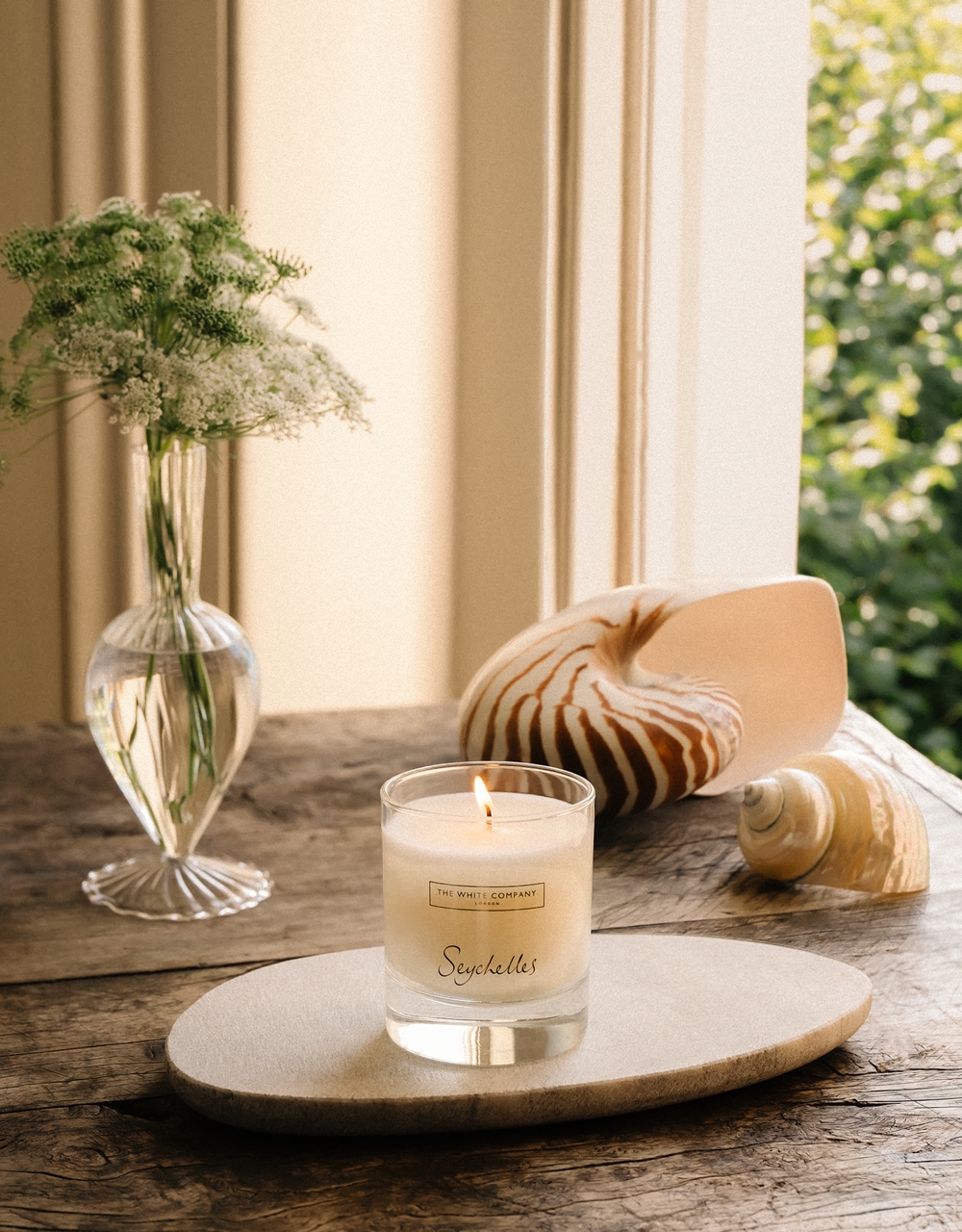
5. The White Company Seychelles Signature Candle, 140g
★★★☆☆ 2.5 / 5
People love this candle. 4.8 out of 5 from 478 reviews on the brand’s own site, a permanent bestseller, and a company Trustpilot score of 4.2 across more than eighteen thousand reviews. We have no reason to doubt that the Seychelles fragrance is lovely, and if that is all you are buying then none of what follows will change your mind.
What we can assess is what the brand tells you, and the answer is close to nothing. Its own product page does not state the weight. It does not state the burn time. It does not state the wax. It does not carry an allergen list. All four of those exist, but only at other people’s shops: John Lewis supplies the 140g and the 28 hours and lists the composition as “glass, mineral wax”, and LookFantastic supplies the CLP allergen line naming benzyl salicylate, linalool and d-limonene among others.
And “mineral wax” is the phrase the Price’s jar decoded for us two entries ago. It is paraffin. So a £25 candle, hand poured in Britain, is on the only disclosure available the same base material as a £12.99 supermarket jar, running at 89p an hour against that jar’s 13p. That is not a scandal. It is a preference for scent quality and finish, and it is worth stating in those terms rather than as a materials claim, because the brand has not made a materials claim at all.
Pros
- 4.8 out of 5 from 478 reviews on the brand site, with bestseller status behind it
- Poured and hand-finished in the UK, which the brand does state clearly
- The full CLP allergen statement does exist, if you go and read it at LookFantastic
- Often discounted, and at LookFantastic’s £20 for a stated 33 hours the running cost drops to 61p an hour
Cons
- 89p an hour, roughly seven times the cost of the Price’s jar for the same disclosed wax type
- The brand’s own page states no weight, no burn time, no wax and no allergens
- “Mineral wax” at John Lewis means paraffin, which the brand does not say anywhere itself
- Retailers cannot agree on the burn time: 28 hours at John Lewis and Selfridges, 33 at LookFantastic
- Single wick confirmed, but the wick material is not published anywhere by anyone
- The review widget served us no reviews below four stars, so we could not assess the complaints at all
Buy it if the Seychelles fragrance is the thing you want and you are buying it on scent rather than on what is in the jar.
The luxury benchmark
£1.26 an hour
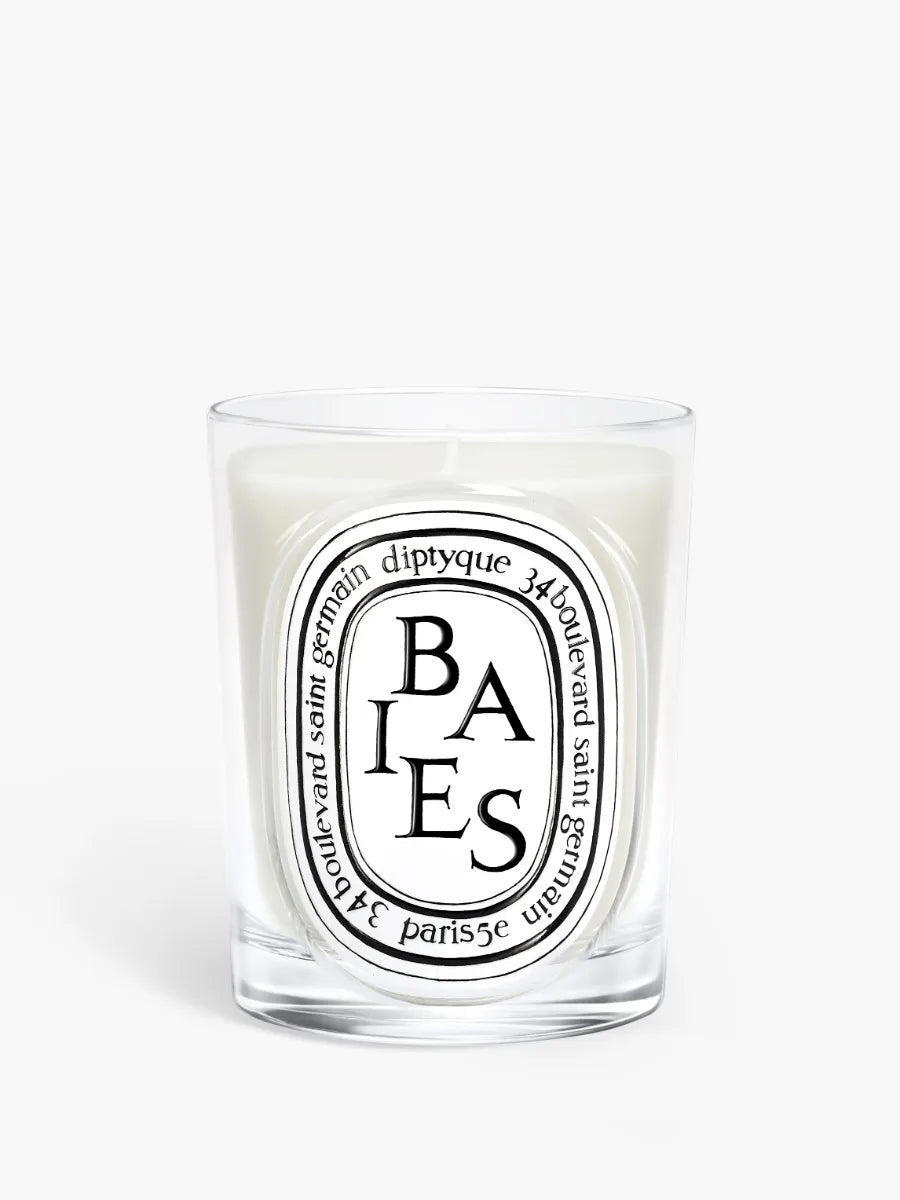
6. Diptyque Baies Classic Candle, 190g
★★☆☆☆ 2.3 / 5
Baies is a famous fragrance and it did not get famous by accident. Blackcurrant and rose, made in France, and for a great many people it is the candle. None of that is in dispute, and if you have burned one you already know whether £63 is worth it to you.
Our problem is everything else. This is the most expensive product in the comparison and it has the weakest disclosure of any of them. The wax is given as “a blend of several types of wax”, which names nothing. Selfridges lists the composition as “100% wax”, which is worse. The only substantive disclosure anywhere is at Liberty, which describes it as a blend of vegetable and paraffin waxes, so the £63 candle is part paraffin too and you have to go to a third shop to learn it. The wick is described as “a selection of a wick”, a sentence with no material in it. And there is no allergen list on the brand page, on Selfridges or on Liberty.
So the £23.99 Yankee names its wax and six sensitisers, and this names neither. At £1.26 an hour it costs eight times the Yankee and ten times the Price’s to run. The brand-level reviews we could find were decent at 4.3 out of 5, but the recurring theme in the low ones is tunnelling and uneven burn, which is the one fault a candle at this price really ought not to have.
Pros
- A genuinely distinctive fragrance with a following that has lasted decades
- Made in France, and the brand publishes clear burn-care instructions including getting a full melt pool and recentring the wick
- Liberty does disclose the wax blend, even though the brand will not
Cons
- £1.26 an hour, eight times the Yankee and ten times the Price’s jar
- The wax is “several types of wax” at the brand and “100% wax” at Selfridges, which is not disclosure in any useful sense
- No wick material named anywhere by anyone
- Not one fragrance allergen published on the brand page, Selfridges or Liberty, on a £63 product
- Tunnelling and uneven burn are the recurring complaints, along with occasional off-smelling batches
- No review count or rating on the brand page at all
- Retailers disagree on burn time: about 50 hours at the brand, 60 at Liberty
Buy it if the Baies fragrance specifically is what you want and the price is not the point, because on every measurable thing here it finishes last.
Prices checked 5 August 2026 and may have changed since.
The clean pick, and the honest catch
Our clean pick
Earl of East Shinrin-Yoku
The only one that names both the wax and the wick fibre
Why it wins on materials
✓
The wax is named, and so is where it came from
✓
The wick fibre is named, which nobody else does
✓
It signposts the allergens rather than hiding them
✓
The claims are of the checkable kind
What you give up
✕
There is no evidence it burns well
✕
Neither certificate carries a number
✕
Soy is not a health upgrade
The catch, said plainly. Our rule is that if a category has a genuinely clean option we name it, and if it does not we say so and show the next best. This category does not have one. There is no such thing as a candle that does not put particles into your air, and swapping wax type does not fix it: the published measurements put soy and stearin at or above paraffin on particle emissions, so “natural wax” is a preference, not a health decision. The Earl of East is our clean pick because it is the only maker here that will tell you what it is made of, which is a different and more modest claim than saying it is clean. If your actual goal is to scent a room without combustion, the answer is a diffuser, and even then you will not be told what three-quarters of the bottle is. The one intervention that genuinely changes what you breathe is free and appears in the guide below.
What to look for when you buy one
How it burns matters far more than what it is made of. This is the finding that reorganises the whole category, so it goes first. The Danish EPA tested 32 candles and found that under good conditions all of them kept particulate matter below 5 micrograms per cubic metre, while a sooting candle emitted 30 to 70 times more carbon particles than a non-sooting one. The chamber studies say the same in different units: a steady burn produces roughly 16 to 379 micrograms of PM2.5 an hour, and a stressed, sooting burn produces 283 to 3,038. That is an order of magnitude, from the same candle, decided by how you use it. No wax swap comes anywhere near that range. The Danish regulator’s own top recommendation is simply to make sure the flame is steady and not sooting.
So trim the wick and kill the draught, in that order of ease and reverse order of importance. A flame disturbed by moving air can create up to 300 per cent more soot, according to the Restoration Industry Association’s technical work on soot deposition, and the culprits it names are the ordinary ones: air conditioning, ceiling fans, an open window, a doorway people walk through. Wicks are designed to sit about 5mm above the wax pool, and a longer wick gives a fuel-rich mixture, incomplete combustion and soot. Get a full melt pool on the first burn, roughly an hour for every inch of jar diameter, then cap sessions at around four hours. Snuff rather than blow, because a smouldering wick throws a distinct cloud of larger particles. Ventilate after you put it out rather than during, so that you are not creating the draught you were trying to avoid.
Price buys you almost nothing in disclosure, and the relationship may actually be inverted. Look at the two ends of this comparison. The £23.99 Yankee jar names its wax as paraffin and lists six fragrance sensitisers on its own product page. The £63 Diptyque names no wax beyond “a blend of several types”, no wick, and not a single allergen. The £25 White Company candle does not publish its weight, its burn time, its wax or its allergens on its own site. The only maker here that names both wax and wick fibre charges £26. If you are using price as a proxy for knowing what you are buying, stop.
“Mineral wax” means paraffin, and one product proves it. Price’s English Lavender is sold at Tesco as “100% mineral wax and vegan friendly” and at Ocado as “100% fully-refined paraffin wax”, on the same day, same jar. Both descriptions are lawful, because UK law places no duty on a candle to declare its wax at all. Once you have seen that, you can read the rest of the category properly. When John Lewis lists a £25 British signature candle as “glass, mineral wax”, that is what it means. The equivalent trick in a reed diffuser is the carrier: the industry’s own suppliers describe the standard base as denatured ethanol and dipropylene glycol at around 25 to 75, and it can be three-quarters of the bottle, yet no consumer page we fetched named it.
Work out the cost per hour before you buy, because the shelf price hides a factor of ten. Divide the price by the stated burn time. In this group that runs from 13p an hour for a supermarket jar to £1.26 for the luxury one, a difference of nearly ten times for what is, on the only disclosure available, partly the same material. Then treat the burn time itself with suspicion, because retailers cannot agree on it. The same White Company candle is 28 hours at John Lewis and Selfridges and 33 at LookFantastic. The same Diptyque is about 50 hours at the brand and 60 at Liberty. There is no legal duty to publish a burn time and no standard method behind the figure.
Know what a UK candle label is actually obliged to say, because it is less than you think. Candles fall under the General Product Safety Regulations, GB CLP and UK REACH, with three designated standards covering fire safety, safety labels and sooting behaviour. What that gets you is a fire safety warning and, if a fragrance sensitiser is present above 0.1 per cent, a line reading “Contains, may produce an allergic reaction” with the ingredient named. What it does not get you is any duty to declare the wax, the wick, the wick’s metal content, the diffuser solvent, a full fragrance list, or a burn time. Most tellingly, the two label instructions that most reduce what you breathe, trim the wick and do not burn in a draught, are optional elements of the labelling standard rather than requirements.
The cosmetics bans stop at the candle aisle. Lilial was banned in UK and EU cosmetics in March 2022 as a reprotoxicant and Lyral was banned in August 2021 as a potent sensitiser. Both remain lawful in candles, because a candle is a mixture under CLP and not a cosmetic, so the duty is to name a sensitiser above threshold rather than to remove it. Yankee names both on its own page. That is a labelling gap rather than a rule being broken, and the practical consequence for you is small unless you are already sensitised, but it is worth knowing that a substance can be too risky to put on your skin and perfectly legal to evaporate into your living room.
If your walls are marking, the candle is probably not the whole story. Soot particles migrate onto cooler surfaces, which is why the black marks trace studs, joists, corners and the cold edges around insulation gaps rather than appearing evenly. Deposition patterns have been produced experimentally by a temperature difference of only a few degrees. The aggravating factors are the ones you can act on: draughts and forced air, an over-long wick, a heavily fragranced candle, and the container format itself. Glass jars are singled out in the restoration literature as major contributors, because the flame runs short of oxygen as it burns down inside the vessel and the rim creates its own unstable airflow. Five of the six products in this comparison are container candles. A candle that feels soft to the touch is carrying a heavy fragrance load and will soot more.
There is specific UK health guidance, and almost nobody knows it exists. NICE guideline NG149 on indoor air quality names candles among the activities that may lead to poor indoor air quality and tells you to increase ventilation when you use them. For pregnant women it goes further and recommends avoiding or reducing activities that produce particulate matter, naming candles alongside open solid-fuel fires. If asthma is triggered by fragranced products, the same guideline advises avoiding them or using non-spray alternatives. That is a national clinical guideline rather than an internet opinion, and it is more direct than anything a candle brand will tell you.
Metal-cored wicks are largely a non-issue, and you still cannot check. Lead cores were banned outright in the United States in 2003, Denmark and Finland restricted them in 2001, and the European trade body says metal appears in under two per cent of wicks today, usually zinc or tin. Independent Danish testing did find traces of lead in the wicks of 26 of 32 candles but concluded the levels were far below anything of concern. So this is not the thing to worry about. It is, however, a neat illustration of the problem with the whole category: of the six products here, exactly one tells you what its wick is made of.
Final verdict
Spend £13, or spend £26. There is not much of a case for £63.
Two things worth taking away from this one, and neither of them is about scent.
The first is that in this category, paying more does not buy you information. It very nearly buys you less. The cheapest branded jar here names its wax and six of its fragrance sensitisers. The most expensive names none of those things and describes its own contents as a blend of several types of wax. The only maker that answers all three basic questions charges £26 and has no reviews. If you want to know what is in the thing you are burning in a closed room, the price tag is not the signal.
The second is that the argument people have about candles, paraffin against soy, is mostly the wrong argument. The measured difference between a candle burning steadily and the same candle guttering in a draught is 30 to 70 times more carbon particles, and roughly a tenfold difference in PM2.5. The measured difference between wax types is nowhere near that, and where it exists it does not reliably favour the natural ones. So trim the wick to 5mm, move it away from the window and the fan, get a full melt pool, cap it at four hours and snuff it rather than blowing it out. That advice is free, it works on every candle in this list, and it matters more than which one you choose.
Our pick is the Earl of East at £26 if you want to be told what you are buying, and the Price’s jar at £12.99 if you want the most hours for your money. The Diptyque finishes last here on everything we can measure, and if you buy it anyway, buy it knowing that is what you are doing.