Home · Kitchen · Cleaning
Best oven cleaners: six compared, and fume free does not mean less dangerous
Six oven cleaners read label by label, safety data sheet by safety data sheet. Four of the six carry H314, causes severe skin burns and eye damage, with the signal word Danger, which makes them among the most hazardous products in an ordinary house. The phrase fume free is on three of them, and it describes the smell rather than the risk. One product manages to print fume free formula and ventilate the room during and after use on the same label.
By Mrs House · Updated 9 September 2026 · 15 minute read
Mrs House is independent. Nobody pays for a place in a ranking here.
The short answer
Buy Oven Pride at £4 if you want the thing that actually works, and treat it as the industrial chemical it is. Gloves on, window open, children and pets out of the kitchen.
- Best overall: Oven Pride Complete Cleaning Kit, £4 for 500ml. 5 to 12 per cent sodium hydroxide, classified Danger H314.
- Genuinely non caustic: Astonish Oven and Cookware Cleaner, £1.50 for 150g. Quartz, soap and water, no hazard classification, but it needs elbow grease.
- Skip: Ecozone Oven and Grill Cleaner, £4.49. No hazard, and not much result either.
Ignore the words fume free, because on this shelf that phrase is attached to the strongest chemistry in the group.
How we assessed these
Six products, and one thing worth understanding before you read any of it. Oven cleaner works because sodium hydroxide, or its close relative potassium hydroxide, turns baked on fat into soap. That reaction is called saponification and it is the only thing that shifts carbonised grease without scrubbing. There is no gentle version of that chemistry. A product is either caustic and effective, or non caustic and hard work.
So the scores here are not a search for a product that is both. They are an assessment of whether each maker is straight with you about which one it is selling.
Five things decided them.
The hazard label, read in full. Signal word, H statements, and whether the precautionary statements match the marketing on the front.
Whether fume free is doing honest work. Hydroxides have almost no vapour pressure, so a caustic product can be odourless and still burn you. We checked what each fume free product actually contains.
Ingredient disclosure. Annex VII of the detergents regulation requires an ingredient data sheet on an unrestricted website. One of six complies.
Whether it is safe on your oven. Caustic cleaner destroys catalytic liners, and the oven makers say so in their own manuals. We checked what the cleaner brands say against what Bosch, AEG and Electrolux say.
Cost per use and whether it works, from independent review scores rather than the brand’s own widget.
All prices read on 9 September 2026.
The ranking, at a glance
| Product | Size and price | Active | Hazard | Ingredients published? | Score | |
|---|---|---|---|---|---|---|
| 1 | Oven Pride Complete Cleaning Kit | 500ml, £4.00 | 5 to 12% sodium hydroxide | Danger, H314 | No | 3.6 |
| 2 | Astonish Oven & Cookware Cleaner | 150g, £1.50 | Quartz, soap, water | None | Yes | 3.4 |
| 3 | Elbow Grease Oven Cleaning Kit | 500ml, £1.00 | 5 to 15% sodium hydroxide | Danger, H314 | No | 3.2 |
| 4 | Mr Muscle Oven Cleaner | 300ml, £3.50 | 1 to 5% sodium hydroxide | Danger, H314 | No | 3.0 |
| 5 | Oven Mate Cleaning Gel Kit | 500ml, £8.99 | 10 to 30% potassium hydroxide | Danger, H314, H302 | No | 2.8 |
| 6 | Ecozone Oven & Grill Cleaner | 500ml, £4.49 | SLES, pumice, salt | None | No | 2.4 |
The two we would actually buy
Best overall
It works
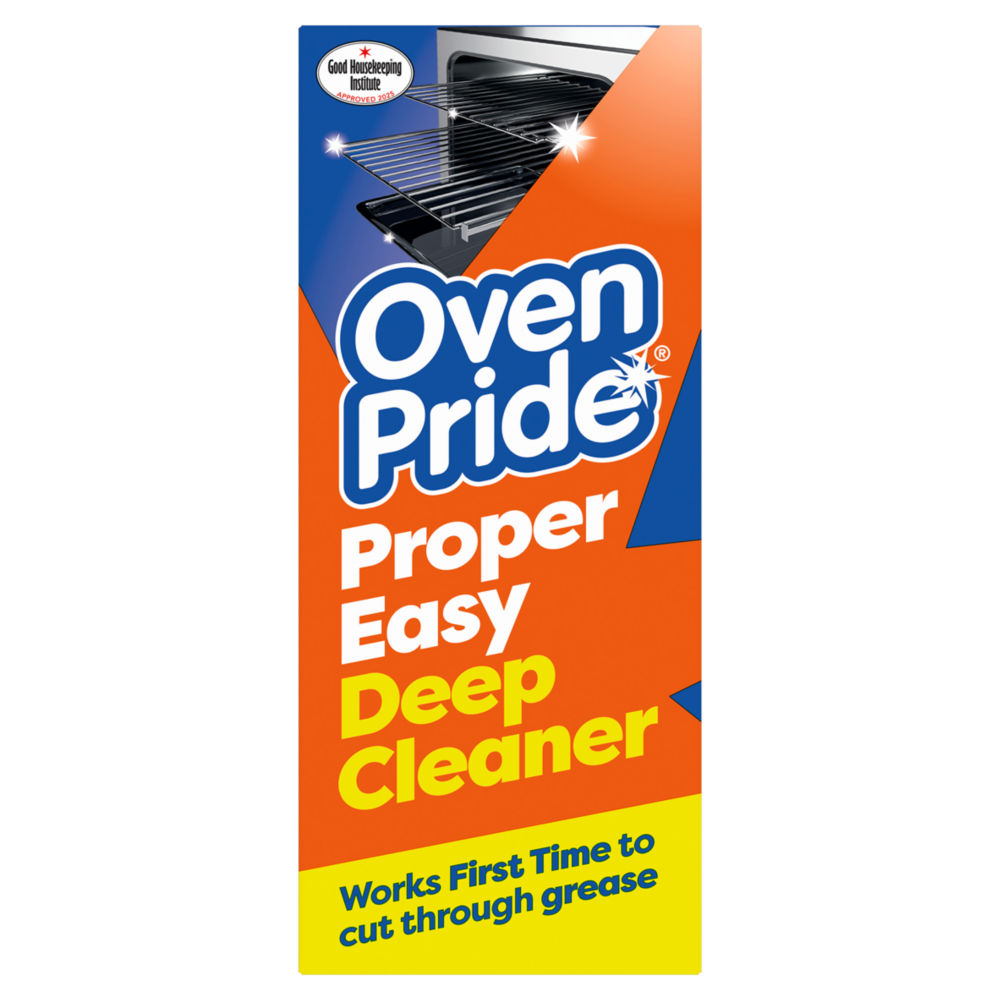
1. Oven Pride Complete Oven Cleaning Kit, 500ml
★★★★☆ 3.6 / 5
It works, which in this category is not a given. You seal the racks in the supplied bag, pour the rest over the oven interior, leave it overnight and the burned on carbon comes away. The bag is a genuinely good idea, because it keeps a caustic liquid contained while it does the slowest part of the job, and it means you are not scrubbing racks in a sink.
It is also, for exactly the same reason, a serious chemical. Sodium hydroxide at 5 to 12 per cent on the label, Danger, H314, causes severe skin burns and eye damage. And there is a specific reason to take the child safety seriously rather than treat it as boilerplate: in 2012 McBride recalled all Oven Pride stock after a two year old defeated the child resistant cap, drank several mouthfuls and spent three weeks at Great Ormond Street with severe oesophageal burns. Gloves are supplied. Wear them, open the window, and keep the bag out of reach while it is working.
Two things we would put to the manufacturer. The retail label declares 5 to under 12 per cent sodium hydroxide while McBride’s own safety data sheet for the same product declares 10 to under 20 per cent at pH above 13. Those bands only overlap between 10 and 12. And the front says fume free formula while the same label says ventilate the room during and after use, which cannot both be the intended message. Waitrose reproduces the ventilation line on its listing. Asda and Tesco do not, so which warning you see depends on where you shop.
Pros
- It genuinely removes carbonised grease, which the non caustic products in this comparison do not
- The sealed bag for the racks is a good design and keeps the caustic contained during the long soak
- £4.00 for a complete kit including gloves, and the maker publishes an application count so cost per use can be worked out
- Consistently the highest rated product in the category on independent retailer scores
- The only overnight product here that does not need you to scrub
Cons
- Sodium hydroxide, Danger, H314, causes severe skin burns and eye damage
- The label and the maker’s own safety data sheet declare different concentration bands, 5 to 12 per cent against 10 to 20 per cent
- Prints fume free formula and ventilate the room during and after use on the same label
- A 2012 recall followed a child defeating the cap and suffering severe internal burns
- No ingredient data sheet published on an unrestricted website, which is what Annex VII requires
- Its FAQ says it is suitable in a self cleaning oven except the sides, while Electrolux and AEG tell you not to put any cleaner on catalytic liners at all
Buy it if you want the oven actually clean, you will read the label properly, and you can keep children and pets out of the kitchen overnight.
The clean pick
No hazard label
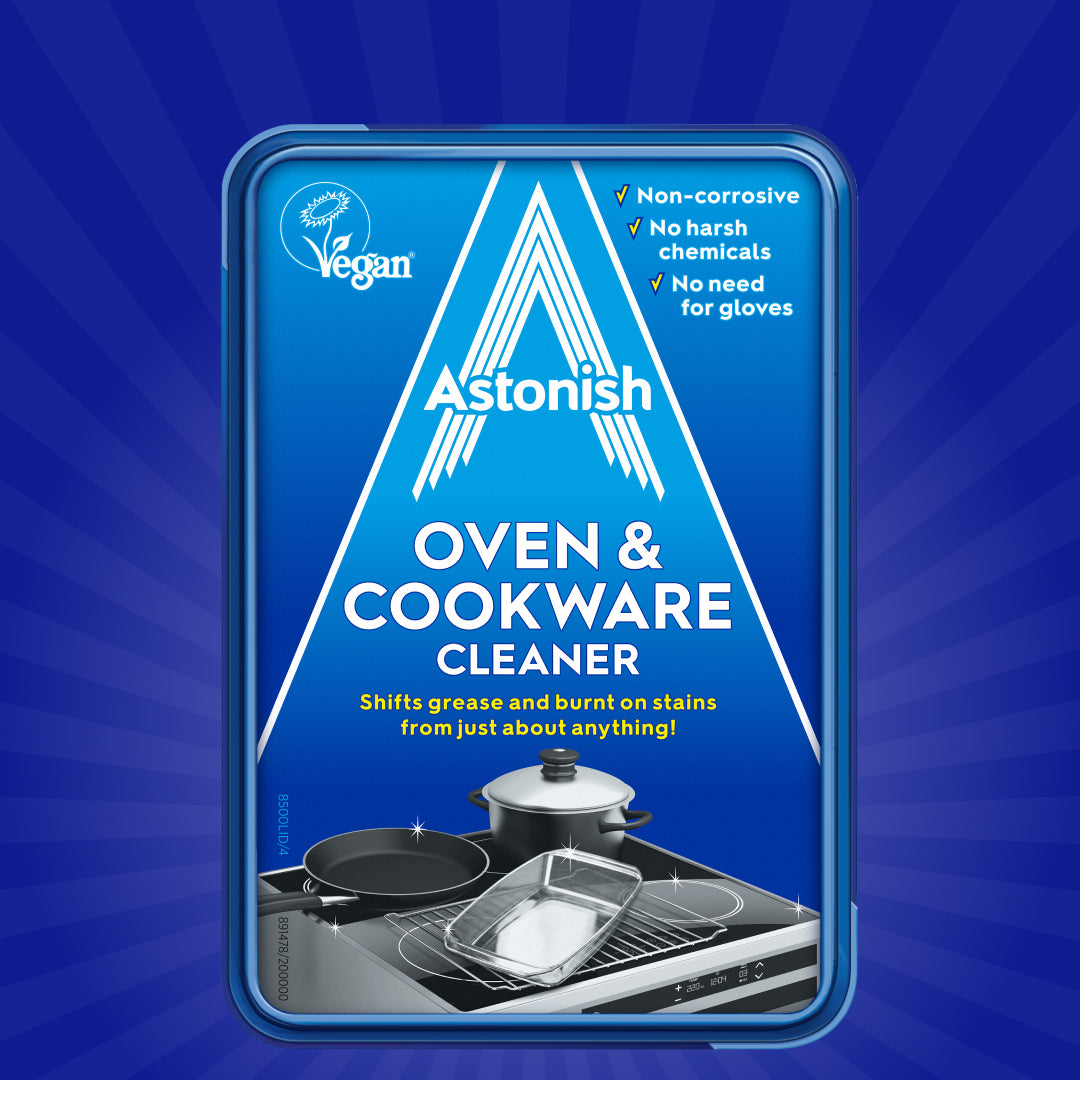
2. Astonish Oven & Cookware Cleaner, 150g
★★★☆☆ 3.4 / 5
£1.50 for a tub of paste that is quartz, soap and water. No sodium hydroxide, no potassium hydroxide, no hazard classification, no signal word and nothing on the label you would not want a child near. It is the only product in this comparison that is genuinely non caustic rather than merely quiet about being caustic, and it is the only one of the six whose maker publishes a proper per product ingredient list, which is what the regulation requires.
It works by abrasion rather than chemistry. Quartz is a mild abrasive and the soap lifts what the abrasive loosens, so on light to moderate grease, on hobs, on pans and on glass it does a good job and it does it immediately rather than overnight. On a genuinely neglected oven with carbonised black deposits it will not compete with the caustic products, and no amount of scrubbing changes that.
The independent scores reflect the trade off precisely. Astonish sits at 3.6 out of 5 across 113 Ocado reviews while every caustic product in this comparison scores above 4.0. That gap is the price of not having a hazard label, and for a lot of households it is worth paying.
Pros
- Genuinely non caustic: quartz, soap and water, with no hazard classification and no signal word
- The only brand of the six that publishes a proper per product ingredient list, as Annex VII requires
- £1.50, the cheapest product here and safe to keep in an accessible cupboard
- Works immediately rather than needing an overnight soak
- Also does hobs, pans, glass and stainless steel, so it earns its cupboard space
Cons
- It will not shift heavy carbonised deposits, and nothing non caustic will
- 3.6 out of 5 across 113 reviews, against above 4.0 for every caustic product here
- It is an abrasive, so it needs physical effort and care on delicate finishes
- 150g is a small tub for a big job
- No certifications published with numbers
Buy it if you clean the oven regularly rather than annually, or you want something in the house that is not an industrial chemical.
The pound shop one, and the aerosol
Cheapest
£1 at Poundland
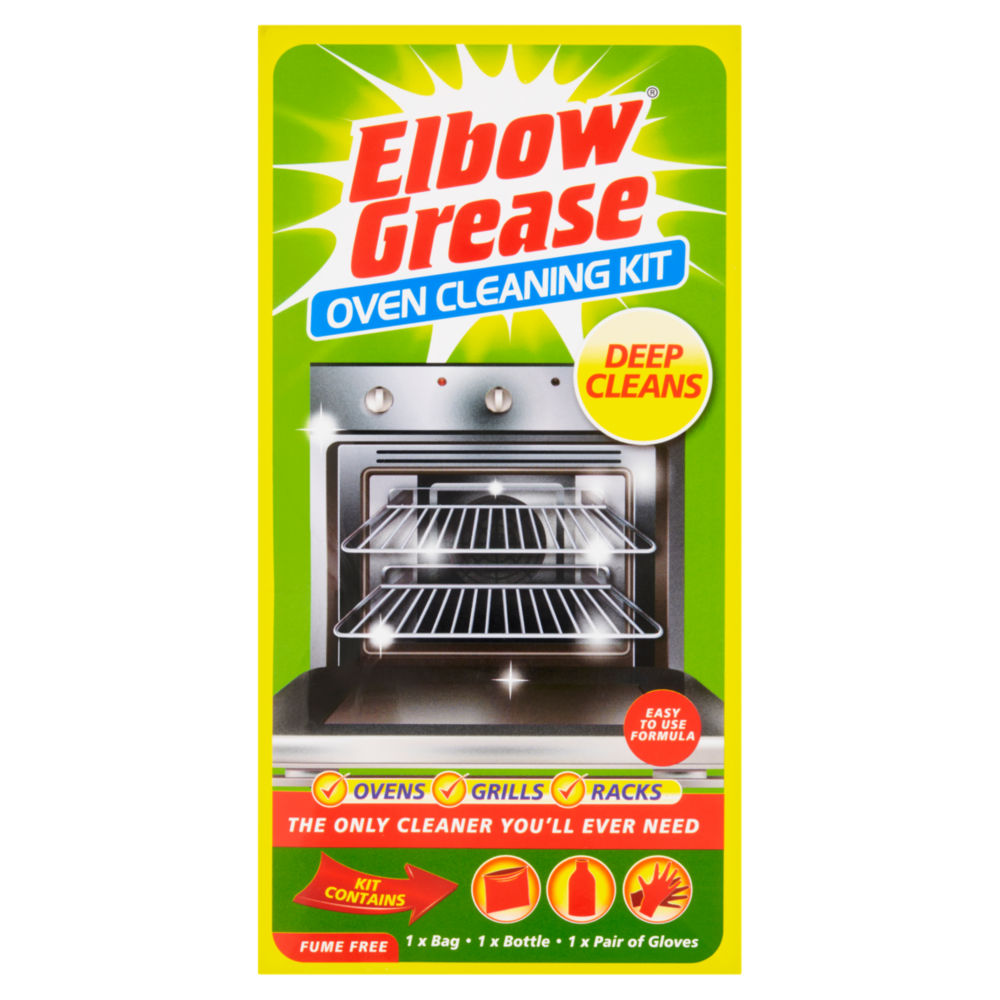
3. Elbow Grease Oven Cleaning Kit, 500ml
★★★☆☆ 3.2 / 5
A pound at Poundland for the same kind of product Oven Pride sells for four, and on the arithmetic that makes it the cheapest effective oven cleaner in Britain. Sodium hydroxide at 5 to 15 per cent, a bag for the racks, and it does the job.
It is also the sharpest example of the fume free problem in this whole comparison. Fume Free is a headline feature on the Ocado listing and sits in the Amazon product title. The product is Skin Corrosive category 1A, H314, signal word Danger, and its own safety data sheet tells you to wear respiratory protective equipment if ventilation is insufficient. Those two things are in the same product listing. Fume free is describing the absence of an acrid smell, which is a genuine formulation achievement, and it is being read by shoppers as a statement about safety, which it is not.
Here is why the confusion is so easy. Sodium and potassium hydroxide have essentially no vapour pressure, so they do not smell of anything. What made old oven cleaners acrid was the ammonia, the monoethanolamine, the glycol ethers and the aerosol propellant. Take those out, keep the caustic, and you get a product that is odourless, silent and exactly as corrosive as before.
Pros
- £1.00 at Poundland, the cheapest effective oven cleaner in this comparison by a wide margin
- Sodium hydroxide at 5 to 15 per cent, so it genuinely works on burned on grease
- Comes as a kit with a bag for the racks and gloves
- Widely stocked at Poundland, Asda and Ocado
Cons
- Marketed as Fume Free while being Skin Corrosive 1A, H314, Danger, with an SDS advising respiratory protection if ventilation is poor
- No ingredient data sheet published on an unrestricted website
- At 5 to 15 per cent the declared band is wider and higher than Oven Pride’s label band
- Poundland availability is inconsistent, so you may end up paying more elsewhere
- No certifications and no independent test data
- Same catalytic liner problem as every caustic product here
Buy it if you want the cheapest thing that actually works and you have read the fume free note above and will still wear the gloves.
The aerosol
Lowest caustic
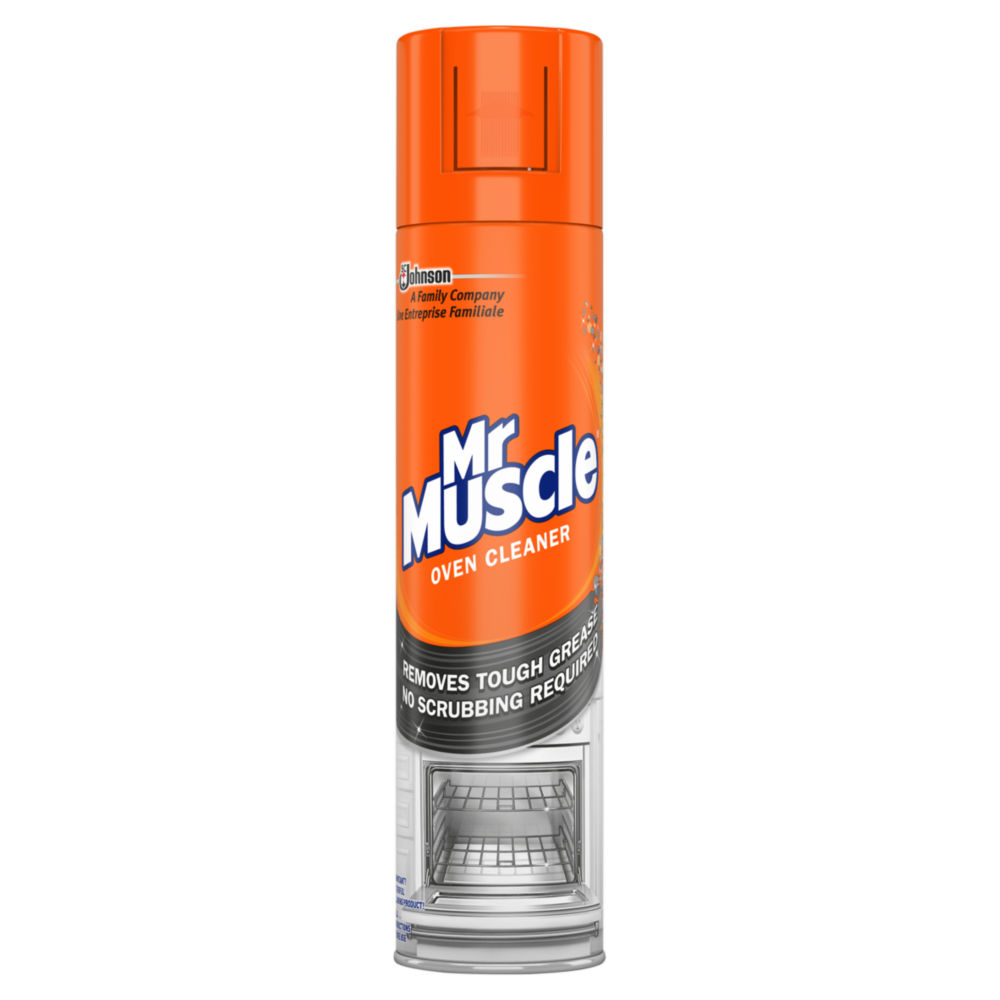
4. Mr Muscle Oven Cleaner, 300ml
★★★☆☆ 3.0 / 5
The lowest caustic concentration in the group at 1 to 5 per cent sodium hydroxide, and the only aerosol. It is also, usefully, the control that proves the fume free point: because it is a spray, it is the only product here carrying do not breathe spray, and it is the only one that smells of anything. Everything else in this comparison is a gel or a liquid, which is why they can be sold as fume free while containing more caustic than this one.
The trade off is real. Less caustic means less effective on heavy deposits, and an aerosol means you are dispersing an alkaline mist in a confined space, which is the one delivery format where the ventilation instruction genuinely matters for your lungs rather than just your nose. Ventilate properly, and do not stand over it.
It is convenient for spot cleaning a door glass or a splashback, and it is the format most people are familiar with. For a whole oven it is neither the cheapest nor the most effective option here.
Pros
- The lowest caustic concentration in the group at 1 to 5 per cent sodium hydroxide
- Aerosol format is convenient for spot jobs, door glass and splashbacks
- The only product here that warns do not breathe spray, which for an aerosol is the correct warning
- Widely available in every supermarket
Cons
- Still Danger and H314, causes severe skin burns and eye damage, despite the lower concentration
- Less effective on heavy carbonised deposits than the stronger gels and liquids
- An aerosol disperses alkaline mist in a confined space, which is the format where ventilation matters most
- No ingredient data sheet published on an unrestricted website
- 300ml does not go far on a full oven
- No application count published, so cost per use cannot be worked out
Buy it if you want to spot clean rather than do the whole oven, and you are comfortable with an aerosol in a ventilated kitchen.
The strongest one, and the one that does not work
Strongest here
H302 as well

5. Oven Mate Cleaning Gel Kit, 500ml
★★★☆☆ 2.8 / 5
This is the most concentrated alkali in the comparison and it is marketed on having no acrid smell. Potassium hydroxide at 10 to 30 per cent, which by mass is more caustic than anything else here, and it is the only product in the group that carries H302, harmful if swallowed, on top of H314.
Potassium hydroxide is not a milder alternative to sodium hydroxide. It is the same kind of chemistry with a different metal on the front, and it is used here because it makes a stable thick gel that clings to a vertical oven wall. That is a real engineering advantage. It is not a safety one, and the marketing of no acrid smell alongside a 10 to 30 per cent hydroxide band is the clearest case in this article of a formulation benefit being sold as a safety benefit.
It also costs £8.99, which is more than twice Oven Pride and nine times Elbow Grease, for a job all three do. The gel and brush are genuinely nice to use and the results are good. You are paying a substantial premium for the application experience.
Pros
- The thick gel clings to vertical oven walls better than the liquids, which is a genuine practical advantage
- A proper brush and gloves included, and the kit is pleasant to use
- Very effective on heavy deposits
- Well reviewed by owners who use it regularly
Cons
- 10 to 30 per cent potassium hydroxide, the most concentrated alkali in this comparison
- The only product here carrying H302, harmful if swallowed, in addition to H314 and Danger
- Marketed on having no acrid smell, which is a formulation fact being read as a safety claim
- £8.99, more than twice Oven Pride and nine times Elbow Grease for the same job
- No ingredient data sheet published on an unrestricted website
- No cost per use figure is possible because no application count is published
Buy it if you clean a badly neglected oven and you want the gel format specifically, having understood that this is the strongest chemistry on this page.
The eco one
2.5 out of 5
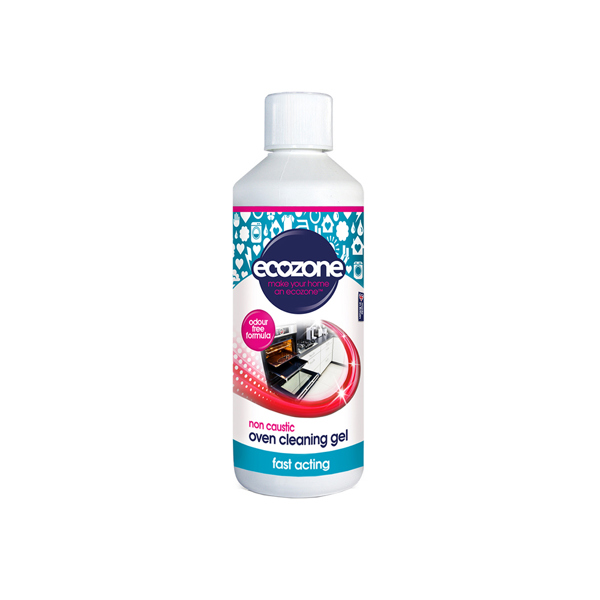
6. Ecozone Oven & Grill Cleaner, 500ml
★★☆☆☆ 2.4 / 5
Ecozone deserves the same credit we gave Astonish: this is genuinely non caustic. Water, SLES, pumice and salt, no hydroxide, no hazard classification. If your objection to the rest of this page is that you do not want a corrosive chemical in the kitchen, that objection is answered here.
The problem is that it does not work well enough to justify £4.49. It scores 2.5 out of 5 on Trolley, the lowest score of any product in this comparison, and the complaints are consistently that it does not shift baked on grease. Astonish does the same non caustic job for £1.50 and scores 3.6.
There is also a disclosure gap that is awkward for a brand built on transparency: Ecozone has no product page for this gel at all on its own site, so there is no ingredient data sheet, no hazard information and no usage guidance published anywhere by the maker. We looked at ecozone.com, ecozonedirect.com and the retailer listings. For the one brand here whose entire position is being open about what is in things, that is the criticism that stings most.
Pros
- Genuinely non caustic: water, SLES, pumice and salt, with no hazard classification
- Safe to store in an accessible cupboard, unlike four of the six here
- Makes no fume free claim, because it has nothing to hide behind it
- Recyclable packaging and a real environmental position at brand level
Cons
- 2.5 out of 5 on Trolley, the lowest score of any product in this comparison
- The recurring complaint is simply that it does not shift baked on grease
- £4.49, three times the price of Astonish, which does the same non caustic job better
- Ecozone publishes no product page for this gel at all, so no ingredients, no hazard data and no guidance
- No certifications published with numbers
- Very few reviews, so the evidence base is thin in both directions
Buy it if you specifically want an Ecozone product and you are cleaning light grease rather than anything baked on.
Prices checked 5 August 2026 and may have changed since.
The clean pick, and the honest catch
Our clean pick
Astonish Oven & Cookware
The only one with nothing on the label to warn you about
Why it wins on ingredients
✓
It is genuinely non caustic
✓
It publishes its ingredients
✓
It makes no fume free claim
✓
£1.50, and it does other jobs
What you give up
✕
It will not clean a neglected oven
✕
It scores 3.6 while the caustics score above 4
✕
It is abrasive, so it needs effort
The catch, said plainly. Our rule is that if a category has a genuinely clean option we name it, and here there are two, but neither of them will clean a badly burned oven and it is dishonest to pretend otherwise. This category has a hard chemical floor: fat that has carbonised onto enamel comes off through saponification or through abrasion, and there is no third route. So the realistic position for most households is to own the mild product and use it often, and to accept that if you have let it go you are buying a caustic once and treating it like the industrial chemical it is. One more thing worth knowing before you reach for the self clean cycle instead: pyrolytic cycles run the oven to around 500 degrees and burn deposits off, and Bosch tells owners in its own manual to ventilate and leave the room while it runs. That is not a chemical free option so much as a different exposure. And if you keep pet birds, keep them well away from the kitchen during any oven cleaning or pyrolytic cycle.
What to look for when you buy one
Fume free is a statement about smell, not about safety, and it is on the strongest products here. This is the single most useful thing in this article. Sodium and potassium hydroxide have essentially no vapour pressure, which means they do not evaporate and they do not smell. What made oven cleaners acrid a generation ago was the ammonia, the monoethanolamine, the glycol ethers and the aerosol propellant that carried them. Take all of that out, keep the caustic, and you have a product that is odourless and exactly as corrosive as it ever was. Three products on this page carry the phrase fume free or no acrid smell. All three are caustic. One of them prints fume free formula and ventilate the room during and after use on the same label.
Read the signal word before anything else. Danger with H314, causes severe skin burns and eye damage, is a different order of product from Warning with H315 or H319. Four of these six carry Danger and H314, which puts them among the most hazardous things in an ordinary house, alongside drain unblockers. One carries H302, harmful if swallowed, as well. If a product carries Danger, it needs gloves, ventilation, and a cupboard children cannot reach, whatever the front of the pack says about being gentle or fume free.
Non caustic is honest, and it means less effective. Accept the trade off rather than looking for a way round it. Two products here are genuinely non caustic and both say so plainly: one is quartz, soap and water, the other is water, surfactant, pumice and salt. Neither carries a hazard classification. Neither will shift carbonised deposits, and the review scores show it: the non caustic products sit at 2.5 and 3.6 out of 5 while every caustic product scores above 4.0. There is no product that is both, because the chemistry does not allow it.
Never put oven cleaner on a catalytic liner, and check whether you have one. Catalytic liners are the rough, matt panels some ovens have on their side or back walls, designed to oxidise grease at normal cooking temperatures. Caustic cleaner destroys them permanently and they are expensive to replace. The oven makers are explicit. Electrolux: do not clean the catalytic surface with oven sprays, abrasive cleaning agents, soap or other cleaning agents. AEG: do not put cleaners on the liners themselves. Note that this directly contradicts one cleaner brand’s own FAQ, which says its product is suitable in a self cleaning oven except the sides. Believe the oven manufacturer, not the cleaner manufacturer.
The bag method is good, and it needs treating with respect. Sealing the racks in a bag with caustic liquid overnight is genuinely the best way to clean oven racks without scrubbing, and it is why the kit products work. It is also several hours of a corrosive chemical sitting in a plastic bag, usually on a kitchen floor. Put it somewhere a child, a dog or a cat cannot reach or puncture it, and think about where the liquid would go if the bag failed. The 2012 recall in this category followed a two year old getting into the bottle, not the bag, but the principle is the same.
Check the ingredient disclosure, because almost nobody bothers. Annex VII of the detergents regulation requires manufacturers to publish an ingredient data sheet on a website with unrestricted access. Of six brands here, one complies. The rest publish nothing, or point at a page that does not exist. One brand whose entire market position is transparency has no product page for its oven cleaner at all. When you are buying something classified as causing severe skin burns, being able to read what is in it is not an unreasonable ask.
Watch for the gap between the label and the safety data sheet. On one product here the retail label declares 5 to under 12 per cent sodium hydroxide while the manufacturer’s own safety data sheet declares 10 to under 20 per cent at pH above 13. Both are published by the same company about the same product. We are not saying which is right, only that when the two documents disagree you should assume the higher figure and handle it accordingly.
The self clean cycle is not the safe alternative it looks like. A pyrolytic cycle runs the oven to around 500 degrees and incinerates the deposits. There is no chemical involved, which sounds ideal, but the process emits ultrafine particles and combustion products into the kitchen, and Bosch tells owners in its own manual to ventilate the room and leave it while the cycle runs. If you keep pet birds, keep them well away from the kitchen during any pyrolytic cycle or oven cleaning: birds have extremely sensitive respiratory systems. The often repeated claim that self clean ovens routinely kill birds traces back to a single newspaper anecdote from 1986 rather than to any measurement, so treat the specific claim with caution while still taking the general precaution.
Bicarbonate of soda and steam are worth trying first, and will not finish the job. A paste of bicarbonate left overnight will soften light to moderate grease and it costs almost nothing, and a bowl of water run hot in the oven loosens deposits through steam. Both are genuinely useful as a first pass and as maintenance. Neither saponifies carbonised fat, so neither will clear an oven that has been neglected for a year. Use them monthly and you may never need anything on this page.
And clean it more often, which is the only advice here that is free. Every product in this comparison exists because grease was allowed to carbonise. Wipe the oven while it is still warm after a roast, catch spills the same week, and the whole category becomes optional. The people who need the Danger labelled products are the people who clean the oven once a year.
Final verdict
Buy the caustic once, the mild one for every week
Three things to take away.
The first is that fume free means it does not smell. It does not mean it will not burn you. Sodium and potassium hydroxide have no vapour pressure, so the strongest products in this comparison are also the quietest ones, and all three products carrying a fume free style claim are caustic. One of them prints that claim and a ventilation warning on the same label.
The second is that the category has a hard floor. Carbonised fat comes off through saponification or through abrasion, and there is no gentle chemistry that does the first. So the two genuinely non caustic products here score 2.5 and 3.6 out of 5 while every caustic one scores above 4.0. That is not a failure of the eco products, it is physics, and it is worth understanding before you spend £4.49 expecting otherwise.
The third is that this is the shelf where the hazard labels are real. Four of six carry Danger and H314, causes severe skin burns and eye damage. One adds harmful if swallowed. A child got into one of these products in 2012 and spent three weeks in hospital, and the whole line was recalled. Gloves, ventilation, high cupboard.
Our pick is Oven Pride at £4 for the once a year job and the Astonish paste at £1.50 for everything else. And if you wipe the oven out while it is still warm, you will not need the first one at all.