Home · Bathroom · Damp, mould and ventilation
Best limescale removers: six compared, and not one of them warns you about chrome
Five of these six are acidic enough to strip chrome plating off a tap. Not one names chrome on its label. The exclusion lists have not caught up with what modern bathrooms are made of.
By Mrs House · Updated 26 August 2026 · 11 min read
Mrs House is independent. Nobody pays for a place in a ranking here, and no brand saw this page before it went live.
The short answer
Buy a bag of plain citric acid. Dri-Pak is £2.29 for 250g, it is one ingredient, and for anything you can soak it does the job for pennies.
- Best overall: Dri-Pak Citric Acid 250g, £2.29. Kettles, shower heads, tap aerators, anything you can submerge.
- For screens and taps: Tesco Limescale Remover at £1.40, or Viakal at £3. Both fine on the things you cannot soak.
- Skip unless desperate: HG Professional, £5.25. pH 0.3 and classified corrosive, H314.
Never near bleach, never on marble or limestone, and be very careful around plated taps.
How we assessed these
Six descalers, one method. The first job was finding out which acid actually does the work in each, because three of the six do not say on the bottle. Where the retail listing was silent we went to the safety data sheet, and where the safety data sheet was silent too we say so on the card.
Then we lined up the pH, the hazard classification exactly as printed, the dwell time, and the list of surfaces each brand says to keep it away from. Those exclusion lists turn out to be the most revealing part of the whole category, mostly for what is missing from them.
We worked out a price per litre for the sprays and a price per use for the powders and sachets, because a £1.70 sachet pack and a £5.25 spray bottle cannot be compared any other way.
On the science we went to the chemistry rather than the marketing: what limescale is, why acid dissolves it, how the acids rank by strength, and what published testing says about whether citric acid really matches the strong stuff. On safety we used UKHSA on what happens when acid meets bleach, and HSE guidance on shower heads.
Every product is scored on the same five parts: does it work (35 per cent), what it is made of (25 per cent), value (15 per cent), everyday use (15 per cent) and honesty of the claims (10 per cent).
The ranking, at a glance
| Product | Price | The acid | pH | Hazard | Warns on chrome? | Score | |
|---|---|---|---|---|---|---|---|
| 1 | Dri-Pak Citric Acid 250g | £2.29 | Citric, 100 per cent | Not published | Eye irritant | No | 4.3 |
| 2 | Viakal Spray 500ml | £3.00 | Formic, 1 to 5 per cent | 2.2 | Skin and eye irritant | No | 3.8 |
| 3 | Tesco Limescale Remove 500ml | £1.40 | Not published | Not published | Eye irritant | No | 3.5 |
| 4 | Bio-D Limescale Remover 500ml | £4.08 | Citric and lactic | Not published | Not published | No | 3.4 |
| 5 | Oust Descaler, 3 sachets | £1.70 | Lactic, 70 to 90 per cent | Under 2 | Severe burns, per pack | No | 3.1 |
| 6 | HG Professional 500ml | £5.25 | Phosphoric under 25, oxalic under 2 | 0.3 | Corrosive, H314 | No | 3.0 |
The last column reads no six times, and that is the finding. Every one of these lists gold, copper, aluminium or natural stone somewhere. None of them mentions chrome, plated taps, or the coated matt and brushed finishes that are in most new bathrooms.
The two we would actually buy
Best overall
And the clean pick
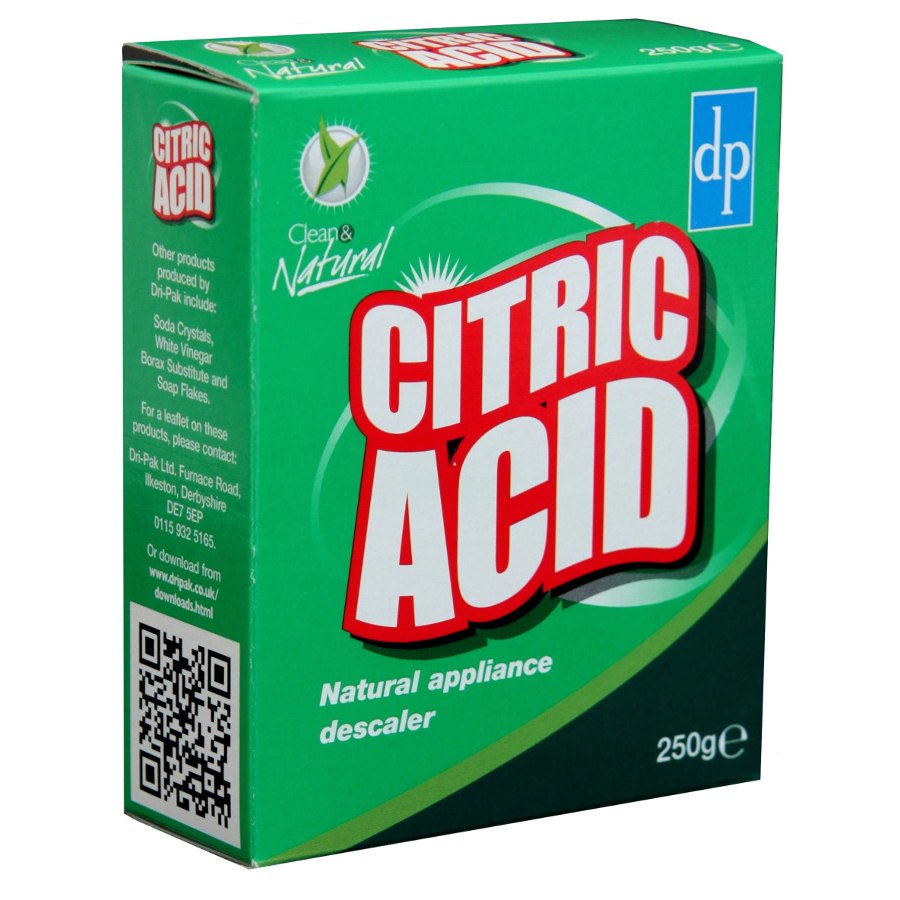
1. Dri-Pak Citric Acid 250g
★★★★½ 4.3 / 5
£2.29 for 250g, which is 92p per 100g, and the ingredient list is one line: 100 per cent citric acid. No surfactant, no perfume, no colour, no preservative. On a page where three products will not tell you what acid they contain, this one is nothing but the acid.
It is at its best where you can soak. Dri-Pak’s own kettle instruction is a third of the packet in half a kettle of just boiled water, left fifteen minutes. That is a far higher concentration and a far longer contact time than any spray on this page manages, and done hot, and it clears a kettle completely. The same applies to a shower head, a tap aerator or a filter you can drop in a bowl. Where it is weaker is a vertical surface, because powder in water runs straight off a shower screen and three minutes of dwell is not enough at that dilution.
Pros
- One ingredient, and it is the working one
- 92p per 100g, and one bag descales a kettle several times over
- Eye irritant only, the mildest hazard classification on this page
- 4.8 from 36 reviews
- No fragrance, no dye, nothing to react with anything else
Cons
- A powder, so it will not stay on a shower screen or a tap
- Slower than the strong sprays, and needs heat and time to match them
- Being weaker does not make it stone safe, it will still etch marble
- Only published surface warning is about washing machine drums, so you are on your own for the rest
Buy it if the job is anything you can drop into a bowl or a kettle. Skip it if the job is a vertical surface, because it will run off.
Best spray
5,593 reviews

2. Viakal Bathroom Limescale Remover Spray
★★★★☆ 3.8 / 5
£3 for 500ml and 4.8 from 5,593 reviews, which is not just the biggest review pool on this page, it is the biggest on this site. The acid is formic at 1 to 5 per cent, pH 2.2, and it is the right strength for the job: acidic enough to shift scale off glass and tiles in three minutes, not so acidic that it needs goggles.
Two things it does that others do not. It publishes a proper exclusion list, gold, silver, copper, aluminium, coloured or damaged enamel, natural stone. And it prints do not mix with bleach or other cleaning products on the label, which is the single most important safety line in this entire category and which three of the six leave off. What it still does not tell you, along with everybody else, is to keep it off chrome and plated taps, and that is where the damage reports cluster.
Pros
- 4.8 from 5,593 reviews, an enormous pool for a cleaning product
- Formic acid at pH 2.2, strong enough for a three minute job without a corrosive label
- Publishes a real exclusion list rather than a vague warning
- Prints do not mix with bleach on the label
- £6 a litre, the middle of the range
Cons
- Says nothing about chrome or plated taps, which is where owners report ruining things
- Contains perfume and named fragrance allergens, unnecessary in a bathroom spray
- Three minute maximum dwell, so heavy scale needs repeat applications
- Twice the price per litre of the Tesco own brand
Buy it if you want the spray with the most owners behind it and clear instructions. Skip it if your taps are matt black, brushed or anything other than solid chrome.
The cheap one, and the clean brand one
Best value spray
£2.80 a litre

3. Tesco Limescale Remove Trigger
★★★½☆ 3.5 / 5
£1.40 for 500ml, which is £2.80 a litre and less than half the Viakal and a quarter of the HG. 4.5 from 44 reviews. For a job most people do once a month with a cloth, that is a lot of the performance for a fraction of the money.
It also publishes the fullest surface exclusion list of the six: gold, copper, aluminium, painted surfaces, coloured old or damaged enamel, plastic water boilers, natural stone including marble limestone and travertine, hot damaged or scratched surfaces, and electrical appliances. Five minute dwell, sprayed from 20cm. What it will not tell you is which acid is in it. Neither the listing nor any safety data sheet we could find names one, and for a bottle you spray around a bathroom that is a gap. You can infer from the exclusion list that it is in the same family as the Viakal, but inference is not disclosure.
Pros
- £2.80 a litre, the cheapest spray here by a wide margin
- The fullest surface exclusion list of the six
- A five minute dwell, longer than Viakal allows
- 4.5 from 44 reviews
Cons
- Does not name its acid anywhere we could find, including in a safety data sheet
- Says nothing about chrome or plated taps
- Contains perfume, with no allergens named
- Fewer reviews than Viakal by a factor of a hundred
Buy it if you want a bathroom spray and you buy on price. Skip it if you want to know what you are spraying.
Names its acids
£8.16 a litre

4. Bio-D Limescale Remover Spray
★★★½☆ 3.4 / 5
£4.08 for 500ml, and it does the thing we keep asking for: it names the acids. Citric plus lactic at under 5 per cent, with the nonionic surfactant declared alongside. It also gives two dwell times rather than one, fifteen seconds for everyday marks and two minutes for stubborn ones, which is more practical guidance than most of this page offers. And it tells you to avoid marble and natural stone and to test a small area first.
The catch is that the product page publishes no hazard statements at all, and no review count or rating, so there is nothing to weigh the claims against. On performance you are also asking two of the weaker acids to do a spray job, which is the wrong end of the trade: citric and lactic are the right choice for a soak and the wrong choice for a shower screen you want clear in two minutes.
Pros
- Names both acids and the surfactant, which three products here do not
- Gives two dwell times rather than one vague instruction
- Tells you to avoid marble and to test a small area first
- A UK brand with a proper ethical record behind it
Cons
- £8.16 a litre, nearly three times the Tesco own brand
- No hazard statements published on the product page
- No review count or rating published anywhere we could find
- Citric and lactic are weak acids doing a job that suits strong ones
Buy it if you want a spray that tells you what is in it and you are not in a hurry. Skip it if the scale is heavy, because these are the two mildest acids here.
The two we would not buy
Pack and data sheet disagree
57p a descale

5. Oust All Purpose Descaler, three sachets
★★★☆☆ 3.1 / 5
£1.70 for three 25ml sachets, which is 57p per kettle descale and genuinely cheap per use. The acid is lactic at 70 to 90 per cent in the concentrate, pH under 2, and it claims results in six minutes, which is fast for a weak acid and is what the high concentration buys you.
Two problems. The pack says danger, causes severe skin burns and eye damage, corrosive to the respiratory tract. The publicly available safety data sheet classifies it less severely, as serious eye damage and skin irritation. Those are different messages about the same product and a reader has no way to know which is current. And there is no exclusion list at all: no marble warning, no aluminium warning, nothing about plated finishes, only a line telling you to check your appliance manual. Zero reviews on the Tesco listing.
Pros
- 57p per kettle descale, the cheapest way to do a kettle other than plain citric powder
- Lactic acid at high concentration, so it works quickly for a weak acid
- Six minute working time, the fastest stated on this page
- Single dose sachets, so no measuring
Cons
- The pack hazard text and the published safety data sheet do not agree
- No list of excluded surfaces at all, on a product acidic enough to need one
- Zero reviews on the listing we checked
- £22.67 a litre of concentrate, which is the highest headline rate here
Buy it if you want single dose sachets for a kettle and nothing else. Skip it if you were going to use it on taps or a shower, because it will not tell you what it damages.
Last place
Corrosive, pH 0.3

6. HG Professional Limescale Remover
★★★☆☆ 3.0 / 5
£5.25 for 500ml, and it is comfortably the most powerful thing on this page. Phosphoric acid under 25 per cent with oxalic acid under 2 per cent, at pH 0.3, which is roughly a hundred times more acidic than the Viakal. If you have scale that nothing else has shifted, this will shift it.
It is last because of what that costs you. The classification is corrosive: causes severe skin burns and eye damage, harmful if swallowed, wear gloves and eye protection. Its own safety data sheet says it attacks many metals releasing flammable hydrogen gas. It is the dearest per litre at £10.50, it has eight reviews, and it is the one product here most likely to destroy something expensive if you are casual with it. To its credit it publishes everything: the acids, the concentrations, the pH, the hazards and a proper stone exclusion list. It is honest about being dangerous, which is not the same as being the right thing to buy for a bathroom.
Pros
- By far the strongest here, and it publishes exactly why
- Full disclosure of both acids, their concentrations and the pH
- A clear natural stone exclusion list
- Thirty minute shower head immersion instruction, the most specific on this page
Cons
- Corrosive. Causes severe skin burns and eye damage, and needs gloves and goggles
- Attacks many metals releasing hydrogen, per its own safety data sheet
- £10.50 a litre, the most expensive here
- Only eight reviews
- Still says nothing about chrome or plated taps, despite being the most likely to strip them
Buy it if you have limescale that has beaten everything else and you will wear the gloves. Skip it if this is for a family bathroom cleaned in a hurry.
Prices checked 26 August 2026 and may have changed since.
The clean pick, and the honest catch
Our clean pick
Plain citric acid
One ingredient, 92p per 100g
Why it wins on materials
✓
It is one thing
One hundred per cent citric acid. No surfactant, no perfume, no dye, no preservative. Three products on this page will not even tell you which acid they contain.
✓
The mildest hazard here
Eye irritant, and that is all. Against a corrosive at pH 0.3 that needs gloves and goggles, and a sachet whose pack warns of severe burns.
✓
It is the right tool for a soak
A third of a packet in half a kettle of just boiled water, fifteen minutes. That is more acid, hotter, for longer than any spray on this page manages, and it works.
✓
Pennies
92p per 100g, and one bag does a kettle several times over. Nothing else here comes close on cost per job.
What you give up
✕
It will not stay on a wall
Powder dissolved in water runs straight off a shower screen. The sprays cling because of surfactants, and that is a real advantage on anything vertical.
✕
Weak still means slow
Published laboratory work on carbonate scale found citric heavy blends dissolved the least of the organic acid mixtures tested, and all of them trailed hydrochloric. Concentration, heat and time are how citric closes that gap.
✕
Clean does not mean stone safe
Citric acid is still an acid and marble is still calcium carbonate. It will etch stone exactly like the others will, and Dri-Pak publishes no surface warnings at all.
The catch, said plainly. The clean pick here does half the job. For anything you can drop in a bowl it is the best answer on this page and the cheapest by a distance. For a shower screen or a set of taps it runs off, and one of the sprays is the sensible tool. The honest recommendation for most households is both: a bag of citric powder that lasts a year, and one cheap spray.
The safety line that matters more than any ranking on this page. Never use an acidic descaler anywhere near bleach. UKHSA states that sodium hypochlorite reacts violently with acids and that mixing with an acid liberates chlorine and oxides of sulphur, and the products carry the hazard code for it. Inhaling that can cause chemical pneumonitis, and pulmonary oedema can follow up to 36 hours later, which is the part people do not expect: you can cough, open a window, think you got away with it, and be seriously unwell a day later. This is not exotic. It is spraying limescale remover into a shower tray or toilet that still has bleach in it. Viakal prints the warning on its own bottle. Three of the six do not.
And the thing none of these labels tell you. Limescale is calcium carbonate. So is marble, so is limestone, so is travertine. The product cannot tell your worktop from your scale, and there is no such thing as a stone safe descaler. Every brand here that publishes an exclusion list names stone. What none of them names is chrome or plated taps, and acid is what platers use to strip plating. Chrome plate is porous at a microscopic level, the acid gets underneath it, and the damage cannot be repaired in place because plating is a dipping process. If your taps are matt black, brushed brass or anything coated, keep all six of these away from them and use warm soapy water.
What to look for when you buy one
Never with bleach. Not in the same session, not in the same bowl, not in a toilet that still has some in it. Acid plus hypochlorite releases chlorine gas, and the serious lung effects can arrive up to a day and a half afterwards. Rinse thoroughly and ventilate before switching products.
Find out which acid it is, and if the bottle will not say, that is information too. Three of the six here do not name one. Formic, lactic, citric and acetic are the weaker acids. Phosphoric, oxalic and sulfamic are the strong ones. Concentration matters as much as which acid: a weak acid at high strength beats a strong acid heavily diluted.
Nothing is safe on marble, limestone or travertine. The scale and the stone are the same compound, calcium carbonate, and no product can distinguish them. If you have a stone worktop, a stone floor or a stone shower tray, none of these should be in the room.
Keep it off plated and coated taps. Not one label warns about this and it is where the expensive damage happens. Acid is what platers use to strip plating. Solid chrome on brass is usually fine if you rinse fast; matt black, brushed and gold coloured finishes are lacquered or PVD coated and will mark. Warm soapy water on those.
Aluminium never. Acid on aluminium produces hydrogen gas, and the HG data sheet says so explicitly. That rules out aluminium stovetop kettles, moka pots and pans.
Match the format to the job. Anything you can submerge, use cheap citric powder, hot, for fifteen minutes or more. Anything vertical, use a spray, because the surfactants are what make it cling long enough to work.
Do not buy a descaler to save energy on a kettle. Measured before and after boil times differ by about a second, which is noise. Descale a kettle for the taste, the flakes and the life of the element, not the electricity bill. On a washing machine or a boiler, where the element is not sitting in the water it heats, scale genuinely does cost you.
Final verdict
A bag of powder and one cheap spray
Almost everything sold in this category is the same reaction in a different bottle. Limescale is rock, acid dissolves rock, and the price runs from £2.80 a litre to £10.50 a litre for products doing that one thing. Buy a £2.29 bag of citric acid for everything you can soak, and a £1.40 Tesco or £3 Viakal spray for the shower screen. That is under a fiver and it covers a whole house.
The HG is last not because it fails but because it is a corrosive at pH 0.3 sold into family bathrooms. It publishes everything, which we respect, and it is the wrong tool for almost everyone reading this.
The finding we would most like you to take away is the one nobody prints. Every one of these bottles warns you about marble. None of them warns you about the taps, and taps are what people ruin. If yours are anything other than plain chrome, keep all six away from them.