The best kettles, compared
Six kettles compared on what actually touches the water (lid, level window, spout and filter), plus speed, efficiency, temperature control and price.
 Our pick
Which one should you buy?
Show me kettles that are…
Tap one or more. The ones that don’t qualify fade out, here and in the reviews below.
| Ranked by score | Aarke#1 · 4.6 | 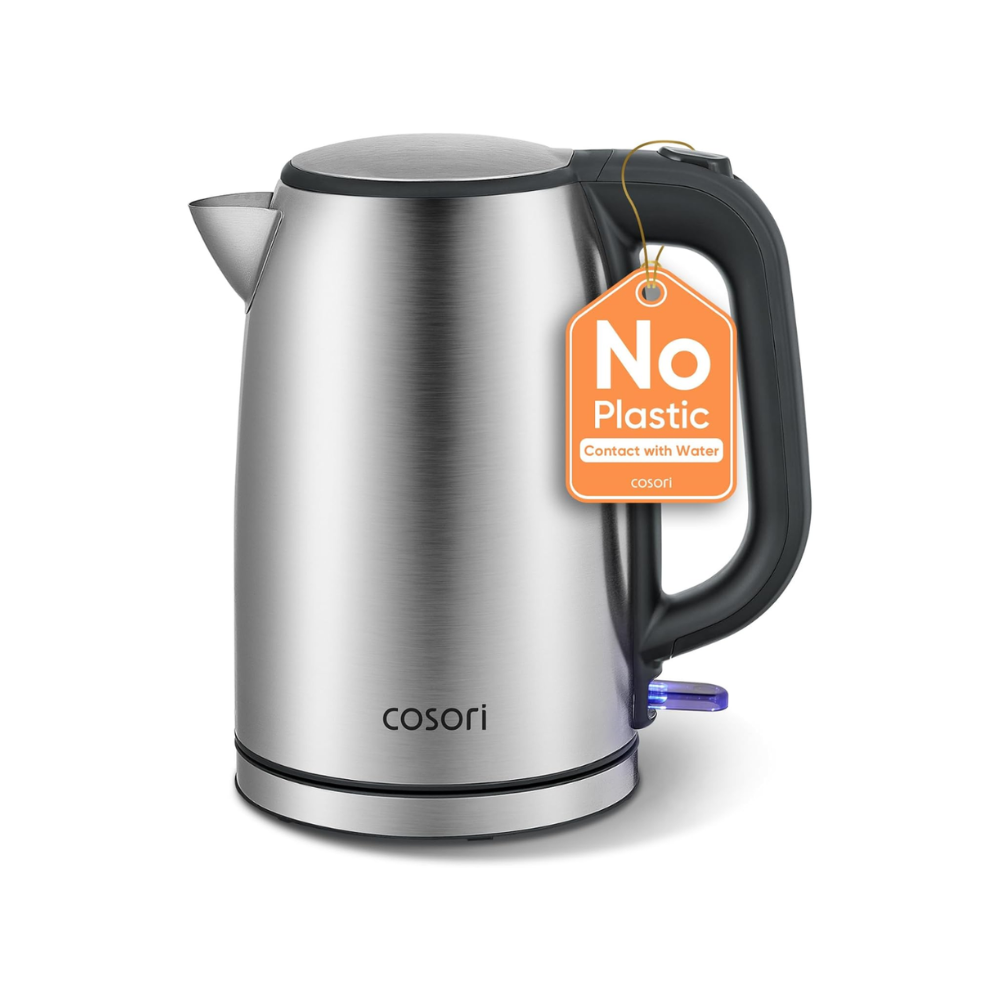 Cosori#2 · 4.4 | 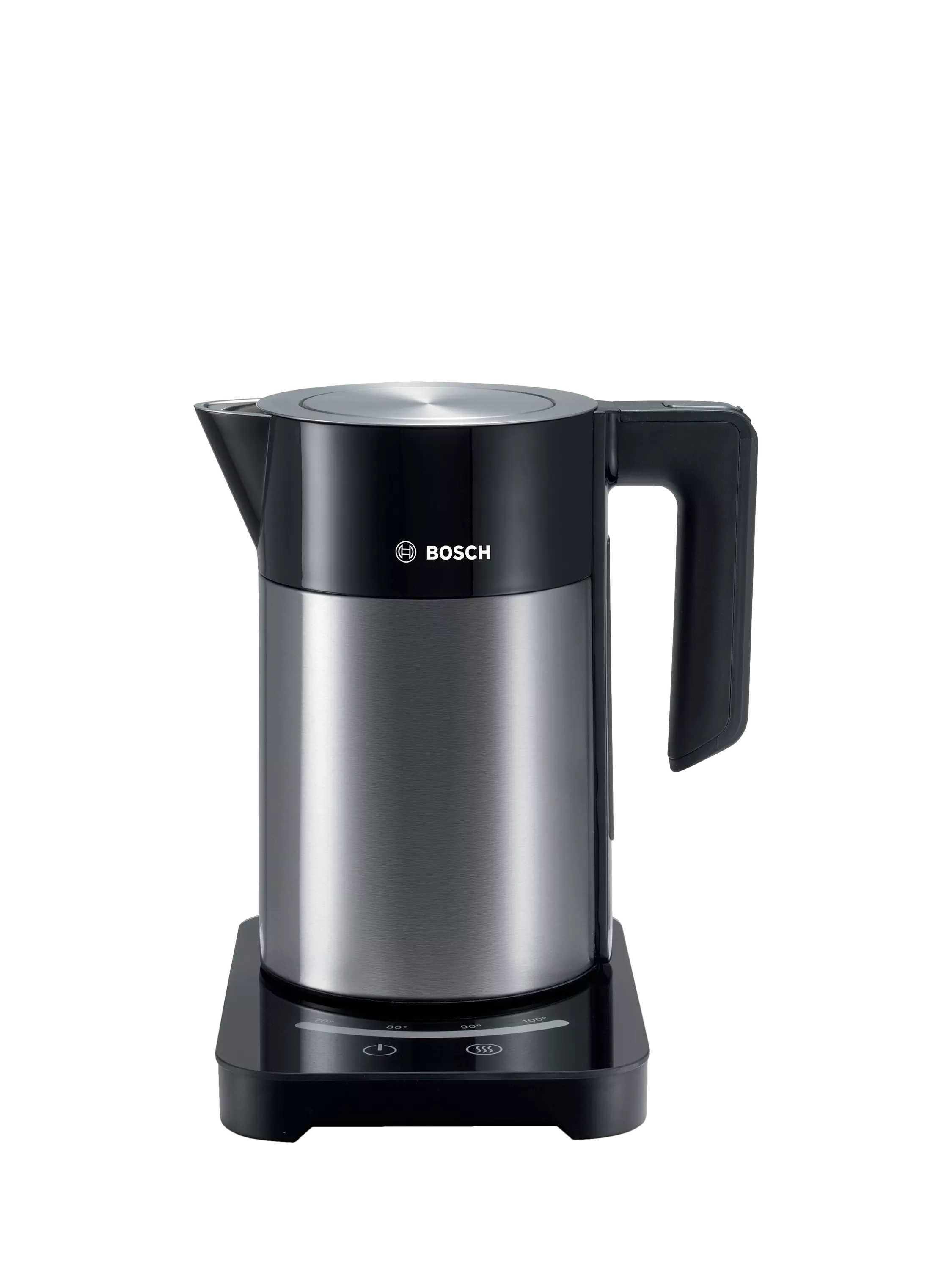 Bosch Sky#3 · 4.3 |  Fellow#4 · 4.2 | 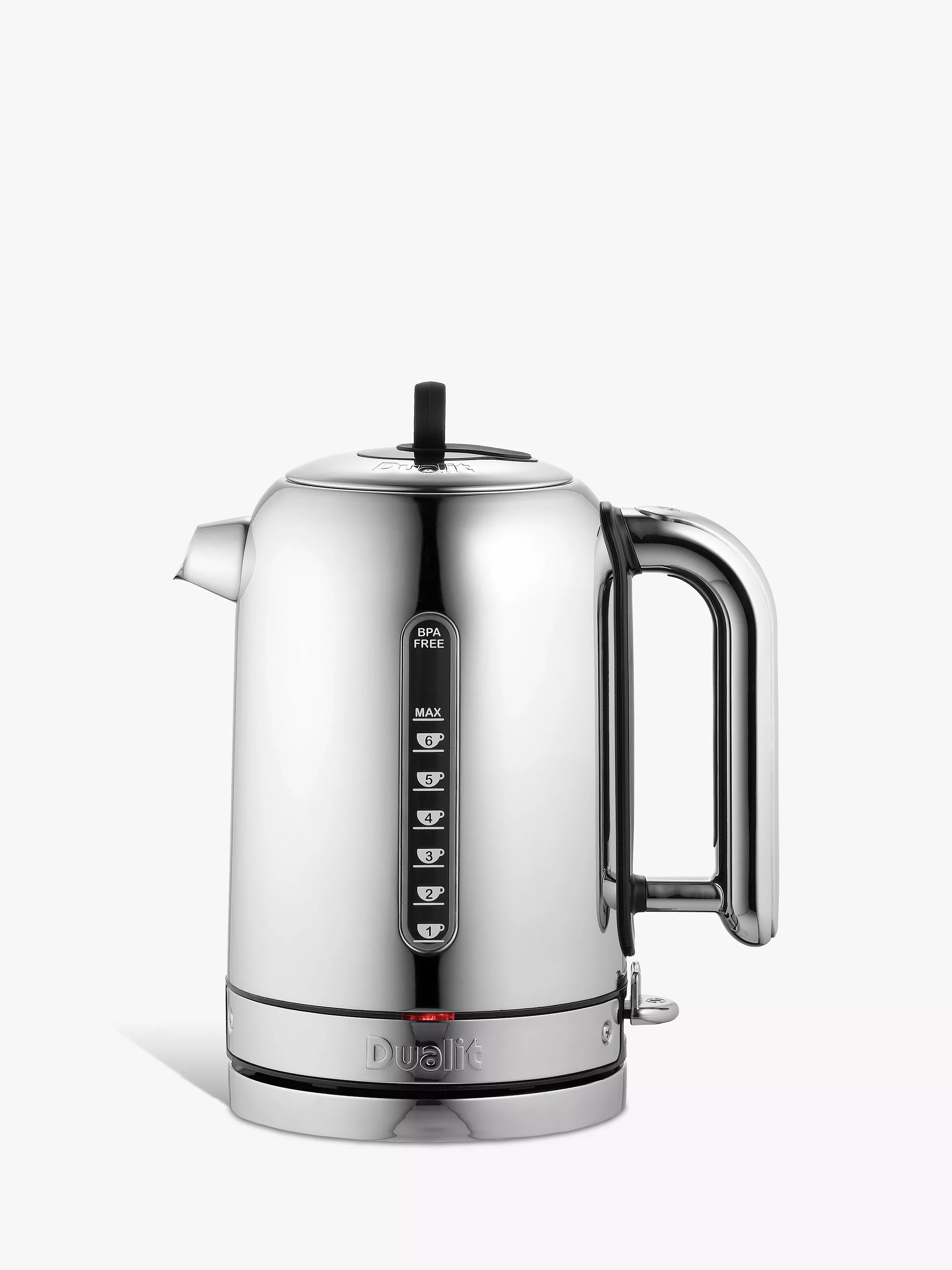 Dualit#5 · 3.9 |  Russell Hobbs#6 · 3.3 |
|---|---|---|---|---|---|---|
| No plastic in the water path | ✓one silicone sensor seal | ✓lid gasket unconfirmed | ✕ | ~plastic lid body | ✕ | ✕ |
| Brand publishes water path materials | ✓ | ✓ | ✕ | ✓ | ✕ | ✕ |
| Stainless steel limescale filter | ✓ | ✓ | ✕ | ✕no filter at all | ?material not published | ✕ |
| Variable temperature | ✓ | ✕ | ✓ | ✓ | ✕ | ✕ |
| Holds 1.5 litres or more | ✕ | ✓ | ✓ | ✕ | ✓ | ✓ |
| Under £50 | ✕ | ✓ | ✕ | ✕ | ✕ | ✓ |
Good, not so good, and the score
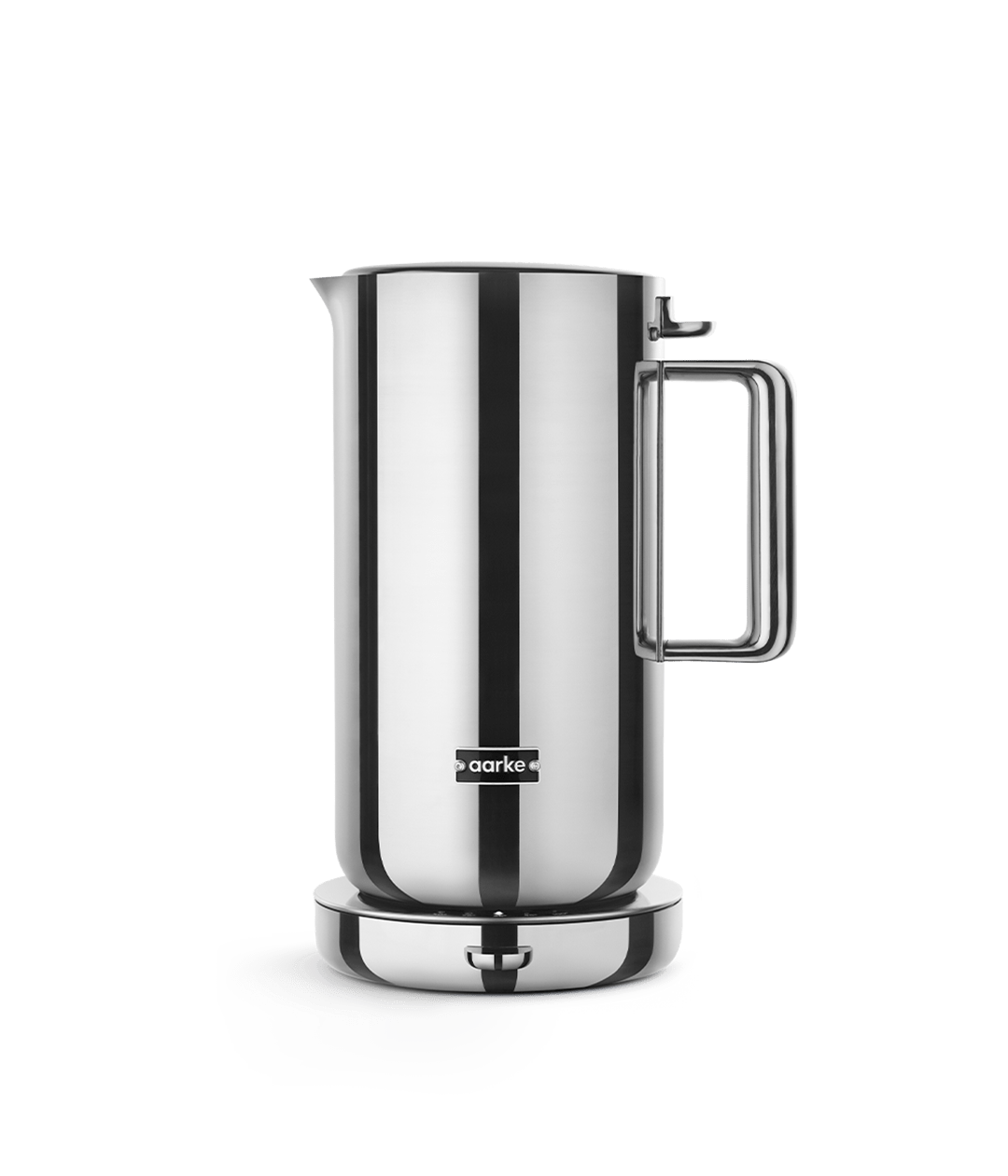
1Aarke Kettle, Steel
The cleanest water path here, confirmed in writing, but expensive and small.
This is the only kettle here where the brand answers the materials question in writing, without being asked, on its own support pages. Their words: no plastic gets in contact with your drinking water in the Aarke Kettle, only stainless steel and food grade BPA free silicone rubber in the bottom sensor seal.
Go through it part by part and it holds up. The body and spout are SUS304 stainless. The lid is stainless with a silicone seal that Aarke say contacts vapour only. There is no sight glass at all, which matters more than it sounds, because a translucent water level window is the single most common hidden plastic on a kettle sold as stainless steel. And the limescale filter is described as plastic free, made in 100 per cent stainless steel, where almost every rival uses a plastic framed mesh.
The one polymer in the water is a food grade silicone ring around the bottom temperature sensor. Aarke are upfront about that, and being upfront about the exception is precisely why we believe the rest.
It is also, separately from all that, a good kettle. An independent tester comparing it against Balmuda and Bodum found the whole household agreed it was best for pouring, after previous kettles dribbled, and recorded it as the fastest of the three to reach a set temperature. Five presets at 40, 75, 85, 95 and 100 degrees with a memory function, a double walled body that genuinely holds heat so keep warm is not a gimmick, and a five year warranty on registration, which is the strongest durability signal in this ranking.
The reservations are real and mostly about money and size. Two hundred pounds is roughly six times the Cosori for a kettle that holds less water. It is 1.2 litres maximum, and the minimum fill is 0.5 litres, which is a high floor. If you make one mug at a time you are boiling roughly double what you need, which quietly undoes part of the energy argument.
It is also slower than a 3kW British kettle, drawing 1850 to 2200 watts for about three minutes on a full fill. And note Aarke’s own warning that the stainless body gets hot in use and should not be touched after boiling. Only the handle is heat safe, which is worth knowing in a house with children.
Buy it if you use it every day for years and you want the materials question answered in writing. Skip it if you boil one mug at a time, or two hundred pounds for a kettle is not the world you live in.
2Cosori Plastic-Free Water Contact Kettle 1.7L
The same stainless water path idea as the Aarke for about a sixth of the price.
The same idea as the Aarke for a sixth of the money and with half a litre more capacity. Cosori state that all water contact parts are 304 food grade stainless steel including the spout, inner lid and filter, and that unlike typical plastic water level indicators, theirs is completely plastic free to prevent plastic odours. That is exactly the right thing for a brand to say, and it is why this is the recommendation most people should actually act on.
Buyers agree, and they say so in the plainest possible terms. The reviews on Cosori’s own UK store keep coming back to the same point: well made, reasonably priced kettle with no plastics in contact with water. Great kettle, light but well built, no plastic touching water. The key, no plastic lining. People are buying this specifically for the water path.
It is fast, with a British Strix thermostat and 3000 watts, and Cosori quote 250ml in 43 seconds. The two stage lid is genuinely clever: 30 degrees to pour without splashing, 70 degrees to clean and refill, and the wide opening means you can get a hand inside to scrub limescale, which you cannot do on most kettles.
Now the honest trade offs, and they follow directly from the design. There is no water window, because a water window would be plastic. You open the lid and read the internal markings. One reviewer found the lid mechanism a little stiff and said so alongside noting there was no window. That is not a fault, it is the cost of the thing you bought it for.
It is noisy, and a five star reviewer still said so. Single wall stainless with a fully exposed metal interior is usually louder than a plastic bodied kettle, and this is no exception. There is no temperature control and no keep warm at this price.
One practical tip that applies to any bare stainless kettle. Across the wider Cosori stainless range some buyers report water marks and cloudy staining inside after the first few boils that will not polish out, and a small number report a chemical or slightly bitter taste on early use. Both are consistent with residual manufacturing oils. Boil and discard two or three full loads before you drink from it.
Buy carefully. Cosori sell several visually similar stainless kettles and only some have a fully metal water path. Look for the exact phrase Plastic-Free Water Contact in the title.
Buy it if you want the plastic out of the water path and you are not spending two hundred pounds to do it. Skip it if you need to see the water level at a glance, or noise in the kitchen bothers you.
3Bosch Sky TWK7203GB
The best performing kettle here, but with plastic in the water path.
Purely as a kettle, this is the best one here and it is not particularly close. Independent testing measured a litre in 2 minutes 4 seconds and the full 1.7 litres in 3 minutes 22, made it their overall best kettle, and recorded 0.106 kilowatt hours per litre, which is the most efficient figure in this group. The double wall means the outside only reached 52.7 degrees, the lowest of the mainstream fast boilers, which matters if there are small hands about.
Seven temperature settings from 70 to 100 degrees on a touch swipe display, a 30 minute keep warm, a concealed element and a 300ml minimum fill, which is genuinely low and is the single most useful energy feature on any kettle. Triple safety shut off. It is a properly good appliance and at £100, often discounted to £80, it is fairly priced.
And then you try to find out what is inside it, and you cannot. Bosch publish a spec sheet whose entire materials disclosure is the line stainless steel body. There is no lid material, no filter material and no gauge material anywhere in the GB documentation. For a page about what touches your drinking water, that is a legitimate criticism and we are going to make it.
Here is what can be established rather than assumed. The inner wall is stainless and it is double walled with an outer shell. The lid is a push button assembly with a gasket, which means a plastic mechanism sitting in the steam space and in contact with condensate. Bosch list a water level indicator, and a see through level strip on a cool touch double walled kettle is a translucent polymer window on the water side. And the removable spout filter is the giveaway: Bosch kettle spout filters sold as spares across the TWK7 range are described by spares suppliers as plastic.
So the honest verdict is this. It is a stainless steel kettle with plastic in the water path. It is not a clean pick and we are not going to pretend it is. It is in this ranking because it is the best all round kettle here and because you deserve to see what stainless steel kettle actually means on a mainstream product.
Two smaller gripes from owners. There are scattered reports of a unit that stopped heating at 80 degrees regardless of the setting, so check yours does what the display says in the first week. And the water level indicator is hard to read in some kitchen lighting, which is a familiar complaint about level windows generally.
Buy it if you want the best performing kettle here and the water path is not your first concern. Skip it if you are reading this page because of what touches the water.
4Fellow Stagg EKG
A precise pour over coffee kettle, too small and slow for a household.
A coffee tool rather than a household kettle, and it should be judged as one. The gooseneck spout exists so you can pour a controlled thin stream over ground coffee, and one reviewer scored it 9.5 out of 10 and wrote that the spout allows for the subtlest of dribbles to remain the stuff of intention. Temperature to the degree from 40 to 100, a hold mode selectable at 15, 30, 45 or 60 minutes, and a built in brew stopwatch. The display shows target and current temperature at the same time, which the same reviewer called the most informative they had seen.
Fellow also publish a proper materials breakdown on their support site, which puts them in a very small club. Their words: the body is high grade 304 stainless, there is a compression moulded silicone ring around the temperature probe in the water, and the lid is made with BPA free food safe polypropylene and a silicone gasket, with the underside of the lid in stainless steel.
Read that carefully, because it is a good example of a brand being precise. The face of the lid that the water and steam touch is steel. The gasket is silicone. The lid body above it is polypropylene, sitting in the steam space. That is a meaningfully better position than a plastic lid mechanism, and it is only knowable because Fellow bothered to write it down.
The problem is the size. Nine hundred millilitres, and there is no bigger version. One reviewer with a two person household said flatly that 900ml is not enough water for their normal morning coffee routine. It cannot boil a litre at all. And at 1200 watts on a UK 3kW socket it is slow, taking roughly four and a half to five minutes for a full fill.
Some design niggles. The flat lid means a slightly overfilled kettle geysers hot water out of the vent holes. The metal ring where the handle meets the body conducts heat and fingers can get uncomfortably hot. And there is no limescale filter at all, which is a real omission in a hard water area.
On durability the evidence splits. One reviewer reported three years of daily use with the dial, screen and finish all intact. A commenter under the same review reported problems inside a year. Both are worth knowing. The UK warranty is also shorter than the American one, at one year back to base from at least one stockist against Fellow’s two years standard in the US. Check what your retailer actually offers.
Buy it if you make pour over coffee and the kettle is part of the ritual. Skip it if it is the only kettle in the house and more than one person wants a hot drink.
5Dualit Classic Kettle 72815
Quiet and repairable, but more plastic in the water than the Cosori.
This is the best teaching example in the whole article, because it looks like a solid stainless steel kettle and on the inside it is not one.
Start with what is good, because there is plenty. It is Quiet Mark certified and it is genuinely the quietest kettle here. It boils a litre in about 2 minutes 14 seconds on independent measurement. And it is properly repairable: the 3kW element is patented and replaceable, which almost nothing else in this category offers, and it is a real answer to the two to three year failure pattern that kills most kettles.
Now turn it round. There are two plastic measuring windows set into it, one in litres and one in cups, plus a small light window. Dualit describe those windows as BPA free, which is a tacit admission of exactly two things: that they are plastic, and that they are inside the kettle. Those windows are in direct contact with boiling water on every single boil.
The lid assembly and the heatproof ring are plastic too. There is a spout insert that directs the flow whose material Dualit do not publish, and a removable limescale filter whose material Dualit also do not publish, though mainstream UK kettle spout filters of this type are plastic framed mesh.
None of that makes it a bad kettle. It makes it a £165 stainless steel kettle with more plastic in the water than the £32.99 Cosori, and that is the point worth taking away from this page.
The other complaints are practical. The replaceable element is a genuine feature but the part is around £65, which is a large chunk of the kettle’s value. The illuminated window is dim and does not actually help you read the level. You cannot fully drain it because of the lip design. And at this price there is no push button lid, no variable temperature and no keep warm.
One thing to check before buying. Dualit’s own site lists a one year guarantee while John Lewis lists two years and one retailer listed three. That is confusing and it is worth knowing which you are getting. There is also a documented run of complaints about lid mechanism failures just after guarantee expiry on a different Dualit kettle, along with poor aftercare responses. Different model, so we are not laying it at this one’s door, but it is a fair note on the brand.
Buy it if quietness and repairability matter most to you and the water path does not. Skip it if you came to this page to get plastic out of your boiling water.
6Russell Hobbs Inspire Kettle 24360
Fast and cheap, but almost entirely plastic inside. Here as the benchmark.
This is here as the comparison point rather than as a recommendation. It is a perennial UK bestseller and it is representative of what most people actually have on the worktop, which makes it the right thing to measure the others against.
It is genuinely fast for the money. Three thousand watts, one 235ml cup in 45 seconds on the manufacturer’s figure, and independent UK testing found one cup in under 45 seconds and a full 1.7 litres in two to three minutes. The rapid boil zone with 1, 2 and 3 cup markers is the single best energy saving feature on any kettle in this comparison, because it lets you deliberately boil a small amount. It is light to lift when full, which matters if you have weak wrists, and the fully removable lid makes filling and cleaning easier than a hinged one. Thirty pounds, five colours, available everywhere.
And the water path is all of it. The body, the lid, the spout, the level gauge and the filter are plastic. Only the element plate is metal. Every boil is water at 100 degrees sitting against polypropylene on all sides.
That is the point where we should be careful and factual rather than dramatic, because there is real research here and the headline number has been mangled. A 2025 study in npj Emerging Contaminants boiled eight polypropylene kettles repeatedly and measured nanoplastic release. Two things it found matter. The first is that release falls off very sharply with use: mass release dropped by more than 96 per cent between the first boil and boil 150, stabilising after about fifty boils. So a new plastic kettle sheds most in its first fortnight and then settles.
The second is that the widely reported figure of 11.8 million particles per litre came from one measurement technique in that study, and the same study using a different technique on the same samples got a figure three orders of magnitude lower. Both are in the paper. Anybody quoting one without the other is not telling you the whole thing, and we are not going to either.
The practical read: if you own one of these, run several boils and discard them when it is new, and consider it when you replace it rather than binning a working appliance today. On its own terms as a kettle, durability is the bigger complaint anyway. One reviewer found it feels cheap and hollow, and cites a unit bought in 2023 that stopped heating by early 2026, with a pattern of failures around two to three years. Russell Hobbs’ own spec sheet lists Quiet Boil as No.
Buy it if you need a cheap fast kettle today and the material is genuinely not a consideration. Skip it if you have read this far down the page.
What the labels don’t tell you
kettles here are what the stainless steel box implies on the inside
buys a kettle whose spout, inner lid and filter are all 304 stainless
drop in nanoplastic release from plastic kettles between the first boil and boil 150, in a 2025 study
The 30 second check
How we scored these
Every product on Mrs House gets the same five scores, with the same weights. We read each ingredient or materials list, chase the safety data and certificates, and look for a published test behind every claim on the box.
4.5 and up: approved. 4.0 to 4.4: recommended. 3.0 to 3.9: fine, with reservations. Under 3.0: not recommended.
Buy the Cosori at £32.99 for a stainless water path, or the Aarke at £200 if you want the full version. Skip the Russell Hobbs if plastic in your boiling water bothers you.