Home · Bedroom · Warmth and bedding
Best electric blankets: six compared, and why a quarter of the ones brought in for testing fail
Electric blanket fires in England hit a five year high in 2024/25, and the failure rate at free fire service testing events is roughly one in four. Almost every one of those failures is an old blanket. So this page is about the safety mark, the timer and the age of the thing, and only then about how cosy it is.
By Mrs House · Updated 10 September 2026 · 14 minute read
Mrs House is independent. Nobody pays for a place in a ranking here, and no brand saw this page before it went live.
The short answer
Buy the Dreamland 168 Organic Cotton at £139.99 for a double. It is the only one here that puts organic cotton rather than polyester fleece against your skin, and its 38cm fitted skirt means it physically cannot bunch up.
- Best overall: Dreamland 168 Organic Cotton, £139.99. Six heat settings, dual controls, programmable timer, three year guarantee.
- Best certified: Slumberdown Perfectly Warm, £65. The only one here with BEAB approval stated at the point of sale, which is independent testing rather than a self declaration.
- Best fabric certification: Beurer HD 75 from £55, or the Dunelm Teddy throw from £32. The only two carrying OEKO-TEX.
BEAB approval matters more than anything else on this page, because this is a heating element you sleep on.
How we assessed these
Six blankets, and a category where the safety questions genuinely outrank the comfort ones.
Here are the numbers we started from. Electrical Safety First analysed government fire data and reported 31 accidental electric blanket fires across England in 2024/25, up 24 per cent on the previous year, with 11 casualties or fatalities. That is a five year high. In absolute terms 31 fires a year is rare, and we are not going to pretend otherwise, but the trend is rising and they hurt people at a high rate per incident.
The more useful number comes from the free testing events that fire services and trading standards run. Oxfordshire report that almost a quarter of the blankets brought in last year failed the test and were deemed unfit to use, and that most failures are down to age. That is the argument for checking yours, in one figure.
One number you will see that we are not going to repeat: a widely circulated claim that electric blankets cause over 5,000 domestic fires a year in the UK. It is unsourced and it is two orders of magnitude away from the actual government fire data. It appears on a lot of affiliate blogs and it is wrong.
So we judged these on the safety mark, on whether there is a real timer, on overheat protection, on washability, and on whether the design lets you heat the bed and then switch it off. Then on fabric, and then on comfort. Prices checked September 2026.
The ranking, at a glance
| Blanket | Price | Type | Timer | Fabric | Score | |
|---|---|---|---|---|---|---|
| 1 | Dreamland 168 Organic Cotton | £139.99 double | Fitted underblanket | Yes, programmable | Organic cotton face | 4.7 / 5 |
| 2 | Dreamland Sherpa Underblanket | £79 to £139.99 | Underblanket | Yes, 1, 3 or 9 hours | Polyester sherpa | 4.6 / 5 |
| 3 | Slumberdown Perfectly Warm | £65 double | Underblanket | Yes, 1, 5, 8 or 12 hours | Polyester, BEAB approved | 4.3 / 5 |
| 4 | Beurer HD 75 Cosy Nordic | £55 to £86 | Overblanket throw | Fixed 3 hour cut off | Polyester, OEKO-TEX | 4.2 / 5 |
| 5 | Dunelm Teddy Electric Throw | £32 to £55 | Overblanket throw | Fixed 4 hour cut off | Polyester, OEKO-TEX | 4.0 / 5 |
| 6 | Silentnight Comfort Control | About £40 to £60 | Underblanket | No timer at all | Polyester | 3.8 / 5 |
The two we would actually buy
Best overall
Our winner
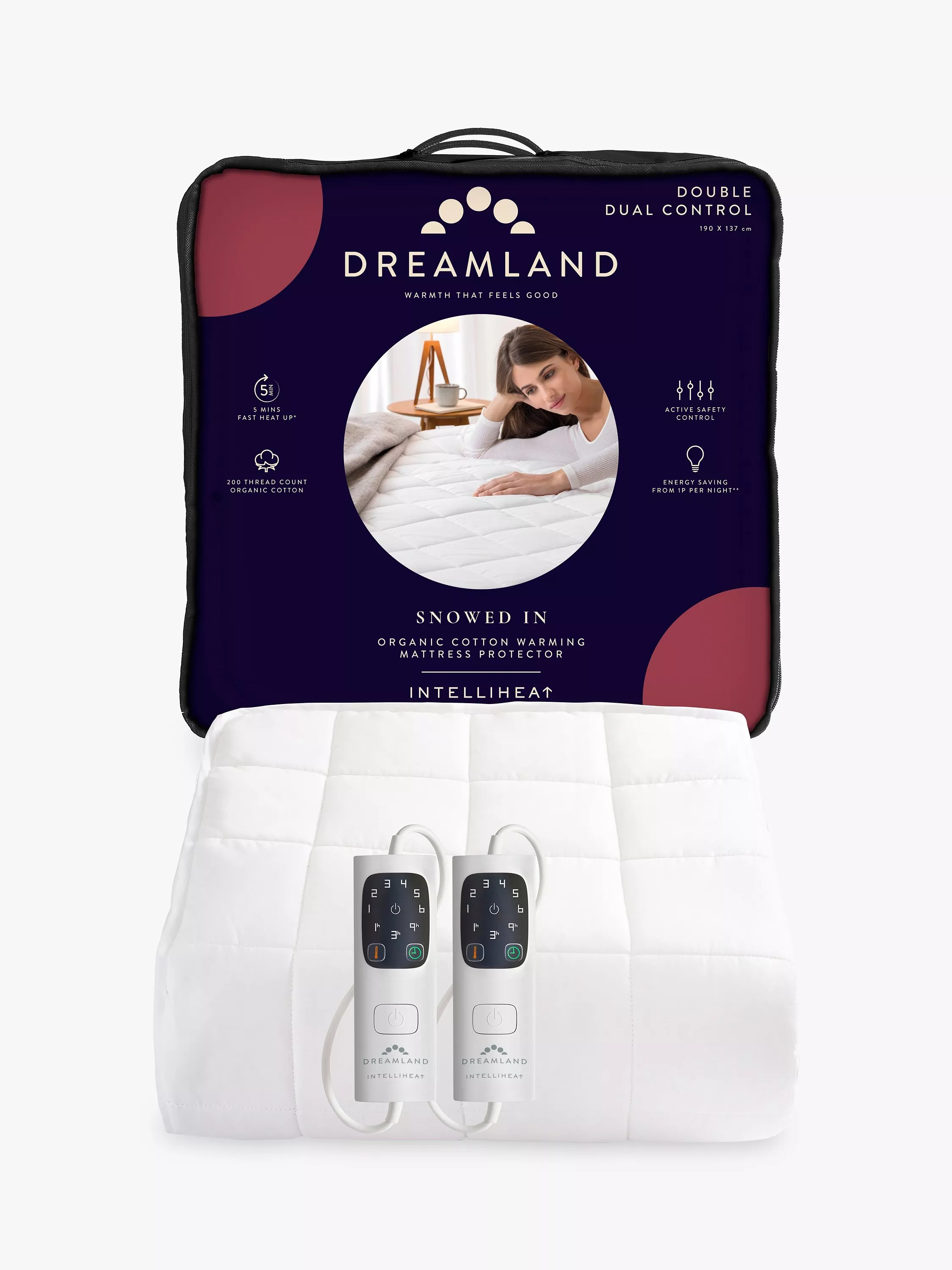
Dreamland 168 Organic Cotton Heated Mattress Protector
★★★★★ 4.7 / 5
Almost every electric blanket and heated throw on the UK market is polyester fleece against your skin. This one puts a 200 thread count organic cotton face between you and the element. The polyester is still in there, in the fill and the underside, but it is not the surface you sleep on, and on the one appliance that sits against your body for eight hours that distinction is worth paying for.
The second thing it does better than anything else here is stay put. It is a fitted mattress protector with a 38cm elasticated skirt, so it grips a deep mattress and cannot ruck or slide. That is not a comfort point, it is the safety point. A rucked underblanket concentrates heat in a fold, and bunching is the single most common complaint about strap on underblankets across every review pool we read.
It heats fast, with Dreamland quoting five minutes and independent testing of the same generation of Dreamland underblankets measuring 54.5 degrees after five minutes and 59.1 after ten on full power. Six heat settings, dual controls, a programmable auto shut off, and intelliheat+ temperature sensing that monitors and adapts to body temperature through the night. Timer options across the range are one, three or nine hours, which is the right spread: one hour to preheat, nine only if you genuinely intend to sleep on it.
It washes at 30 degrees with the control detached, and it carries a three year guarantee, which is longer than most of the category. Customer rating at John Lewis is 4.7 out of 5 across 427 reviews, which is a big enough sample to mean something.
The drawbacks are money and bulk. A hundred and forty pounds for a double is roughly four times the cheapest thing on this page for the same basic function. It is 2.7kg of padded construction, so it is awkward to wash, awkward to store, and it will not dry quickly, which matters because a blanket that takes three days to dry is a blanket that does not get washed.
One practical thing to check before ordering. The cable is only 150cm, which is short if your socket is not right beside the bed. If you need an extension for it, use a properly rated one and unwind it fully, because a coiled extension lead under a bed running a heating appliance is exactly the kind of thing fire services write leaflets about.
Pros
- The only blanket here with organic cotton rather than polyester fleece against your skin
- A 38cm fitted skirt, so it physically cannot bunch, which is the real safety issue
- Six settings, dual controls, a programmable timer and temperature sensing through the night
- Machine washable at 30 degrees, with a three year guarantee
- Four point seven out of five across 427 reviews
Cons
- A hundred and forty pounds for a double, roughly four times the cheapest option here
- Bulky at 2.7kg, so it is awkward to wash, dry and store
- Higher rated wattage than budget models, though the thermostat cycles it down
- Only a 150cm cable, so you may need a properly rated extension
- No published OEKO-TEX certificate, despite the organic cotton
Buy it if you want cotton rather than fleece against you, and a blanket that cannot ruck. Skip it if a hundred and forty pounds is a lot for something you will use four months a year.
Best reviewed
Tumble dries
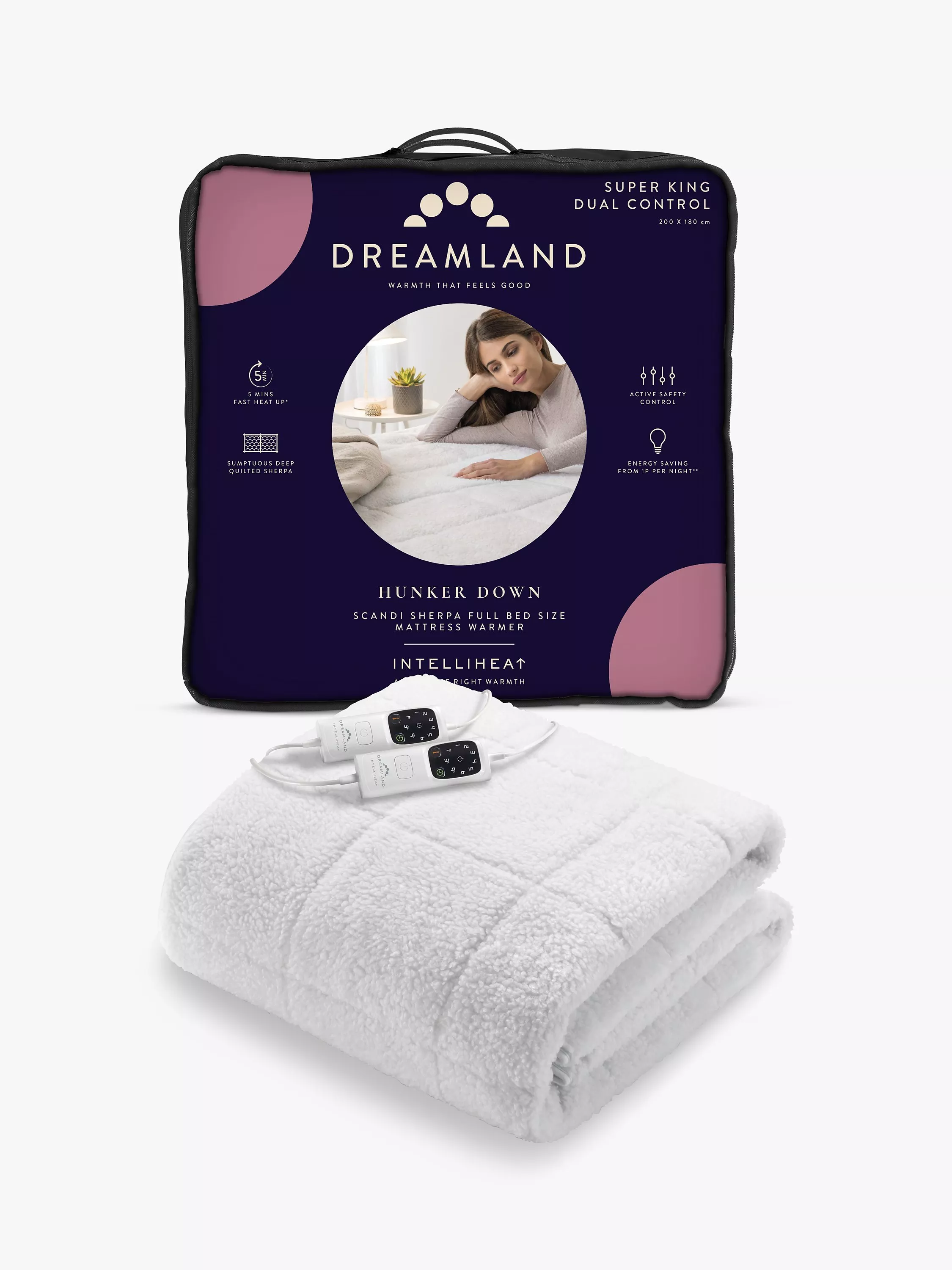
Dreamland Sherpa Electric Underblanket
★★★★★ 4.6 / 5
The largest and most consistent body of positive feedback in this comparison: 4.8 out of 5 from 751 reviews at one retailer and 4.7 from 216 at another, with 94 per cent of customers recommending it. Buyers say the same things over and over, that it is wonderfully fluffy, that it warms up quickly, and that they wish they had bought one years ago.
The speed is independently verified rather than just claimed. Testing of the equivalent model in this range recorded 54.5 degrees after five minutes and 59.1 after ten on full power. Six settings, with 1 to 3 intended for overnight use and 6 for a fast preheat, dual controls on double and above, and an auto shut off at one, three or nine hours.
The feature we rate most highly is the least glamorous one: it is tumble dryer safe as well as machine washable. Almost nothing else in this category is. That matters because a blanket that takes three days to line dry in a British winter is a blanket that quietly never gets washed, and soiling and damp patches are named on every fire service damage checklist as a warning sign. This is the underblanket to recommend to somebody who will realistically clean it.
It is also reversible, fleece side up when you want the plush surface and plain side up when you do not, and the measured running cost is genuinely low: testing recorded an actual draw of 36 watts on full power rather than the 150 watts on the rating plate, which works out at under a penny an hour.
Two specific criticisms from testing. The element wires are too prominent on the thin reverse side, so if you use it reversed you feel them. And there is a cold spot at the bottom edge, which taller sleepers will notice at their feet.
Two things to check before buying. There is a cheaper single control double in circulation, so make sure you are getting the dual control version if you share a bed. And not every Dreamland underblanket in this family has the full timer, with at least one sibling model marked down by testers for having no adjustable timer at all. Check the exact variant rather than assuming the range is uniform.
Pros
- Four point eight out of five from 751 reviews, with a second retailer independently at 4.7
- Independently measured at 54.5 degrees after five minutes on full power
- Tumble dryer safe as well as machine washable, which almost nothing else here is
- Measured real draw of 36 watts, so under a penny an hour to run
- Reversible, with a plain side if you do not want fleece
Cons
- The element wires are too prominent on the thin reverse side
- A cold spot at the bottom edge, which taller sleepers will feel
- Polyester sherpa throughout, with no OEKO-TEX certificate published
- A cheaper single control version exists and is easy to buy by mistake
- Not every model in this family has the full adjustable timer
Buy it if you want the best reviewed underblanket here and you will actually wash it. Skip it if you want cotton against your skin, or you are tall enough to notice the foot end.
The wool one, and the one for a child’s bed
Only one BEAB approved
Best certified
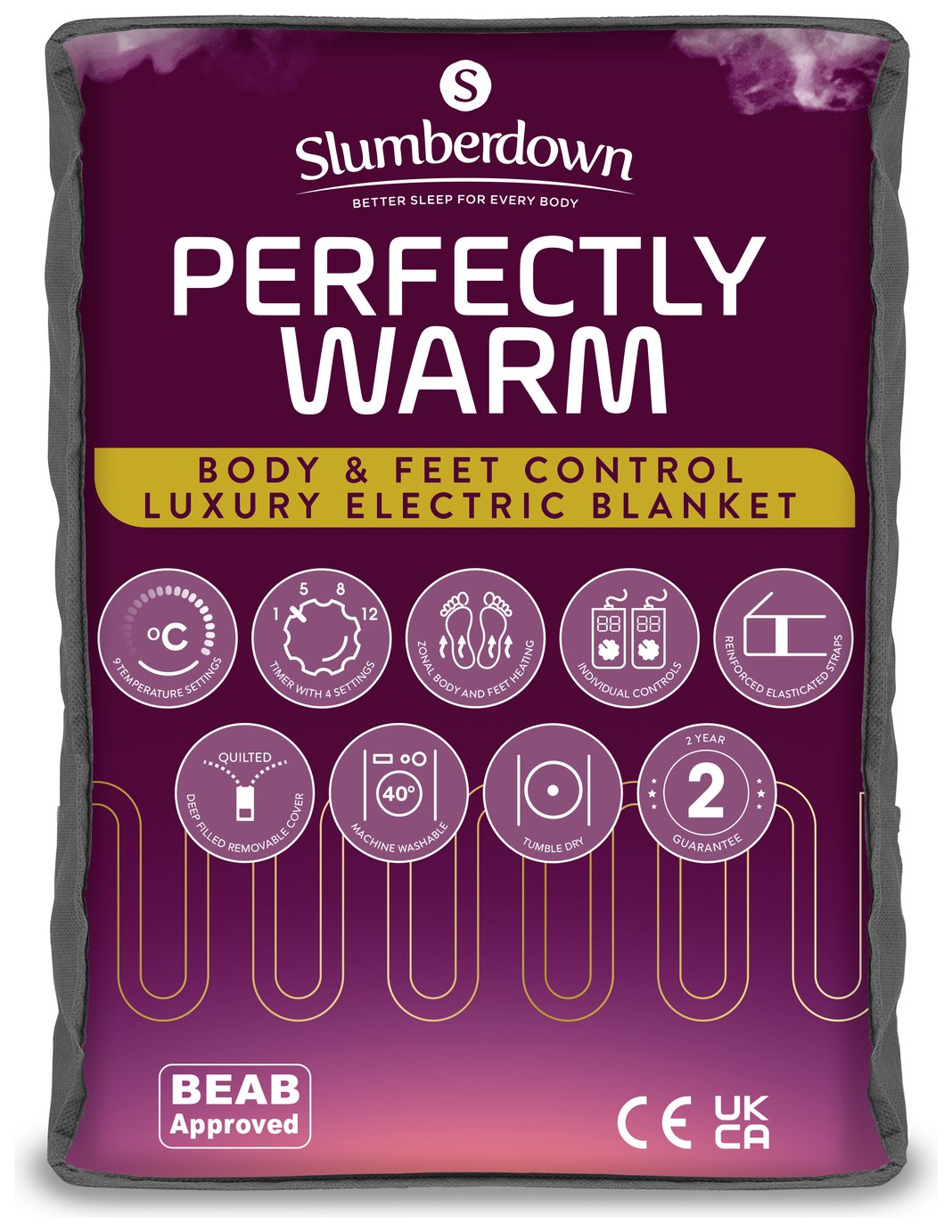
Slumberdown Perfectly Warm Luxury Electric Blanket
★★★★☆ 4.3 / 5
This is the only blanket in the six with BEAB approval stated at the point of sale, and that is a bigger deal than the marketing anywhere makes it look, so here is what it means.
BEAB stands for the British Electrotechnical Approvals Board, and the mark now sits with an independent testing house. It means a third party, independent of the manufacturer, has tested the product against the relevant safety standard and certified it. A UKCA or CE mark means something different: for most household appliances it is a manufacturer self declaration that the product conforms. That is a legal requirement and it is not nothing, but nobody outside the company necessarily looked at it.
So a blanket can be entirely legal, correctly marked, and never have been near an independent laboratory. Every other product on this page relies on self declaration. This one does not, and on an appliance that heats up underneath a sleeping person, we think that is worth more than an extra heat setting.
The rest of it is good too. Sixty five pounds for a double, 4.6 out of 5 from 769 verified reviews with 91 per cent recommending, nine heat settings with independent body and feet zones, dual detachable controls, and a timer with one, five, eight or twelve hour options. The measured real draw was 47 watts, which is about 1.2p an hour. A two metre cable, which is longer than either Dreamland.
Slumberdown also publish that their electric blankets are UKAS tested for flammability to the British Standards covering mattresses and upholstered furniture. That is a genuine checkable claim and it is worth being precise about what it implies: the textile has been ignition tested, and for most UK bedding that is achieved with a flame retardant treatment or a barrier layer. Slumberdown do not publish the chemistry, so the honest line is that the fabric is fire tested and the treatment is not disclosed.
The complaints in the reviews are about bunching, and that is the safety relevant flaw rather than a comfort niggle, because a rucked underblanket concentrates heat in a fold. If you buy this, pull it taut and use a well fitted sheet over the top. There is no OEKO-TEX claim on this line, and the warranty is two years against three from Dreamland.
Pros
- The only blanket here with BEAB approval, which is independent testing rather than self declaration
- Nine heat settings with independent body and feet zones, and dual detachable controls
- A timer with one, five, eight or twelve hour options
- Sixty five pounds, with 4.6 out of 5 from 769 verified reviews
- Measured at 47 watts, about 1.2p an hour, and a two metre cable
Cons
- Bunching is the recurring complaint, and a rucked underblanket concentrates heat
- Polyester throughout, with no OEKO-TEX claim on this line
- The fabric is fire tested but the flame retardant chemistry is not disclosed
- Two year warranty against three years from Dreamland
- Several catalogue variants with different control layouts, so check what you order
Buy it if you want the one that an independent lab has actually certified, at a sensible price. Skip it if you want cotton against your skin or a longer guarantee.
OEKO-TEX certified
Best throw
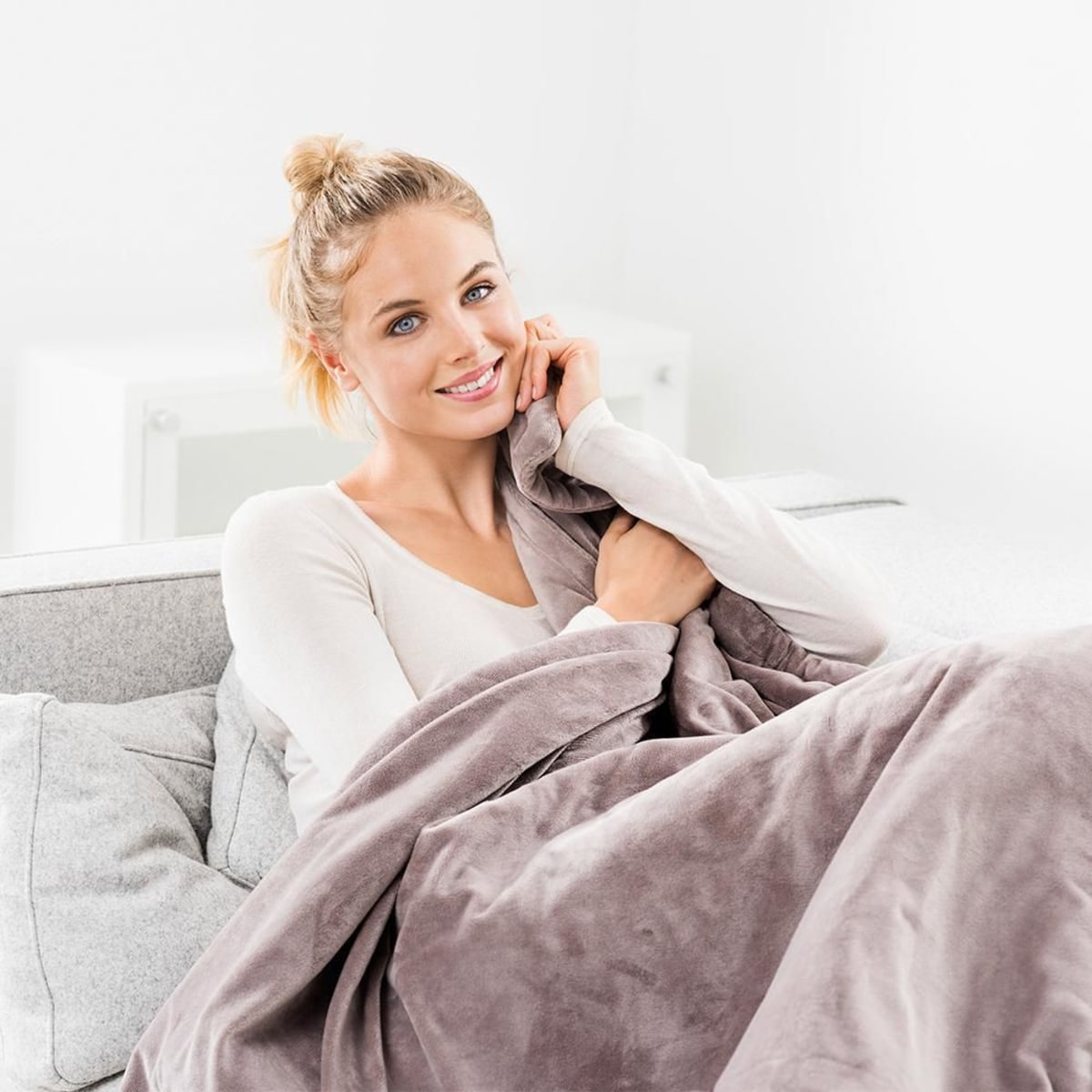
Beurer HD 75 Cosy Nordic Heated Overblanket
★★★★☆ 4.2 / 5
The most meaningful textile claim in this whole category, because Beurer state OEKO-TEX certification on the official product specification and the retailer describes it as OEKO-TEX 100 certified machine washable soft fleece. OEKO-TEX Standard 100 is a tested limit on harmful substances in the finished textile rather than a claim about where the fibre came from, and for a fabric that is going to sit against you warm for hours that is the right certification to look for.
It is an overblanket, which changes the whole safety and exposure conversation and mostly for the better. It goes over you rather than underneath you, so there is no weight compressing the element, no bunching under a sheet, and no question of falling asleep on top of it. Beurer name their Safety System as a defined thing rather than a vague claim, with temperature monitoring and safety switch off, plus an automatic cut off after three hours.
Six settings on a sliding switch, a detachable controller, machine washable at 30 degrees, and a three year warranty which is at the top of this category and unusual for a throw. The mains cable is 2.3 metres, the longest of the six, which genuinely matters: it means you are far less likely to need an extension lead to reach the sofa, and extension leads under soft furnishings are their own hazard.
The complaints are mostly commercial rather than technical. UK pricing for it is chaotic, with the same model appearing anywhere between roughly £45 and £86 depending on colour and seller, so shop around and do not assume the first price is the right one. There are relatively few independent UK customer reviews compared with Dreamland or Slumberdown, so there is less crowd evidence about how it holds up over years.
Two practical limits. The three hour cut off is not adjustable, so if you want it on for half an hour you have to remember to switch it off yourself. And at 180 by 130cm it is throw sized rather than bed sized. It will not cover a double bed properly, and anybody wanting a bed overblanket needs the larger sibling or a different product entirely. The retailer also lists it as suitable for ages eight and over, which is worth surfacing if you are buying for a family.
Pros
- OEKO-TEX certified, which is a tested limit on harmful substances in the finished textile
- An overblanket, so nothing compresses the element and it cannot bunch under a sheet
- A named safety system with temperature monitoring and a three hour automatic cut off
- A 2.3 metre cable, the longest here, so no extension lead needed for a sofa
- Three year warranty, which is at the top of this category
Cons
- UK pricing is chaotic, with the same model between roughly £45 and £86
- The three hour cut off is fixed and not adjustable
- Throw sized at 180 by 130cm, so it will not cover a double bed
- Few independent UK customer reviews, so long term reliability is unproven
- Listed as suitable for ages eight and over
Buy it if you want a heated throw for a sofa and the fabric certification matters to you. Skip it if you want to heat a bed, in which case buy an underblanket instead.
The two we would not buy
Best budget throw
Cheapest here
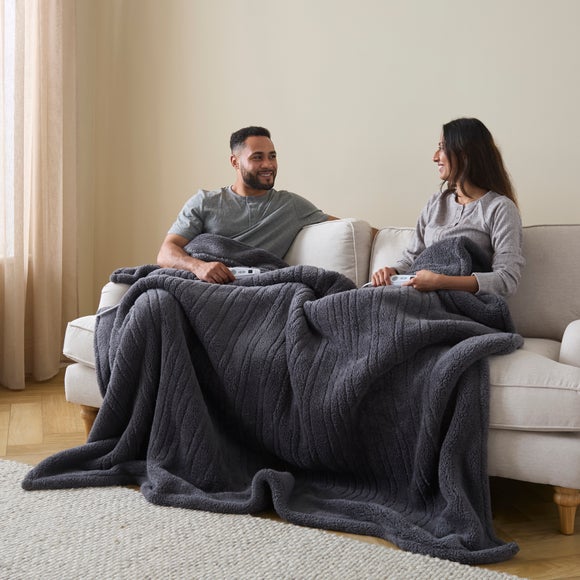
Dunelm Teddy Electric Throw
★★★★☆ 4.0 / 5
Thirty two pounds, often discounted to twenty, and it is OEKO-TEX verified, with Dunelm stating it has been independently tested for harmful substances. A real textile certification on a product this cheap is why this earns a place over the various no name throws you will find online for similar money.
It is also genuinely cheap to run. Independent testing measured an actual draw of 18 watts on full power and 14 on half, which is under half a penny an hour, against Dunelm’s own rated figure of 100 watts. It reached 44.8 degrees after ten minutes on maximum, and testers praised the soft teddy bear feel and the rapid heating. The cable is 278cm, the longest in this comparison, so it reaches a sofa without an extension lead.
Four point four out of five from 427 reviews at Dunelm, which for a sub £40 product is a strong signal.
The reason we are recommending it despite ranking it fifth is a document rather than a feature. Dunelm publish a care guide for this appliance that states, plainly and in writing, the contraindication list that most retailers bury. It says the throw must not be used by or on an incapacitated or immobile person, someone who is diabetic or insensitive to heat, a paraplegic, quadriplegic or amputee person, someone with poor blood circulation, anyone with cuts, skin lesions, sores or damaged skin, anyone unable to understand the instructions or work the controller, children under three, or any person unable to react to overheating.
That is the manufacturer telling you who must not use it, and it is a genuinely important list. Low temperature contact burns in people with reduced sensation are a documented risk with heated bedding, and the people at risk are precisely the ones most likely to be bought one as a kindness.
The limitations are what you would expect at this price. There is no adjustable timer, only a fixed four hour cut off, which testers called an annoyance and which is long for a sofa throw. The fabric is thin compared with premium alternatives and the texture is slightly synthetic. It cannot be tumble dried, with the care guide specifying a cold gentle wash and line drying in shade, which is slow in a British winter. And Dunelm’s published wattage of 100 watts is well above the 18 watts actually measured, so their own running cost claim is a worst case rather than a realistic one.
Pros
- Thirty two pounds and OEKO-TEX verified, independently tested for harmful substances
- Measured at 18 watts actual draw, so under half a penny an hour
- Reached 44.8 degrees after ten minutes, with a soft teddy texture testers rated
- A 278cm cable, the longest here, so it reaches a sofa without an extension
- Four point four out of five from 427 reviews
Cons
- No adjustable timer, only a fixed four hour cut off, which is long for a throw
- Thin fabric compared with premium alternatives, with a slightly synthetic feel
- Cannot be tumble dried. Cold gentle wash and line dry in shade only
- Dunelm’s stated 100 watts is far above the 18 watts actually measured
- Sold at Dunelm only
Buy it if you want a cheap certified throw for the sofa and you will switch it off yourself. Skip it if you need a timer, or you want something substantial rather than thin.
Cheapest underblanket
No timer

Silentnight Comfort Control Electric Underblanket
★★★★☆ 3.8 / 5
The cheapest credible way into a heated bed, and it does the basic job. Independent testing measured the actual draw at each level and found it genuinely cheap to run: 28 watts on level one at about a penny an hour, 51 watts on level two at about two pence, and 90 watts on level three at about three pence. Testers called it thin and unobtrusive, said it heats up quickly and rated it very affordable to operate compared with central heating.
Thinness is a real advantage here that the premium models lose. Because there is no padding, you feel the element far less than on a thick quilted underblanket, and Silentnight use pinsonic stitching to hold the wires in place so they cannot migrate over time.
It has overheat protection, it machine washes at 40 degrees once the connector is removed, and the models stocked at John Lewis carry a three year guarantee.
And then there is the reason it finishes last, which is not a small thing on this page. There is no timer. Not a short one, not a fixed one, none. An underblanket with no timer is on until somebody switches it off, and every piece of manufacturer and fire service guidance on underblankets says to heat the bed and then turn it down or off. A product that makes the correct behaviour entirely dependent on you remembering it, at bedtime, is a worse product than one that does it for you. That alone rules it out of the top spots.
The other complaints are about fit and are consistent across testers. It was found undersized for the listed mattress dimensions with poor coverage of the top half of the bed, and it bunches up or shifts sideways during use. The connector is positioned awkwardly, right where one sleeper lies, and more than one tester found the control attachment uncomfortable. You can feel the wires through the sheet, and it takes about fifteen minutes to heat rather than the five the premium models manage.
One thing to get right when ordering. The base Comfort Control is single control, so couples cannot set different temperatures. There are dual control variants in the range at a higher price if that matters, and review volumes on some of the Silentnight electric bedding lines are so low, in single figures, that the star ratings on them are noise rather than information.
Pros
- The cheapest credible route to a heated bed, at roughly a penny an hour on level one
- Thin and unobtrusive, so you feel the element far less than on a padded model
- Pinsonic stitching holds the wires in place so they cannot migrate
- Overheat protection, machine washable at 40 degrees, and three years on some models
- Testers rate it as very affordable against running the central heating
Cons
- No timer of any kind, which on an underblanket is the wrong omission to make
- Undersized for the stated mattress dimensions, with poor coverage of the top half
- It bunches and shifts sideways in use, which concentrates heat in a fold
- The connector sits awkwardly where one sleeper lies, and testers found it uncomfortable
- Single control on the base model, so couples cannot set different temperatures
Buy it if you want the cheapest way to take the chill off a bed and you will unplug it yourself. Skip it if you want a timer, which on an underblanket you really should.
Prices checked 5 August 2026 and may have changed since.
The clean pick, and the honest catch
Our clean pick
Dreamland 168, with a caveat
Nothing here clears all five tests
Why it is the one to buy
✓
Cotton against your skin, not fleece
✓
A skirt that cannot bunch
✓
A real timer, and sensing that adapts
✓
It washes, and it is guaranteed for three years
What you give up
✕
It is not BEAB approved
✕
It does not carry OEKO-TEX either
✕
A hundred and forty pounds, and bulky
The catch, said plainly, and it is a criticism of the category rather than of one product. We could not find a single blanket in this six that meets all five of the things we set out to judge on, because only one of them has independent safety certification stated at the point of sale and that one is polyester with no OEKO-TEX. So this is a split recommendation and we would rather say so than pretend otherwise. The Dreamland 168 is the one to actually buy and use, because of the cotton face, the fitted skirt, the real timer and the sensing. The Slumberdown is the one that an independent laboratory has actually certified. The Beurer is the one with the tested fabric. Pick the criterion that matters most in your house, and then read the section below on checking the blanket you already own, because on the published failure rates that is more likely to matter than which new one you buy.
What to look for when you buy one
Check the one you already own, before you read anything else
Oxfordshire fire and rescue and trading standards run free electric blanket testing, and their published finding is that almost a quarter of the blankets brought in last year failed and were deemed unfit to use. Most failures are down to age, and they try to retain any blanket over ten years old.
One in four. That is the number that should decide what you do next, and it applies to the blanket on your bed right now rather than to anything on this page.
What to look for yourself: scorch marks or discoloured patches, exposed or kinked element wires, fraying fabric, a damaged or worn flex, a controller that is cracked or smells hot, and damp patches or staining. Lay it flat and look at it in daylight. If anything on that list is present, it goes in the bin rather than back on the bed.
The age tell is easy. If your blanket carries the old round BEAB safety symbol, it is more than a decade old and it should be replaced. Fire services and the safety charity say the same thing.
And never buy one second hand. Electrical Safety First are explicit about this: you have no way of knowing how it has been stored, folded or treated, and the damage that causes fires is mostly invisible until it is not.
BEAB, UKCA and CE, and why they are not the same
This is the single most useful thing to understand before you buy. The BEAB mark means a third party independent of the manufacturer has tested the product against the relevant safety standard and certified it. A UKCA or CE mark on a household appliance is, in most cases, the manufacturer declaring that their own product conforms.
Both are legal. Only one involves somebody outside the company opening it up. On an appliance that heats itself underneath a sleeping person, we think that distinction is worth actively shopping for, and it is why the £65 Slumberdown scores as well as it does against blankets costing twice as much.
The standard itself, if you want to check a claim, is BS EN 60335-2-17, which is the particular requirements part covering blankets, pads and similar flexible heating appliances. Do not confuse it with the BS 7175, 7176 and 7177 series, which are about the flammability of the textile rather than the electrical safety of the appliance.
Underblanket or overblanket, and why it changes the safety picture
An underblanket goes under the bottom sheet and heats the bed. The intended use, and every manufacturer says this, is to warm the bed before you get in and then turn it down or off. Underblankets get compressed by your body weight, which is why bunching and rucking matter so much, and why a fitted skirt beats straps.
An overblanket or heated throw goes over you, usually on a sofa. Nothing compresses the element, it cannot ruck under a sheet, and you are not lying on top of it. It is the safer format and it is also the one that suits a living room rather than a bed. If you want to heat a double bed, buy an underblanket. A throw sized product will not do it, whatever the picture on the box implies.
Never use either one with a hot water bottle. That combination comes up on every fire service list, and the reason is that a leaking bottle puts water into a live electrical element.
Who should not use one
This list is genuinely important and it is usually buried in the small print, so here it is from a manufacturer care guide, in their own terms. An electric throw or blanket must not be used by or on an incapacitated or immobile person, someone who is diabetic or insensitive to heat, a paraplegic, quadriplegic or amputee person, someone with poor blood circulation, anyone with cuts, skin lesions, sores or damaged skin, anyone unable to understand the instructions or operate the controller, children under three, or any person unable to react to overheating.
The reason is low temperature contact burns. Skin does not need to touch anything hot to be damaged. Prolonged contact with something moderately warm will do it, and it happens to people who cannot feel the heat building or cannot move away from it. Diabetic neuropathy is the most common reason for reduced sensation in the feet, and the feet are exactly where a heated underblanket sits.
If you have a pacemaker or any implanted device, check with your clinic before using one rather than taking a view from a leaflet.
EMF, honestly
Some readers will want this addressed, and it deserves a straight answer rather than either scaremongering or a sneer.
A mains appliance running at 50 hertz produces two things. An electric field, which exists whenever the appliance is plugged in and live, even with the controller switched off. And a magnetic field, which exists only when current is actually flowing. Both are extremely low frequency and non ionising, meaning they do not break chemical bonds and they are not radioactivity. An electric blanket is unusual among appliances only because it sits a couple of centimetres from your body for hours.
The measured numbers vary enormously with design and age. Compiled published measurements give typical magnetic flux densities of roughly 0.5 to 1.2 microtesla with maxima up to around 30 microtesla very close to the element, against an international public exposure reference level of 200 microtesla. So magnetic fields sit below the guideline. Electric field measurements are less comfortable: figures up to around 7 kilovolts per metre on top of a blanket appear in older studies, against a reference level of 5 kilovolts per metre. Older blankets with a single loop element are much worse than modern ones, which use a counter wound element that cancels a lot of the field by design.
On the health evidence: in 2002 the International Agency for Research on Cancer classified extremely low frequency magnetic fields as Group 2B, possibly carcinogenic. Electric fields were not classified at all. Group 2B means limited evidence in humans and less than sufficient evidence in animals, and it is the weakest category the agency uses for anything it classifies. It also classifies hazard rather than risk, meaning could this cause cancer under some conditions, not how likely is it to hurt you at the dose you actually get. Group 2B is a famously mixed bag that has included pickled vegetables and, for a time, coffee.
The practical upshot is boring and it is the same advice the manufacturers already give for a different reason. Heat the bed, then switch it off and unplug it before you get in. You get a warm bed, no field at all while you sleep, and the lowest running cost. If it matters to you, that costs you nothing.
Running cost, done properly
This is why sales spiked, so the arithmetic is worth doing rather than repeating a slogan. At 26p per kilowatt hour a 150 watt underblanket at full rated draw costs 3.9p an hour. But rated draw is not real draw, because the thermostat cycles. Independent testing measured actual consumption at 36 watts on one premium underblanket and 18 watts on a budget throw, which is under a penny an hour and under half a penny respectively.
A thirty minute preheat therefore costs somewhere around one to two pence. Compare that with running central heating for a whole house to keep one person warm in bed and the case makes itself.
One caution on the marketing. Several brands advertise approximately one penny per night. That figure refers to a short preheat, not to running it all night, and we would not repeat it without saying so.
Washing and storage, which is where blankets get damaged
Almost all of these are machine washable now, but the details matter. Detach the controller first and never let it get wet. Use the temperature on the label, usually 30 or 40 degrees, and a gentle cycle. Most cannot be tumble dried, and the ones that can are worth seeking out precisely because a blanket that takes three days to line dry in January is a blanket that stops being washed. Never iron one, and never dry clean one, because solvents attack the insulation on the element.
Never switch it on to dry it out. That is on every warning list for a reason.
For storage, roll it or lay it flat. Do not fold it, because a fold is a stress point in the element wire and repeated folding along the same line is exactly how a blanket develops the invisible damage that shows up as a fault years later. Do not put anything heavy on top of it in a cupboard.
Final verdict
The blanket you own matters more than the one you buy
If you take one thing from this page, take the testing figure. Roughly a quarter of the electric blankets brought to free fire service testing events fail and are declared unfit to use, and most of those failures are down to age. Go and look at yours in daylight. Scorching, exposed wires, fraying, a worn flex, damp patches, or the old round BEAB symbol all mean it goes in the bin. Ten years is the sensible replacement age and a lot of blankets in British homes are well past it.
If you are buying new, the Dreamland 168 is the one we would put on a bed: organic cotton rather than fleece against your skin, a fitted skirt that cannot ruck, a real programmable timer and sensing that adapts through the night. A hundred and forty pounds for a double is a lot, and the tumble dryer safe Dreamland Sherpa at £79 upwards is a very reasonable alternative if you would rather spend less and be able to wash it easily.
If independent certification is the thing that decides it for you, the Slumberdown at £65 is the only one here with BEAB approval stated at the point of sale, and that means a third party actually tested it rather than the manufacturer declaring it fine. If you want the fabric itself tested, the Beurer and the £32 Dunelm throw carry OEKO-TEX and nothing else here does.
Whichever you buy, use it the way the manufacturers intend. Heat the bed, then turn it off. That is cheaper, safer, and it settles the EMF question at the same time.