Home · Kitchen · Dishwashing
Best dishwasher tablets: six compared, and the cheapest is a quarter the price of the dearest
Six all in one tablets, costed per tablet at today’s price rather than per box, because the boxes are designed to make that comparison hard. The same Finish pack sells at six different prices at six retailers on the same day, a fifty per cent spread. Fairy is sold in thirteen different counts across four retailers, so almost no two packs on a shelf are directly comparable. Do the arithmetic and the range runs from 7.5p a wash to 33.3p for products doing the same job.
By Mrs House · Updated 9 September 2026 · 15 minute read
Mrs House is independent. Nobody pays for a place in a ranking here.
The short answer
Buy the Aldi Power Force at 7.5p a tablet if you want the cheapest thing that works. Buy the Ecover Wrapper Free at 24p if you want to know what is in it.
- Best overall: Ecover Wrapper Free All in One, 24p a tablet. Full ingredient list, no plastic film, and it names what protects the silver.
- Cheapest: Aldi Power Force All in One Lemon, 7.5p a tablet. Cleans well and publishes nothing at all.
- Skip: Fairy Platinum Plus, 22.5p a tablet. Classified Danger H318 and its ingredient portal returns an empty payload.
Check your water hardness first, because in a hard water area the all in one claim quietly stops being true.
How we assessed these
Six tablets, one method, and one arithmetic problem the industry has created on purpose.
Tablets are sold in pack counts from 24 to 200, on rolling multibuys, at prices that move weekly. The unit price on the shelf edge is printed on three different bases depending on the supermarket: per kilogram at one, per tablet at another, per item at a third. So we did the only comparison that means anything and worked out the cost per tablet at the best price we could find today, marking which ones are promotional.
Five things decided the scores.
Cost per tablet, at today’s price, at the retailer where it is cheapest.
Does the maker publish a full ingredient list. Annex VII of the detergents regulation requires an ingredient data sheet on an unrestricted website. Two of the six do it. One publishes nothing whatsoever.
Benzotriazole and tolyltriazole. These are the silver and metal protection agents in dishwasher detergent, they are an aquatic toxicity concern, and they almost never appear in plain language. German testing found them in eleven of twelve tablets at 2 to 66 milligrams a tablet. We could only clear two products here, because the other four do not publish enough to tell.
The all in one claim against what appliance makers actually say. This is the best consumer point in the category and it is set out below.
The wrapper, the hazard label, and what the reviews say.
All prices read on 9 September 2026.
The ranking, at a glance
| Product | Pack and price | Per tablet | Full ingredients? | Hazard | Score | |
|---|---|---|---|---|---|---|
| 1 | Ecover Wrapper Free All in One | 45, £10.80 | 24.0p | Yes | Warning, H319 | 3.6 |
| 2 | smol Dishwash | 30, £6.50 | 21.7p | Yes | Warning, H319 | 3.5 |
| 3 | Aldi Power Force All in One Lemon | 40, £2.99 | 7.5p | No, nothing at all | Not published | 3.3 |
| 4 | Bio-D Eco Dishwasher Tablets | 30, £8.15 | 27.2p | Label bands only | Not published | 3.2 |
| 5 | Finish Ultimate All in One Lemon | 75, £13.00 | 17.3p | No, portal broken | Warning, H319 | 3.0 |
| 6 | Fairy Platinum Plus All in One | 71, £15.97 | 22.5p | No, empty payload | Danger, H318 | 2.7 |
The two we would actually buy
Best overall
The clean pick
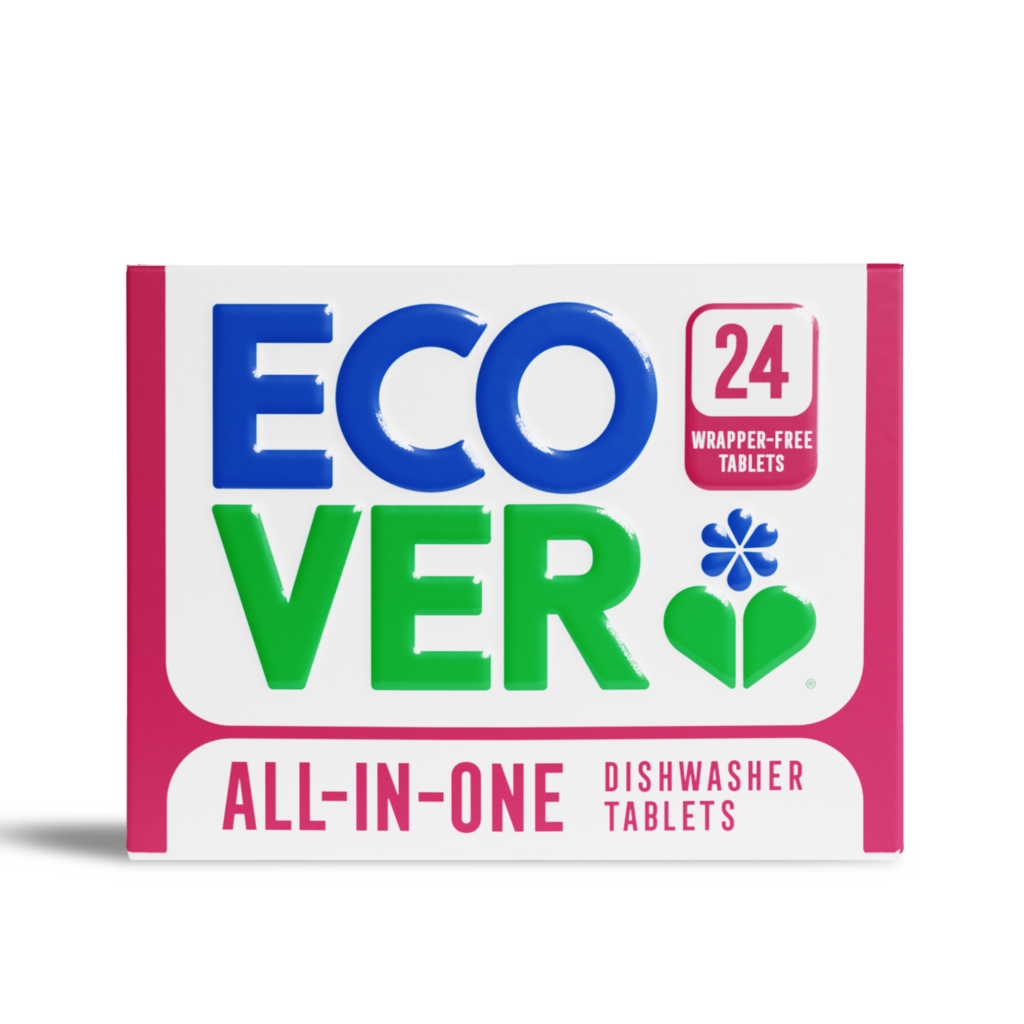
1. Ecover Wrapper Free All in One, 45 tablets
★★★★☆ 3.6 / 5
Two things separate this from everything else on the shelf. It publishes a full named ingredient list on an unrestricted website, which is what the detergents regulation requires and which four of the six here do not do. And it is the only product in the comparison with no water soluble film around the tablet at all.
That second point matters more than it sounds. Almost every tablet on sale is wrapped in polyvinyl alcohol, a film that dissolves in the wash. There is a live scientific argument about whether it fully biodegrades in wastewater treatment, and the honest summary is that it is contested: a 2021 paper concluded that around 77 per cent passes through untreated, but that paper was funded by a competitor selling a plastic free product, an expert panel scored its methodology 3.9 out of 10, the American EPA declined its central petition in 2023, and the standard OECD figures put degradation nearer 80 per cent. Ecover sidesteps the whole argument by not using a film. Nobody else in this group engages with it, and one brand markets itself on plastic free packaging while polyvinyl alcohol sits in its own published ingredient list.
Because the list is published, it is also one of only two products here where we can positively rule out benzotriazole. Ecover uses sodium thiosulfate for silver protection instead. The cost is the obvious problem: 24p a tablet at the best price we found, and 33.3p at Sainsbury’s list price, which is 4.4 times the Aldi tablet.
Pros
- Full named ingredient list published on an unrestricted website, as the regulation requires
- The only tablet here with no polyvinyl alcohol film, so the whole wrapper argument does not apply
- Benzotriazole and tolyltriazole positively ruled out, with sodium thiosulfate used for silver protection instead
- Warning and H319 rather than the Danger and H318 carried by the market leader
- A genuine environmental position rather than a claim, because the packaging change is visible
Cons
- 24p a tablet at best and 33.3p at Sainsbury’s list, up to 4.4 times the cheapest tablet here
- Publishes no water hardness ceiling, so you cannot tell when you need to add salt
- Availability is patchy outside the bigger supermarkets and specialist sites
- Wrapper free tablets are more fragile in the box and can crumble
- Cleaning performance in independent testing is respectable rather than class leading
Buy it if you want to know exactly what is in it, you want no film, and the difference of about 16p a wash against Aldi is worth that to you.
Best certified
Full INCI
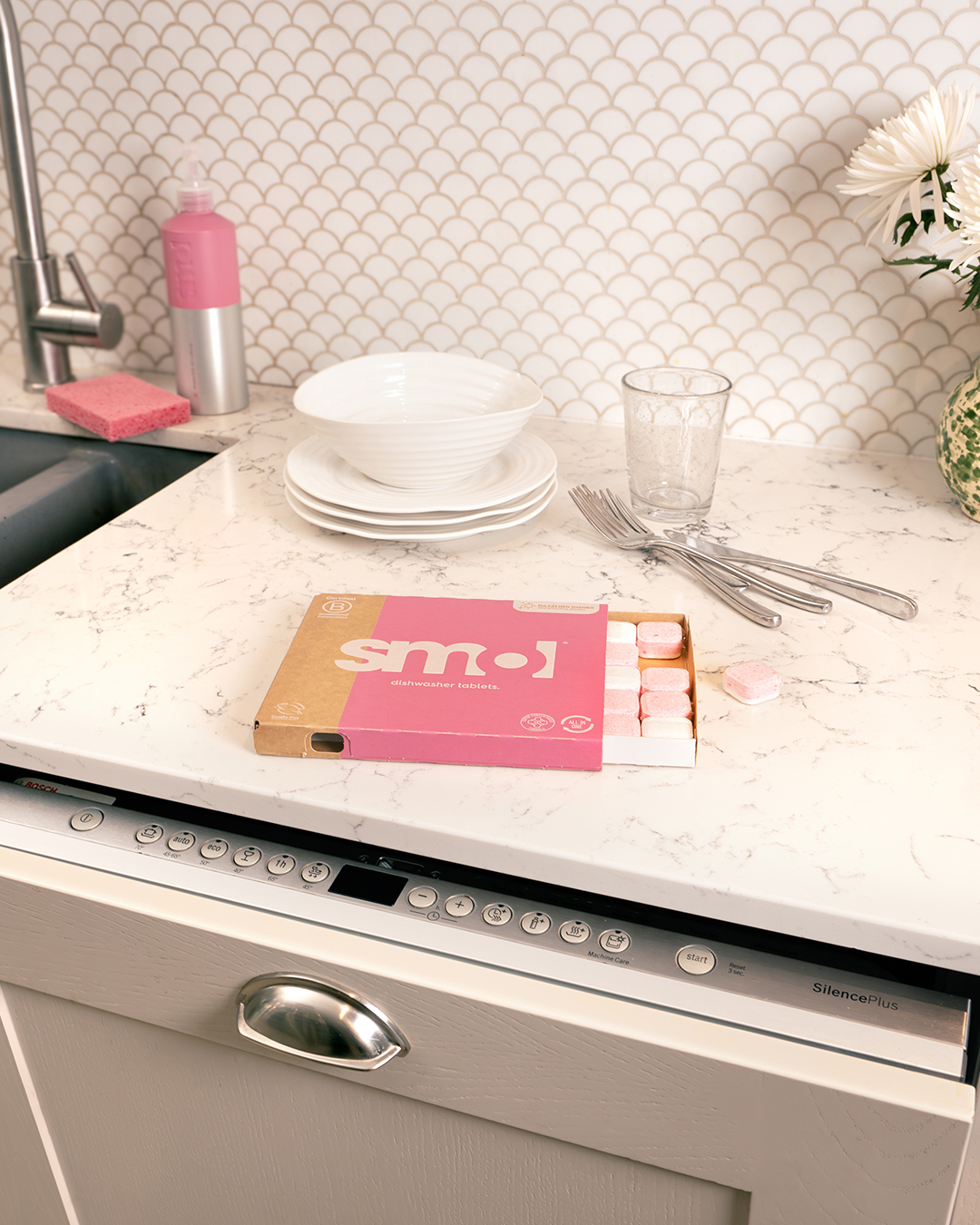
2. smol Dishwash, 30 tablets
★★★★☆ 3.5 / 5
The other one of the two that publishes properly. smol has a dedicated ingredients page with a full named list, which is how we were able to establish that its silver protection is zinc acetate rather than benzotriazole. Two products out of six can be cleared on that question. The other four simply cannot be assessed, and German market testing found benzotriazoles in eleven of twelve tablets it analysed at 2 to 66 milligrams each.
At 21.7p a tablet on subscription it undercuts Ecover, and the cardboard packaging is genuinely minimal. It is a certified B Corp with a published score, which is a checkable credential rather than a logo.
The awkward bit is the plastic free claim. smol markets 100 per cent plastic free packaging, and the box genuinely is. But polyvinyl alcohol appears in its own published ingredient list, which is the film around the tablet, and that is a plastic by most people’s understanding of the word even if it dissolves. We are not calling that dishonest, because the claim is about packaging and the film is arguably part of the product, but it is exactly the sort of distinction a shopper will not make. It also publishes no water hardness ceiling, so you get no guidance on when the all in one function stops being enough.
Pros
- Full named ingredient list on a dedicated page, one of only two here
- Benzotriazole ruled out, with zinc acetate used for silver protection
- 21.7p a tablet on subscription, cheaper than Ecover
- Certified B Corp with a published impact score and date
- Genuinely minimal cardboard packaging with no plastic outer
Cons
- Markets 100 per cent plastic free packaging while polyvinyl alcohol sits in its own ingredient list as the tablet film
- No water hardness ceiling published, so no guidance on when you need salt
- Subscription only, so you cannot pick one up when you run out
- Its own site claims a Trustpilot score that does not match Trustpilot today
- 30 tablets is a small box, so deliveries are frequent
- No independent group test has assessed its cleaning performance
Buy it if you want a published ingredient list and a certification you can look up, and a subscription suits how you shop.
The cheapest, and the British one
Cheapest by far
7.5p a wash
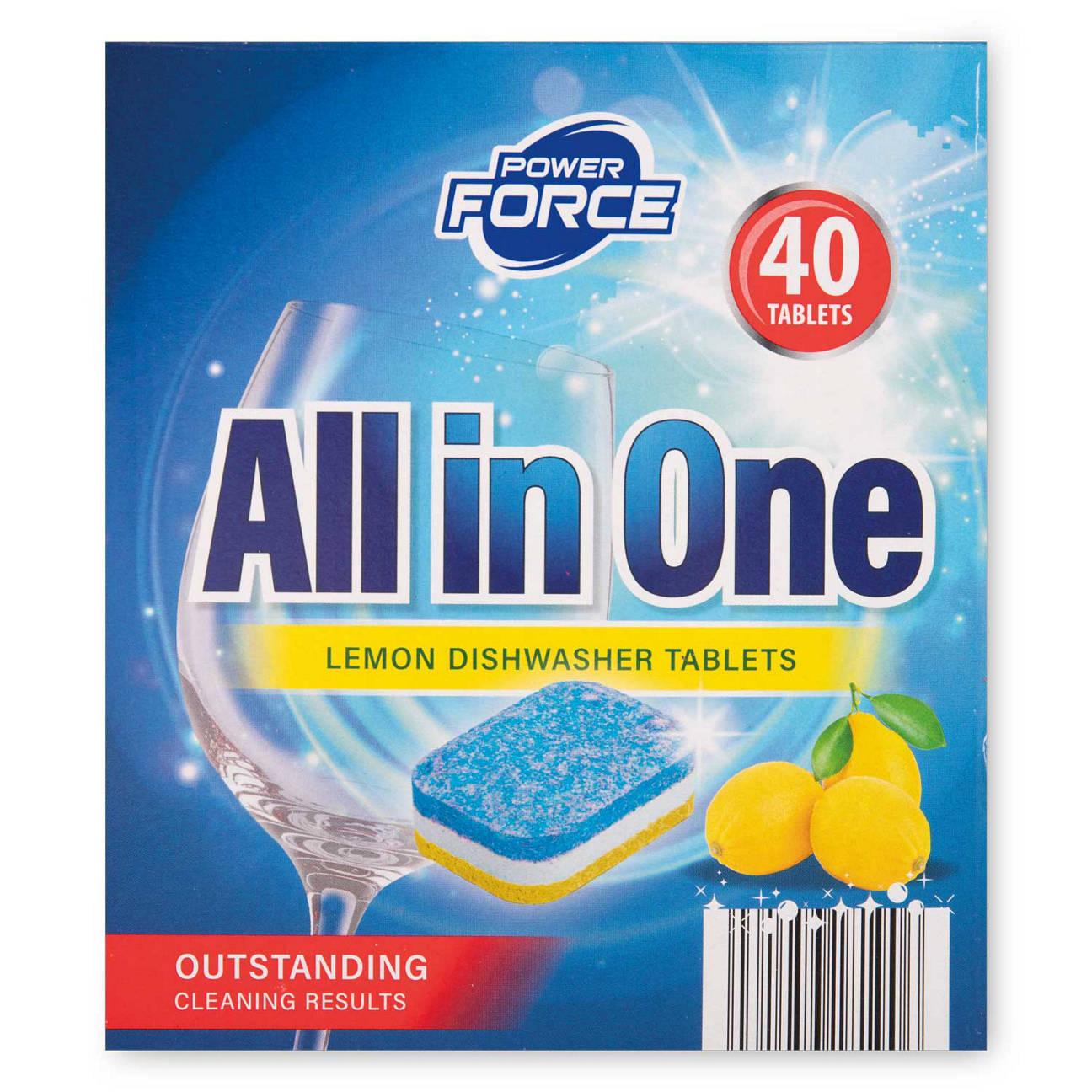
3. Aldi Power Force All in One Lemon, 40 tablets
★★★☆☆ 3.3 / 5
£2.99 for forty tablets, which is 7.5p a wash. The Ecover at Sainsbury’s list price is 4.4 times that. Over a year of daily use the difference between this and the most expensive tablet here is roughly £80, for a job that in independent testing the own brands do perfectly well.
Note the rebrand while you are shopping. Aldi has renamed this line from Magnum to Power Force on the same product page, and the price comparison sites still show Magnum listings as out of stock everywhere, which makes it look discontinued when it is not.
The reason it is third rather than first is that Aldi publishes nothing. Not a full ingredient list, not the label bands, not a CLP classification. Nothing. So there is no way to know whether it contains benzotriazole, what the surfactant system is, or what hazard warnings the box carries until it is in your kitchen. It also publishes no water hardness ceiling, which matters because London and much of the South East sits above the level at which appliance makers say you need separate salt. On our five pillars it wins the cost one outright and cannot be scored on three of the others.
Pros
- 7.5p a tablet, less than a third of the cost of everything else here except Finish
- Roughly £80 a year cheaper than the most expensive tablet in this comparison for daily use
- Independent testing consistently finds own brand tablets clean as well as branded ones
- Widely available, and Aldi stock levels on it are good since the rebrand
Cons
- Aldi publishes no ingredient information of any kind, not even the label bands the regulation requires
- No CLP hazard classification published online, so you cannot see the warnings before buying
- Benzotriazole and tolyltriazole cannot be ruled out or confirmed
- No water hardness ceiling published, so no guidance on when the all in one claim runs out
- Recently rebranded from Magnum, which makes it look discontinued on comparison sites
- No refill or reduced packaging option
Buy it if price is the deciding factor, your water is soft to moderately hard, and you are content not to know what is in it.
Most honest about hard water
Made in Yorkshire

4. Bio-D Eco Dishwasher Tablets, 30 tablets
★★★☆☆ 3.2 / 5
Bio-D does the one thing no other brand in this comparison will do: it tells you to use salt and rinse aid in a hard water area, rather than pretending its tablet has made those obsolete. Given what the appliance manufacturers say, which is set out in the guide below, that is straightforwardly the correct advice and it costs Bio-D a sale of the convenience story everyone else is selling.
It is also the only brand here that names the polymer in its tablet film and makes a biodegradability claim about it specifically, rather than either ignoring the question or marketing around it. Made in the East Riding of Yorkshire by a certified B Corp with a published impact score, and available in a 200 tablet box that brings the cost down to 21.8p.
The weakness is the same one that runs through the whole Bio-D range: label bands rather than a full ingredient list, so benzotriazole cannot be ruled out, and no CLP classification published online. For a brand built on transparency, that gap keeps showing up.
Pros
- The only brand here that tells you to use salt and rinse aid in hard water rather than claiming you do not need to
- Names the polymer in its tablet film and addresses biodegradability directly
- Certified B Corp with a published impact score, made in the East Riding of Yorkshire
- The 200 tablet box brings the cost to 21.8p, competitive with smol and Ecover
- A real refill and bulk option rather than a subscription
Cons
- Label bands only, so no full ingredient list and benzotriazole cannot be ruled out
- No CLP hazard classification published online
- 27.2p a tablet on the 30 pack, over three times the Aldi price
- The 200 pack is a £43.67 outlay in one go
- Mostly sold direct or through independents
- No independent group test has assessed its cleaning performance
Buy it if you have hard water and you would rather buy from the one maker in this group that tells you the truth about it.
The two big brands
Best branded price
Agrees with Bosch
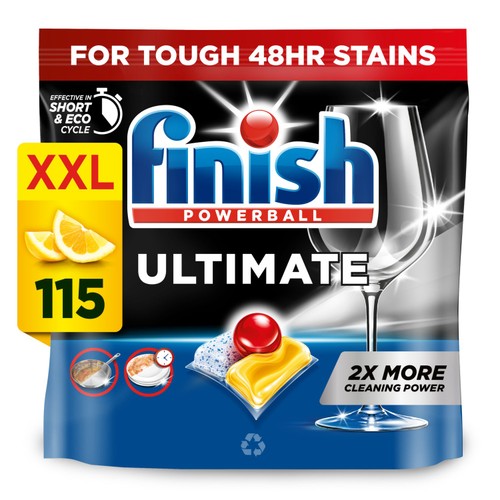
5. Finish Ultimate All in One Lemon, 75 tablets
★★★☆☆ 3.0 / 5
Finish deserves credit for one thing that nobody else here manages: it publishes a water hardness ceiling. Its pack states the salt function works up to 26 degrees Clarke. Bosch’s own manual says salt is still required above 21 degrees German hardness, which converts to 26 Clarke. Those are the same number. So the market leader and a major appliance maker actually agree on where the all in one claim runs out, and Finish is the only brand in this comparison that tells you.
It is also the cheapest branded option at 17.3p a tablet at Asda, though that requires shopping around: the same 75 pack sells at six different prices at six retailers on the same day, from £13.00 to £19.50. That is a fifty per cent spread on an identical box, and it is the single strongest argument for checking before you buy rather than picking up whatever is on the end of the aisle.
On disclosure it fails. Finish.co.uk has no ingredients page at all, and Reckitt’s portal serves a broken application shell that returns nothing without an account. Annex VII requires an unrestricted ingredient data sheet. There is no route to one. That means benzotriazole cannot be ruled out, which given German testing found it in eleven of twelve tablets is a real gap rather than a technicality.
Pros
- The only brand here that publishes a water hardness ceiling, at 26 degrees Clarke, which matches what Bosch says
- 17.3p a tablet at Asda, the cheapest branded option
- The most tested and iterated formula in the category, with a very large user base
- Warning and H319 rather than the Danger and H318 on Fairy
Cons
- No ingredient data sheet reachable anywhere: finish.co.uk has no ingredients page and Reckitt’s portal returns an empty shell
- Benzotriazole and tolyltriazole cannot be ruled out
- The same 75 pack sells from £13.00 to £19.50 across six retailers on the same day
- Polyvinyl alcohol film with no engagement with the biodegradability question
- 2.3 times the cost of the Aldi tablet for a job independent testing says own brands do well
- The Ocado score of 3.9 against 4.9 elsewhere on the same formula is unexplained
Buy it if you want a branded tablet, you have hard water and value the published ceiling, and you will shop around on price.
Most hazardous label
Danger, H318
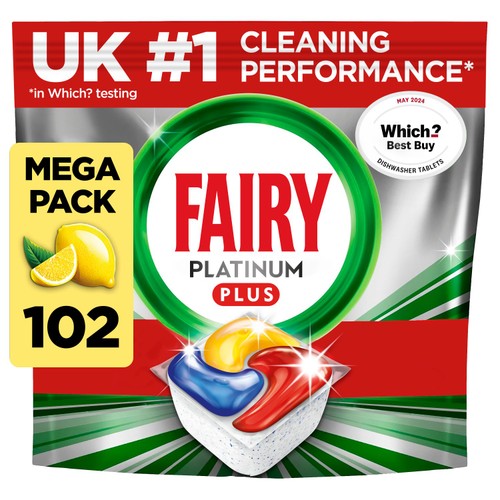
6. Fairy Platinum Plus All in One, 71 tablets
★★★☆☆ 2.7 / 5
Fairy Platinum Plus is the only product in this comparison classified Danger rather than Warning, carrying the corrosion pictogram and H318, causes serious eye damage. Every other tablet here that publishes a classification carries the milder H319, causes serious eye irritation. That is a meaningful difference and it belongs on the front of your mind if these live in a low cupboard.
It matters more than usual in this category because of where the harm actually happens. UK poisons data published in 2020 covering 1,548 enquiries about dishwashing tablets found that soluble film tablets produced symptoms in under fives 28.2 per cent of the time against 19.1 per cent for traditional pressed tablets. The film makes a tablet more attractive to a small child and more likely to release its contents in the mouth. So the wrapper is a child safety question as well as an environmental one, and this is the tablet with the most serious classification behind that film.
On disclosure, P and G at least points at the correct portal and cites the regulation by name, which is more than Reckitt manages, but the UK product page returns an empty payload so there is still no list to read. At 22.5p a tablet it is three times the Aldi price, and it is sold in thirteen different pack counts across four retailers, which makes comparing it on shelf close to impossible.
Pros
- A well regarded cleaning performance with a large and loyal user base
- P and G points at the correct Annex VII portal and cites the regulation by name
- Widely stocked, and frequently on multibuy promotion
- Good at the specific things it markets, including baked on grease
Cons
- The only tablet here classified Danger with the corrosion pictogram and H318, causes serious eye damage
- The UK product page on the ingredient portal returns an empty payload, so no list is actually readable
- Benzotriazole and tolyltriazole cannot be ruled out
- 22.5p a tablet, three times the Aldi price
- Sold in thirteen different pack counts across four retailers, which defeats shelf comparison
- Publishes no water hardness ceiling, unlike its direct competitor
- Polyvinyl alcohol film, with UK poisons data showing higher symptom rates in under fives from film tablets
Buy it if you are committed to the brand and you store it high up, out of reach, having read the classification above.
Prices checked 5 August 2026 and may have changed since.
The clean pick, and the honest catch
Our clean pick
Ecover Wrapper Free
No film, a published list, and the silver protection actually named
Why it wins on ingredients
✓
There is no plastic film
✓
The ingredient list is published and readable
✓
Benzotriazole ruled out, not just unmentioned
✓
The milder hazard classification
What you give up
✕
It is up to 4.4 times the price
✕
No water hardness ceiling
✕
No independent cleaning test
The catch, said plainly. Our rule is that if a category has a genuinely clean option we name it, and here there is one, with a large qualification. Almost the entire environmental case for a premium tablet rests on the wrapper argument, and that argument is not settled. The most cited paper claiming polyvinyl alcohol survives treatment was funded by a competitor selling a plastic free alternative, an expert panel scored its methodology 3.9 out of 10, and the American EPA declined its central petition. The clearest rebuttal compilation, meanwhile, is hosted by Tide, which is equally interested. Nobody in this comparison engages with any of it. The better documented point is the child safety one: UK poisons data covering 1,548 enquiries found soluble film tablets produced symptoms in under fives 28.2 per cent of the time against 19.1 per cent for pressed tablets. If there are small children in the house, that is a stronger reason to avoid film than anything about wastewater.
What to look for when you buy one
Work out the price per tablet, because nothing else on the shelf is comparable. These are sold in counts from 24 to 200, on rolling multibuys, at prices that move weekly. Tesco, Asda and Ocado print the unit price on three different bases: per kilogram, per tablet and per item. Fairy alone is sold in thirteen different pack counts across four retailers. Divide the price by the number of tablets and the range in this comparison runs from 7.5p to 33.3p for products doing the same job. That is roughly £27 against £120 for a year of daily washing.
Shop around on the same box, because the spread is enormous. The same 75 pack of Finish sold at six different prices at six retailers on the same day, from £13.00 to £19.50. That is a fifty per cent difference on an identical product, and it is not a sale versus full price, it is just how this category is priced. Thirty seconds on a comparison site is worth more than choosing a different brand.
The all in one claim quietly expires in hard water, and only two brands will tell you. This is the most useful thing in this article. Bosch’s own manual states that separate dishwasher salt is still required above 21 degrees German hardness, which is 26 Clarke, 37 French or 3.7 millimoles per litre. Finish’s own pack says its salt function works up to 26 degrees Clarke. Those are the same number, so the appliance maker and the market leader agree exactly on where the convenience story runs out. The problem is that four of the six brands here publish no ceiling at all, and large parts of London and the South East sit above it. If your water is hard, you need salt and rinse aid regardless of what the box says, and Bio-D is the only brand in this group that volunteers that.
Check your water hardness before anything else. Your water company publishes it by postcode and it is free to look up. Then set the water softener setting inside your dishwasher to match, which is a menu almost nobody touches. There is a well documented case of a user blaming white residue on an eco brand when the actual cause was the machine’s softener set to the wrong hardness. A branded tablet can mask a badly configured machine. It does not fix it.
Ask what protects the silver, because the answer is usually benzotriazole and usually unstated. Dishwasher detergents contain a metal protection agent to stop cutlery tarnishing and to protect the machine. The common ones are benzotriazole and tolyltriazole, which are persistent and an aquatic toxicity concern. German researchers found them in eleven of twelve tablets tested at 2 to 66 milligrams a tablet, and a Danish Consumer Council review of forty products found benzotriazole in seven. In this comparison only two brands publish enough to rule it out, using sodium thiosulfate and zinc acetate instead. For the other four it is simply unknowable.
Read the hazard classification, because one of these is not like the others. Most tablets here carry Warning and H319, causes serious eye irritation. One carries Danger, the corrosion pictogram and H318, causes serious eye damage. Two publish no classification online at all. These live in kitchen cupboards, often at child height, and the UK poisons data is specific: 1,548 enquiries about dishwashing tablets, with soluble film tablets producing symptoms in under fives 28.2 per cent of the time against 19.1 per cent for pressed tablets. The film is part of the hazard, not just the packaging.
Treat the plastic free claims carefully in both directions. The wrapper on almost every tablet is polyvinyl alcohol. Whether it biodegrades in wastewater treatment is contested and both sides are funded: the paper claiming 77 per cent passes through untreated came from a company selling a plastic free product and was scored 3.9 out of 10 by an expert panel, while the most convenient rebuttal compilation is hosted by Tide. Standard OECD figures put degradation nearer 80 per cent. Meanwhile one brand here markets 100 per cent plastic free packaging while listing polyvinyl alcohol in its own ingredients, which is defensible and still misleading. The only product that settles the argument is the one with no film.
Use the eco cycle, and stop pre rinsing. Which? measured 8.88 litres and £52.13 a year on eco, 10.79 litres and £71.01 on the main programme, and 10.46 litres and £73.93 on quick wash. Read that last one again: the quick wash cleans worst at 74 per cent against 83, and costs the most. Eco takes longer because it heats more slowly, which is exactly why it uses less energy. Scrape plates rather than rinsing them, because modern detergents need something to work on and the enzymes are designed for it.
And do not assume the expensive tablet cleans better. Which? group tested fifteen detergents in April 2026 with scores ranging from 26 to 83 per cent, so the spread within the category is real, but every independent test we could find that included supermarket own brands put at least one of them in the top half. On this page the cheapest tablet is a quarter the price of the dearest, and the difference you can actually verify is in what the makers are willing to tell you, not in what comes out of the machine.
Final verdict
Check your water hardness, then buy on price per tablet
Three things to take away.
The first is that price per tablet is the only comparison that means anything here, and the industry has made it hard on purpose. Thirteen pack counts across four retailers for one brand, three different unit price bases across three supermarkets, and a fifty per cent price spread on an identical box on the same day. Divide by the number of tablets and the range is 7.5p to 33.3p, which is about £27 against £120 a year.
The second is that the all in one promise has a limit and almost nobody prints it. Bosch says you still need salt above 26 degrees Clarke and Finish says its salt function works up to 26 degrees Clarke. They agree. Four of the six brands here say nothing at all, and if you are in a hard water area that silence is costing you a machine. Look up your hardness by postcode, set the softener inside the dishwasher to match, and add salt if you need it.
The third is that four of six will not tell you what is in the tablet. Two ingredient portals return broken shells and one supermarket publishes nothing whatsoever. That is why we can only rule out benzotriazole on two of the six, and why the two products that publish properly finish first and second even though they are not the cheapest.
Our pick is the Ecover Wrapper Free if you want the full list and no film, and the Aldi Power Force at 7.5p if you are buying on price and are content not to know. Either way, use the eco cycle and stop pre rinsing.