Home · Living room · Air and damp
Best dehumidifiers: six tested on damp, on noise and on what they do to the air
A dehumidifier is bought to stop black mould and dry the washing, but the reason it matters is that it changes the air your family breathes for months at a time. We ranked six on extraction, on running cost, on how quiet they really are, and on whether the filter does anything for your lungs or just protects the coil.
By Mrs House · Updated 9 September 2026 · 16 minute read
Mrs House is independent. Nobody pays for a place in a ranking here, and no brand saw this page before it went live.
The short answer
Buy the MeacoDry Arete Two 12L at around £199.99. It is the only unit here with a stated H13 HEPA filter, no ioniser and a humidistat accurate enough to hold a bedroom at 45 to 50 per cent.
- Best overall: MeacoDry Arete Two 12L, £199.99. 35 decibels on its lowest speed and about 3.5p an hour to run.
- Cold or unheated rooms: EcoAir DD1 Simple MK3, about £199.98. Desiccant, so it still works near freezing when no compressor unit will.
- Best budget: Pro Breeze 12L, £114.99. Holds a room at 50 per cent perfectly well, with a plain dust filter rather than a HEPA.
Check the temperature of the room before you check the price, because that is what decides compressor or desiccant.
How we assessed these
Six dehumidifiers, one method, applied in the same order to all of them.
We started with the extraction curve rather than the number on the box. Every dehumidifier in Britain is sold on a litres per day figure measured in a test chamber at 30 degrees and 80 per cent relative humidity, which is a condition that does not occur in a British home. Meaco publish their whole curve, and it is worth knowing what it looks like. The Arete Two 12L pulls 11.99 litres a day in the test chamber, 5.40 litres at 20 degrees and 60 per cent, and 1.97 litres at 10 degrees and 60 per cent. Expect a third to a half of the headline number in a real winter room, and size up accordingly.
Then we looked at the filter, because this is where the health claims live and where most brands say nothing at all. A plain mesh screen exists to stop fluff reaching the coil. It does nothing for your lungs. Only one machine here publishes a filter grade you can hold the manufacturer to.
Then ionisers, which we treat as a mark against a machine rather than a feature. Ionisers emit ozone as a by product, ozone is a lung irritant with no established safe level for asthmatics, and they can react with terpenes from air fresheners and cleaning sprays to form secondary ultrafine particles indoors. We checked every specification sheet individually.
Then noise, measured in decibels at the lowest setting, because a dehumidifier that cannot go in a bedroom is not solving the bedroom problem. And running cost, calculated at 26p per kilowatt hour. Check the live unit rate before you take those pence per hour figures literally.
Prices were read in September 2026 and this category moves a lot between September and January.
The ranking, at a glance
| Machine | Price | Type | Filter | Noise (low) | Score | |
|---|---|---|---|---|---|---|
| 1 | MeacoDry Arete Two 12L | £199.99 | Compressor | H13 HEPA, no ioniser | 35 dB | 4.7 / 5 |
| 2 | MeacoDry Arete One 20L | £259.99 | Compressor | H13 HEPA, no ioniser | 38 dB | 4.5 / 5 |
| 3 | EcoAir DD1 Simple MK3 | £199.98 | Desiccant | Silver Nano mesh, no ioniser | 34 dB | 4.4 / 5 |
| 4 | Pro Breeze 12L | £114.99 | Compressor | Dust filter only, no ioniser | 38 dB | 4.2 / 5 |
| 5 | Ebac 3650e 18L | About £250 to £300 | Compressor | Carbon, no ioniser | 46 dB | 4.0 / 5 |
| 6 | De’Longhi AriaDry Multi 16L | £299.99 RRP | Compressor | Three stage allergen | 50 dB | 3.8 / 5 |
The two we would actually buy
Best overall
Our winner
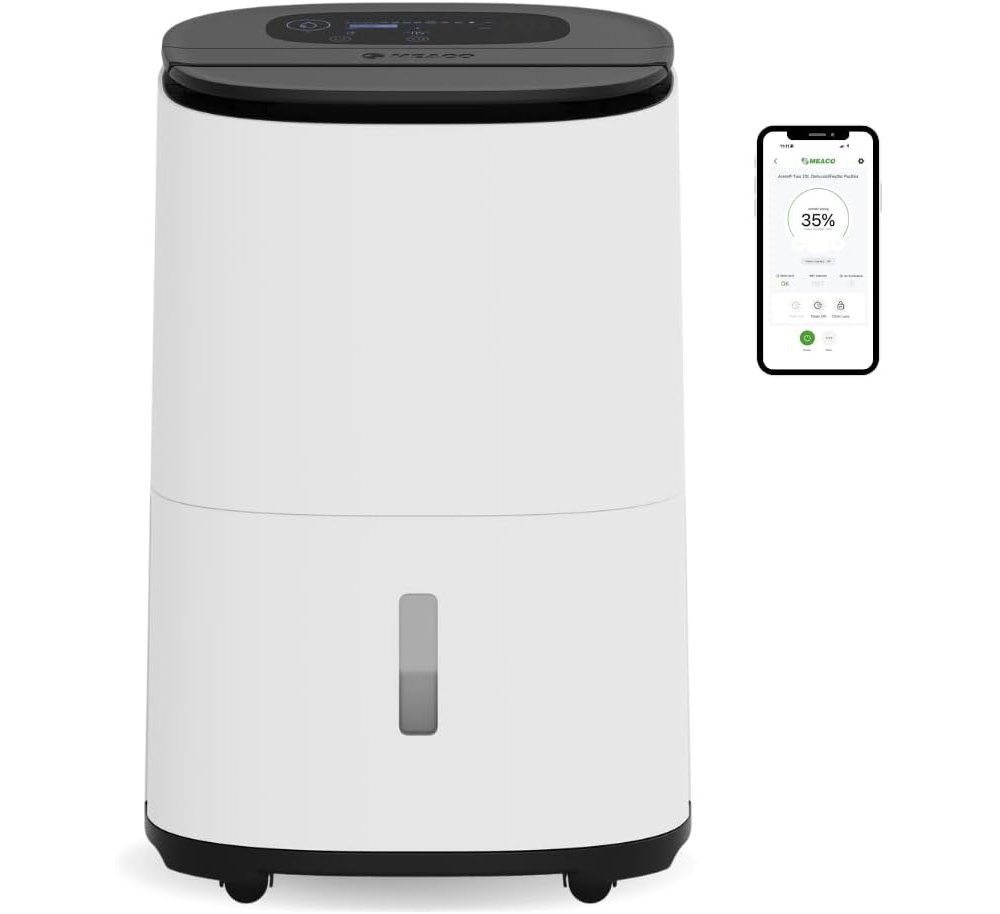
MeacoDry Arete Two 12L
★★★★★ 4.7 / 5
This wins on the thing almost nobody checks, which is the filter. Every dehumidifier has something in front of the coil. On most machines it is a plastic mesh whose only job is stopping fluff getting into the works. The Arete Two has a washable coarse pre filter and, behind it, a genuine EN 1822 H13 HEPA element. That is the class that captures mould spores, which run roughly 2 to 10 microns, along with pollen and dust mite allergen fragments. Meaco are the only brand here who publish a filter grade you can hold them to.
On accuracy, H13 is rated 99.95 per cent at the most penetrating particle size under the European standard. You will see 99.97 per cent quoted, including on Meaco’s own packaging, and that is the American definition at 0.3 microns. Both numbers are defensible, they just come from different standards.
It is quiet enough to sleep next to. Thirty five decibels on the lowest fan speed and Quiet Mark certified, which is roughly the level of a quiet library. Two independent testers went further than the datasheet: one called it amazingly quiet, another measured 32 decibels with a meter while it was drying laundry. A verified B and Q buyer of this exact model wrote that the noise was far quieter than expected, to the point of barely noticing it was on.
It is also cheap to run and genuinely fast. One hundred and thirty six watts at 20 degrees and 60 per cent relative humidity, which works out at about 3.5p an hour, or roughly 85p for a full 24 hours if it never cycled off. It will. Testers cleared bathroom condensation in half an hour and dried two full airers overnight. For context, running a tumble dryer costs somewhere around 85p an hour.
The reason all of that matters more than the litre rating is the humidistat. You can set a target across 40 to 70 per cent and it will hold it. That is the active ingredient here, because dust mites absorb water vapour straight out of the air rather than drinking, and sustained humidity below roughly 50 per cent means they cannot maintain their water balance and the population declines. Dust mite allergen is one of the strongest asthma triggers in British homes. Being able to hold a bedroom at 45 to 50 per cent all winter is worth more than any filter.
The complaints are ergonomic rather than functional. It is 10.9kg, which is a job to get upstairs, and one reviewer specifically criticised the pull up carry handle. Purifier mode runs at one fan speed only. And the tank will need emptying often for the first few days until the house dries out.
Pros
- A stated EN 1822 H13 HEPA element plus a washable pre filter. Nothing else here publishes a grade
- No ioniser anywhere on the machine, so no ozone by product
- Thirty five decibels on low and Quiet Mark certified, so it can genuinely live in a bedroom
- About 3.5p an hour to run, and Meaco publish the full extraction curve rather than one flattering number
- Five year warranty, Wi-Fi and app control, and a humidistat that actually holds its target
Cons
- At 10.9kg it is heavy, and the carry handle is not well integrated
- Purifier mode has a single fan speed, so you cannot run it harder independently
- The 2.5 litre tank fills fast in the first days of use
- It is a compressor unit, so it falls off badly in a room below about 5 degrees
- Two hundred pounds is a lot, and the customer review base for this exact model is still thin
Buy it if you want one machine that dries the house and cleans the air, and it has to be quiet enough for a bedroom. Skip it if the room you need it in is an unheated garage or outbuilding.
Best for a whole house
Bigger sibling
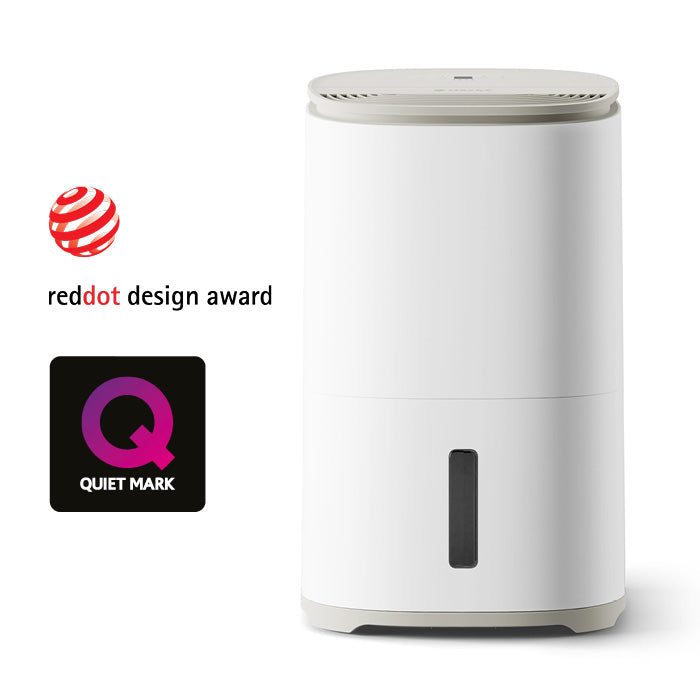
MeacoDry Arete One 20L
★★★★★ 4.5 / 5
Same filter, same absence of an ioniser, same five year warranty, more capacity. If you have a three or four bedroom house where the damp is being generated by four or five people breathing, showering and drying washing indoors, the 12L will run flat out and never quite get there. This one will.
Twenty litres a day rated, 4.8 litre tank so far fewer trips to the sink, and 216 watts at 20 degrees and 60 per cent, which is about 5.6p an hour. Meaco rate it for up to a four bedroom home and testers put the maximum room size around 75 square metres. One reviewer described it as perfect for laundry drying and singled out that it adjusts power and fan speed automatically rather than sitting at one setting.
It is quiet for its size. Thirty eight decibels in night mode, 40 standard, 50 in laundry mode, Quiet Mark certified and a Red Dot design award for the way it looks, which we mention only because it is the one dehumidifier here you would not mind seeing in a hallway.
Two honest warnings. It is 15kg and reviewers who tested a 20L Arete described it as difficult to move even with castors. And the bigger tank is a mixed blessing for hygiene. Four point eight litres of condensate at room temperature will sit for longer in a household that is not diligent, and standing water in a warm plastic tank is where biofilm and musty smells come from. If you can run a hose to a drain, do it on this machine specifically.
The other thing to know is that the One is the older platform. In the 12L size the newer Arete Two costs less and adds Wi-Fi and a better display. It is only at 20L, where the Two gets considerably more expensive, that the One makes obvious sense.
Pros
- Same H13 HEPA filter and no ioniser, in a machine sized for a four bedroom house
- Big 4.8 litre tank means far fewer trips to the sink
- Adjusts fan and power automatically rather than running at one speed
- Thirty eight decibels in night mode, Quiet Mark certified
- Five year warranty, which is unusually long in this category
Cons
- Fifteen kilos, and testers found it hard to move even on castors
- Compressor design, so unsuitable for rooms below about 5 degrees
- The larger tank means more standing water if you do not empty it daily
- The older platform. In 12L the newer Arete Two costs less and does more
Buy it if you have a three or four bedroom house with damp across all of it, not one problem room. Skip it if you only need to fix one bedroom, in which case the Arete Two is cheaper and better.
The wool one, and the one for a child’s bed
Best for cold rooms
Desiccant pick
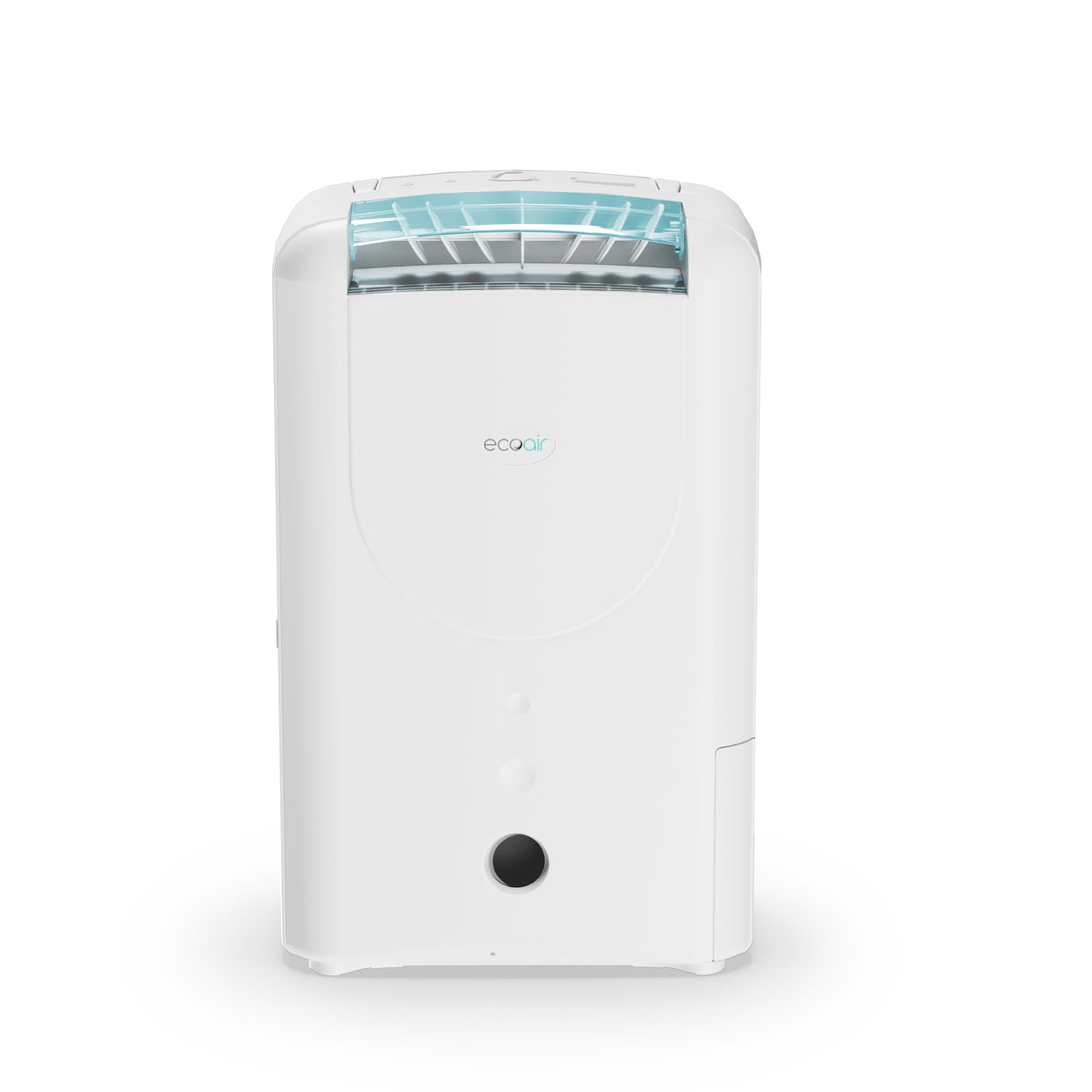
EcoAir DD1 Simple MK3
★★★★☆ 4.4 / 5
Read this bit before you buy anything else on this page. A compressor dehumidifier is a fridge running backwards. It chills a coil below the dew point so water condenses onto it and drips into the tank. In a cold room there is much less moisture in the air to condense out and the coil starts icing over, so the machine spends its life defrosting instead of drying. Below about 5 degrees most of them give up. If your problem is a garage, a workshop, a conservatory, a caravan, a boat or a freezing spare room in a solid wall Victorian house, no compressor on this page will fix it.
A desiccant works completely differently. Air passes over a rotating zeolite wheel that pulls water vapour straight out of it, and a small internal heater then drives that water off the wheel to condense into the tank. Nothing is being chilled, so it keeps working down to about 1 degree with almost no drop off. This one is confirmed running at 1 degree.
It is also the lightest thing here at 6kg, against 10.9kg for the Arete Two and 15kg for a 20L compressor, which is the difference between carrying it upstairs and dreading it. And it is the quietest machine in this whole comparison on its low setting, at 34 decibels. It dries a full rack of laundry in about four hours.
Now the trade offs, and they are real. It costs three to four times as much to run: 300 watts on low and 580 on high, which is roughly 8p to 15p an hour against 3.5p for the Meaco. That heater is the reason. Over a wet winter that difference adds up to real money. It is loud on high at 47 decibels. The tank is only 2 litres, so at 7.5 litres a day that is three or four empties in 24 hours. And the exhaust air comes out warmed by around 10 to 12 degrees, which is lovely in a January garage and unwelcome in a bedroom in July.
The filter is a Silver Nano antibacterial mesh, not a HEPA, and we are not going to pretend otherwise. It is better than a bare plastic screen but it will not capture mould spores or fine allergen the way an H13 element does. If your driver is asthma rather than a cold damp room, buy the Meaco and, if you need both, run a separate purifier.
One warning that matters more than anything else in this entry. EcoAir sell the DD1 Classic MK6 right next to this one on their own site at £229.98. It looks like the same machine. It has a built in ioniser. This one does not. For anyone buying for asthma or respiratory health, that single word in the name is the whole decision. Buy the Simple.
Pros
- Works down to 1 degree, which no compressor on this page can do
- Thirty four decibels in quiet mode, the quietest low setting here
- Six kilos, so you can actually carry it between rooms
- No ioniser, so no ozone by product
- Three year warranty and a 30 day money back guarantee direct from EcoAir
Cons
- Expensive to run at 8p to 15p an hour, three to four times the Meaco
- Forty seven decibels on high, and it is noticeably louder than a compressor
- Only a 2 litre tank, so three or four empties a day at full output
- The Silver Nano filter is not a HEPA and should not be treated as one
- Exhaust air comes out 10 to 12 degrees warmer, which is a nuisance in summer
Buy it if the room is unheated. Garage, workshop, conservatory, caravan, boat, or a cold spare room. Skip it if the room is heated, in which case a compressor will do the same job for a third of the running cost.
Best budget
Best under £120
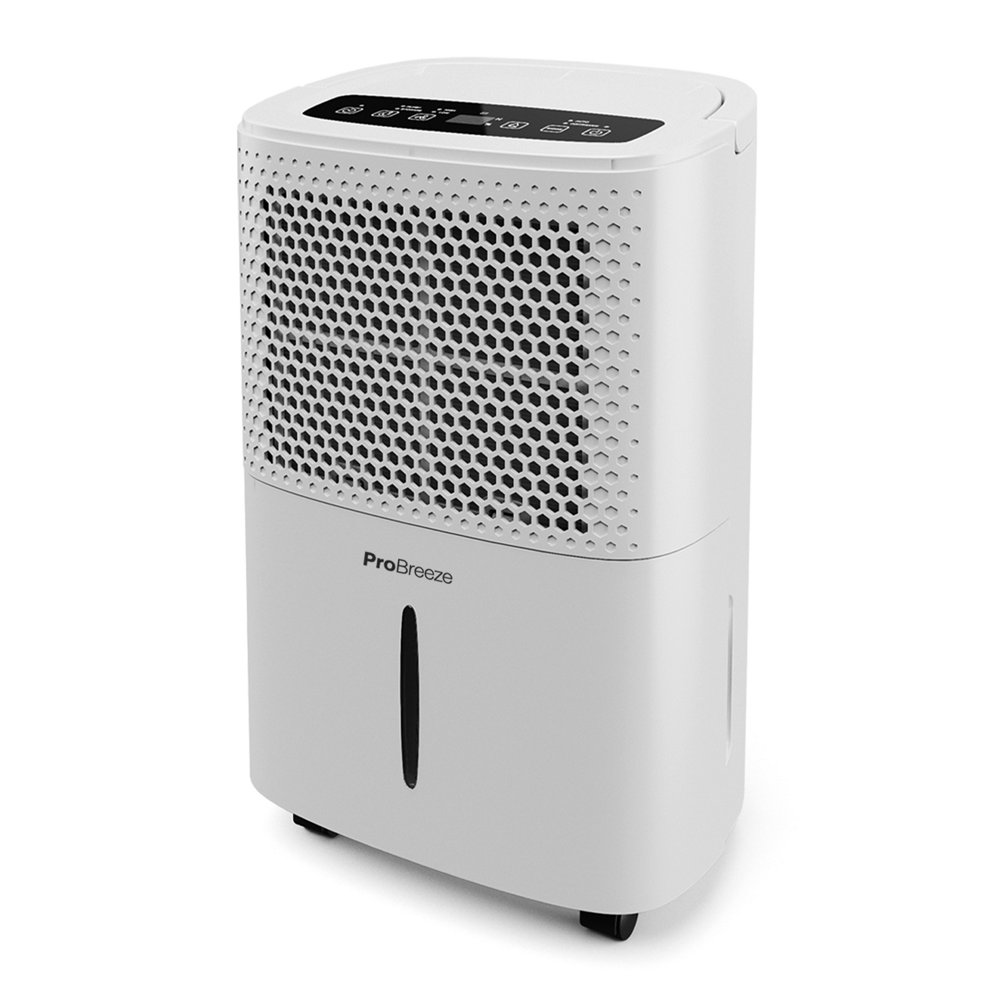
Pro Breeze 12L Low Energy Dehumidifier
★★★★☆ 4.2 / 5
A hundred and fifteen quid for a machine that will genuinely hold a room at 50 per cent relative humidity, with the continuous drainage hose in the box rather than sold separately. We would rather see somebody buy this than not buy anything, and a £114.99 machine that actually gets used will do more for a child’s asthma than a £300 one that never gets bought.
Twelve litres a day rated, 200 watts which works out at about 5.2p an hour, 38 decibels which is roughly a fridge hum and fine for most rooms though borderline for a light sleeper. There is no ioniser, which we checked on the specification sheet rather than taking on trust. Pro Breeze also tell buyers on their own listing to target 40 to 60 per cent relative humidity, which is exactly the right advice.
The hose being included is the best thing about it and most reviews miss why. Run it to a sink, a shower tray or a floor drain from day one and three things happen. You never empty a tank again, the machine never stops mid night because the tank filled, and there is no standing water sitting in a warm plastic box growing biofilm. On a machine with a 1.8 litre tank and a 12 litre a day rating, that last point is not academic.
What you give up is filtration. There is a washable dust filter and nothing else. It protects the coil. It will not capture mould spores or fine allergen. If your problem is condensation, black mould on the window reveals and a musty smell, this fixes the cause by removing the moisture and the filter does not matter. If your problem is hay fever or a pet allergy, this machine does not help with that at all.
Two honest caveats. There were no customer reviews at all on the retailer listing for this exact model when we checked, so the evidence here is the specification and the brand record rather than a wide review base. And on the brand record, buyers of the larger 20L sibling repeatedly complain that its humidity reading is out by as much as 20 per cent against other meters. That is the complaint worth carrying across, not the noise ones, since the 12L is rated ten decibels quieter and weighs half as much.
Pros
- A hundred and fifteen pounds for a machine that holds a room at 50 per cent
- Continuous drainage hose included in the box, which eliminates standing water entirely
- Two hundred watts, about 5.2p an hour, and 38 decibels
- No ioniser, confirmed on the specification sheet
- R290 refrigerant, which has a low global warming potential
Cons
- A plain dust filter and nothing more. No HEPA, no allergen stage
- No customer reviews on the listing for this exact model, so the evidence base is thin
- Only a two year guarantee against five from Meaco
- The 1.8 litre tank is small for a 12 litre a day machine if you do not use the hose
- Buyers of the larger sibling report the humidity reading being noticeably inaccurate
Buy it if you have a damp problem and a tight budget, and you will run the hose to a drain. Skip it if your reason for buying is allergy or asthma rather than damp.
The two we would not buy
Made in Britain
Hard to buy
Ebac 3650e 18L
★★★★☆ 4.0 / 5
Start with the problem, because it is the biggest thing about this entry. When we checked, every single domestic model on Ebac’s own site was listed as sold out, across the whole range, and the 3650e page carried no price at all. Ebac units do still turn up at Amazon, Currys and other third party sellers, and the comparable 18L model sits around £250 to £300. Check live availability before you set your heart on one. We have left it in the ranking because when you can get one it is a genuinely good machine, and because you deserve to know it exists.
Ebac make dehumidifiers in County Durham and have done for decades, and they supply the Ministry of Defence, London Underground and the Channel Tunnel. That is not marketing fluff, it is the reason these things are built like industrial kit rather than consumer appliances.
The interesting feature is Smart Control, which is more than a humidistat. Rather than simply switching off at a set number it learns the house and optimises when the machine runs. Ebac claim that saves up to £113 a year against a conventional unit. Treat that as a manufacturer claim, because it is one, but the underlying idea is sound and the measured draw is only 190 watts for 18 litres a day, which is efficient for the output.
It also goes colder than most compressors, down to 3 degrees against the usual 5, and it is rated for 360 cubic metres, three to four bedrooms and up to five occupants. Buyers of Ebac machines, though generally of the smaller models rather than this one, are consistently positive. One wrote that the amount of water it pulled out of the air was incredible and that they hoped it would help their daughter’s airways at night. Another said theirs was quiet enough to use in a bedroom, though that was a 15L unit.
Two things pull it down. Forty six decibels is the loudest rated figure of any compressor here and there are only two fan speeds, so there is no true quiet setting and it belongs on a landing rather than in a bedroom. And the accessories are nickel and dimed: on a machine at this price, both the permanent drainage kit and the castors are listed as bought separately. Charging extra for wheels on a 13kg appliance is poor. The filter is carbon as standard, with antibacterial and pollen filters as paid options, so it is not a HEPA machine out of the box.
Pros
- Made in Britain for decades and built accordingly, with a five year warranty
- Smart Control learns the house rather than just switching off at a set humidity
- Only 190 watts for 18 litres a day, which is efficient for the size
- Works down to 3 degrees, colder than most compressors
- No ioniser, and rated for a whole three or four bedroom house
Cons
- Every domestic model was sold out on Ebac’s own site when we checked
- Forty six decibels and only two fan speeds, so it is not a bedroom machine
- Castors and the permanent drainage kit are both extra cost accessories
- Carbon filter as standard. Antibacterial and pollen filters cost more
- Thirteen kilos with no castors in the box is an awkward combination
Buy it if you want a British made machine for a whole house and you can find one in stock. Skip it if you need it quiet, or you want it delivered this week.
Allergy certified
Only at a discount
De’Longhi Tasciugo AriaDry Multi DEXD216RF
★★★★☆ 3.8 / 5
This one earns its place on a credential nothing else here has. De’Longhi state the machine is certified by the Allergy Standards Foundation for asthma and allergy sufferers, which is a third party certification tested against a published standard rather than a phrase somebody wrote on a box. For a readership buying on health grounds that is a real signal and it is worth understanding what it means.
The filtration is three stage: a dust filter, a removable allergen filter and an active carbon filter. That is more stages than anything here except the Meacos. One important precision, though. De’Longhi do not state a HEPA class anywhere, so nobody should call this a HEPA machine, us included. It is a three stage filter with a dedicated allergen element. If you want a stated capture efficiency you can hold somebody to, the Meaco is the one with a number attached.
The clothes drying function is dedicated rather than just a higher fan speed, the continuous drain hose is in the box, and the casing uses a minimum of 30 per cent recycled plastic. It also looks better than most, which matters if it is going to live in a hallway.
The reason it finishes sixth is noise, and it is not marginal. Independent testing measured 50 decibels across every single setting on this model. There is no meaningful night mode. Fifty decibels is approaching normal conversation volume and decibels are logarithmic, so that is roughly twice as loud to the ear as the Meaco at 35. Sleep quality is part of respiratory health, so a machine that will not go below 50 decibels cannot be the health pick no matter what certificate it carries. Put it on a landing or in a utility room.
It is also power hungry for its output, drawing 290 watts for 16 litres a day against 216 watts for 20 litres from the Arete One, and the RRP of £299.99 is more than the bigger, quieter, better filtered Meaco. It discounts heavily and has been seen around £175, and at that price it makes sense. At full RRP it does not.
Pros
- Certified by the Allergy Standards Foundation, which nothing else here is
- Three stage filtration including a dedicated removable allergen element
- Continuous drain hose included, dedicated clothes drying mode
- No ioniser listed anywhere in the specification
- Made with a minimum of 30 per cent recycled plastic, and it looks the part
Cons
- Fifty decibels at every setting with no real night mode. Not a bedroom machine
- Two hundred and ninety watts for 16 litres a day is thirsty for the output
- No stated HEPA class, so the filtration cannot be compared like for like
- Two hundred and ninety nine pounds RRP is more than a bigger, quieter Meaco
- A very thin UK review base. Treat customer sentiment on this model as unproven
Buy it if the allergy certification matters to you and you find it discounted well below RRP. Skip it if it needs to go anywhere near a bedroom.
Prices checked 5 August 2026 and may have changed since.
The clean pick, and the honest catch
Our clean pick
MeacoDry Arete Two 12L
The only one that clears all four health tests
Why it wins on the air, not the water
✓
No ioniser, so no ozone
✓
A stated filter grade, which nobody else publishes
✓
Thirty five decibels, so it can live in a bedroom
✓
A humidistat that actually holds its target
What you give up
✕
Ten point nine kilos, and an awkward handle
✕
One fan speed in purifier mode
✕
It is a compressor, so cold rooms are out
The catch, said plainly. Neither reservation above touches the four things we actually judged this on, they are both ergonomic, and that is why it still wins. But there is one trap in this category that we want to flag hard, because it will catch people shopping on price. EcoAir sell the DD1 Classic MK6 at £229.98, sitting immediately next to the DD1 Simple MK3 on their own website. Near identical body, one word different in the name. The Classic has a built in ioniser. The Simple does not. If you are buying a dehumidifier because somebody in the house has asthma, that one word is the entire decision, so read the model name twice before you check out.
What to look for when you buy one
The litre rating is not what you will get
This is the most useful thing in this guide, so we have put it first. Every dehumidifier is sold on a litres per day figure measured in a test chamber, usually at 30 degrees and 80 per cent relative humidity, and that condition does not occur in a British home. Meaco publish their whole curve and it is stark. The Arete Two 12L pulls 11.99 litres a day at 30 degrees and 80 per cent, 5.40 litres at 20 degrees and 60 per cent, and 1.97 litres at 10 degrees and 60 per cent. One real buyer put it better than any spec sheet, saying a 20L machine at a room temperature of 19 degrees seemed to manage about 7 litres a day. Expect a third to a half of the headline number in a real winter room and buy accordingly.
How to size one
Seven to twelve litres a day is small capacity: one person in a small flat, or a single persistent problem room. Fourteen to sixteen litres is medium: a normal household in a two or three bedroom home. Eighteen litres and above is large: serious or whole house damp, a big family, or heavy indoor laundry drying. Cross check against the manufacturer’s own room rating, and if you are between two sizes, size up. An oversized machine reaches its target and cycles off, so it costs less to run. An undersized one runs constantly and never gets there.
Compressor or desiccant
A compressor unit is a fridge running backwards. It chills a coil below the dew point so water condenses out of the air onto it. Cheap to run, because you are only paying for a fan and a small compressor. It gets progressively worse as the room gets colder, because there is less moisture in cold air to condense and the coil starts icing over. Most are rated down to about 5 degrees. Choose one for any heated room in a house you actually live in.
A desiccant has no compressor and no refrigerant. Air passes over a rotating zeolite wheel that adsorbs water vapour, and a small heater drives it off the wheel to condense into the tank. Nothing is chilled, so it works down to about 1 degree with almost no drop off. Two consequences. The exhaust comes out warmed by roughly 10 to 12 degrees, welcome in a freezing garage and a nuisance in July. And the heater is why they draw 300 to 580 watts instead of 136 to 216, which is why they cost two to three times as much per hour. They are also much lighter. Choose one for unheated garages, workshops, outbuildings, conservatories, caravans, boats, holiday homes left empty over winter and cold spare rooms in solid wall houses.
What humidity to aim for
Forty to sixty per cent relative humidity is the mainstream answer, and here is how to refine it. Below about 40 per cent the air starts to feel dry, eyes and throats get irritated and static builds. Forty to fifty per cent is the sweet spot if allergy is the driver, because dust mites cannot maintain their water balance in sustained humidity below roughly 50 per cent and populations decline. Fifty to sixty per cent is comfortable and safe for most homes and mould will not germinate on normally warm surfaces. Above 60 per cent dust mites thrive. Above 70 per cent sustained, mould growth becomes likely.
One subtlety most articles miss. Mould responds to the humidity at the surface, not in the middle of the room. A cold external wall can sit at 80 per cent surface humidity while the room air reads a comfortable 55 per cent, which is exactly why black mould appears behind wardrobes and in the corner above the skirting board. Dehumidifying helps, but so does pulling furniture 5cm off external walls and letting air move behind it.
Use the continuous drain
Every machine on this page supports continuous drainage and two of them include the hose in the box. Run it to a sink, a shower tray, a floor drain or an external gully, sloping downhill the whole way because almost all of these are gravity fed with no pump. Three reasons. You never empty a tank again. The machine never stops at three in the morning because the tank filled, so it actually holds your target overnight. And there is no standing water sitting in a warm plastic box.
That last one is worth a sentence of honesty rather than scaremongering. A dehumidifier tank holds condensate at room temperature, and Legionella multiplies in stagnant water between roughly 20 and 45 degrees. The reason the risk to you is low is that a dehumidifier does not aerosolise its tank water the way a humidifier or a spa does. The realistic problems with a neglected tank are biofilm, bacterial and mould growth, and the musty smell that comes with them. So if you cannot run a hose: empty it daily whether or not it is full, wash it weekly in hot soapy water, dry it before refitting, and never drink the water or give it to pets or plants.
What it actually costs to run
At 26p per kilowatt hour, 136 watts is about 3.5p an hour or 85p for a full day. Two hundred watts is 5.2p an hour. Two hundred and sixteen watts is 5.6p. Two hundred and ninety watts is 7.5p. Three hundred watts is 7.8p. Five hundred and eighty watts, which is a desiccant on high, is 15.1p an hour or about £3.62 a day. Check the live unit rate, because that assumption moves.
Three caveats. Nothing runs flat out for 24 hours, because a humidistat controlled machine reaches target and cycles down, so real daily cost in a house already near 55 per cent is a fraction of those figures. Against a tumble dryer a dehumidifier is very cheap, roughly 5p an hour against roughly 85p, and plenty of owners report abandoning the dryer entirely once they have one. And there is a genuine second order benefit that buyers mention unprompted: drier air is cheaper to heat and feels warmer at the same thermostat setting.
Noise, if it is going anywhere near a bedroom
A quiet library is around 30 to 35 decibels, a fridge hum around 40, normal conversation around 60. Decibels are logarithmic, so 48 is not a bit louder than 38, it is roughly twice as loud to the ear. Thirty four to thirty five decibels is genuinely bedroom safe. Thirty eight to forty is borderline and fine for most people. Forty six and above belongs on a landing, in a hallway or in a utility room. Look for Quiet Mark certification, and look for a night mode that dims the display as well as slowing the fan, because a bright LED in a dark bedroom is its own problem.
Final verdict
Buy for the room, not the litre rating
Two questions settle this, and neither of them is about capacity.
First, is the room heated? If it is not, and it drops near freezing in January, stop reading the compressor entries. Buy the EcoAir DD1 Simple MK3, accept that it costs three times as much per hour to run, and check twice that you have bought the Simple and not the Classic with the ioniser in it.
Second, is anybody in the house asthmatic or allergic? If yes, the filter grade stops being a footnote and the MeacoDry Arete Two 12L is the answer, because it is the only machine here that publishes an H13 HEPA rating, runs at 35 decibels so it can sit in the bedroom where the dust mites are, and holds its humidity target well enough to actually shift the mite population.
If neither applies and you just want the condensation and the black mould to stop, the Pro Breeze 12L at £114.99 will do that perfectly well for eighty five pounds less. Run the included hose to a drain from the first day and forget about it.
Whatever you buy, aim for 45 to 50 per cent, pull the furniture off the external walls, and remember that the number on the box was measured somewhere much warmer and wetter than your house.