Home · Living room · Floors
Best carpet cleaning solutions: six compared, and the warranty threat does not hold up
Six solutions for carpet cleaning machines, and one claim that shapes what most people buy. Vax tells you in its own user guide that using another brand’s solution will invalidate your guarantee. Bissell says non Bissell solutions may harm the machine and void the warranty in its manuals, and then says on its own European site that the solution in this test is safe to use in other full sized competitor carpet cleaners. Rug Doctor’s actual warranty says its own products are recommended. Three brands, three different positions, and one of them contradicts itself in public.
By Mrs House · Updated 9 September 2026 · 15 minute read
Mrs House is independent. Nobody pays for a place in a ranking here.
The short answer
Buy the 1001 solution at £3. It is the only product here that publishes a full ingredient list, a real dilution ratio and a pH figure, and it is WoolSafe approved.
- Best overall: 1001 Carpet Machine Solution, £3 for 1 litre. Ratio published, pH 8 to 9, WoolSafe approved.
- If you want a machine brand: Vax Ultra+, £22.99 for 1.5 litres. WoolSafe approved, but a fill line instead of a ratio.
- Skip: Ecozone Carpet Shampoo, £9.99. No ratio, no WoolSafe, no pH, and seven times the price of the winner.
Using a third party solution does not void your rights. Under the Consumer Rights Act your claim is against the retailer, and they have to prove your solution caused the fault.
How we assessed these
Six solutions, and the first thing to say is that this is about the liquid rather than the machine. The machines are broadly similar. The liquid is where the money is, where the claims are, and where the disclosure disappears.
Four things made this comparison unusually hard, and they are all findings in themselves. Four of the six publish no dilution ratio at all, because Vax and Bissell tell you to fill to a line on their own tank, which makes cross brand cost comparison impossible by design. Only one publishes a pH figure, which matters enormously on wool. Only one publishes a full ingredient list. And only two appear in the WoolSafe approved directory.
Five things decided the scores.
The warranty position, read from the manuals and warranty documents rather than from the marketing, and set against what UK consumer law actually says.
Cost per tank at the maker’s own dilution, where one is published.
Wool safety: the WoolSafe listing, the pH, and whether optical brighteners are declared.
The residue problem, which is why carpets often re-soil faster after cleaning.
Ingredient and hazard disclosure against the Annex VII duty.
All prices read on 9 September 2026.
The ranking, at a glance
| Product | Size and price | Ratio published? | WoolSafe? | pH published? | Score | |
|---|---|---|---|---|---|---|
| 1 | 1001 Carpet Machine Solution | 1L, £3.00 | Yes | Yes | Yes, pH 8 to 9 | 3.7 |
| 2 | Rug Doctor Carpet Detergent | 4L, £24.99 | Coverage only | No | No | 3.2 |
| 3 | Vax Ultra+ Carpet Solution | 1.5L, £22.99 | No, fill line only | Yes | No | 3.0 |
| 4 | Bissell Wash & Protect | 1.5L, £16.00 | No, fill line only | No | No | 2.9 |
| 5 | Dr. Beckmann Carpet Stain Remover | 650ml, £4.00 | n/a, spot product | No | No | 2.7 |
| 6 | Ecozone Carpet Shampoo | 1L, £9.99 | No | No | No | 2.5 |
The two we would actually buy
Best overall
The clean pick

1. 1001 Carpet Machine Solution, 1 litre
★★★★☆ 3.7 / 5
The £3 bottle publishes everything the £22.99 bottle does not. A full ingredient list under Annex VII. A sixteen section safety data sheet. A real dilution ratio, four capfuls into a litre, so you can actually work out what a tank costs. A pH figure, 8 to 9, which is the only pH published by anyone in this comparison. A statement that it contains no optical brighteners. And it is in the WoolSafe approved directory.
That last point matters more than it sounds. WoolSafe is the wool industry’s own certification body and its WS 1001 standard tests specifically for quick re-soiling, which ties the certification directly to the residue problem described below. Two products here are approved and four are not, and the two approved ones are the cheapest and the most expensive.
It is also honest about its own limitation in a way nobody else is. 1001’s own instructions tell you to thoroughly rinse the spot with water to remove traces of the surfactant. That is a manufacturer telling you its product leaves residue and what to do about it, which is the single most useful sentence in this whole category and the reason carpets often get dirty faster after a clean than before it.
Pros
- The only product here publishing a full ingredient list, a safety data sheet, a real dilution ratio and a pH figure
- £3.00, a seventh the price of the machine brand solutions
- WoolSafe approved, so tested against the wool industry’s own standard including for quick re-soiling
- States explicitly that it contains no optical brighteners, which matters on wool
- Tells you to rinse the residue out afterwards, which is the honest instruction nobody else gives
Cons
- pH 8 to 9 is at the upper end of what is comfortable on wool, which is generally damaged above about 8.5
- The machine brands will tell you it invalidates their guarantee, and you may have to argue the point
- WoolSafe publishes no certificate numbers for consumer products, so the approval has to be taken from the directory listing
- No independent test data on cleaning performance exists for any product in this category
- Verbatim owner complaints could not be retrieved
- It is a general solution rather than one tuned to any particular machine
Buy it if you want to know what you are putting through the machine and into your carpet, and you would rather spend £3 than £22.99 for less information.
Most honest warranty
Says recommended
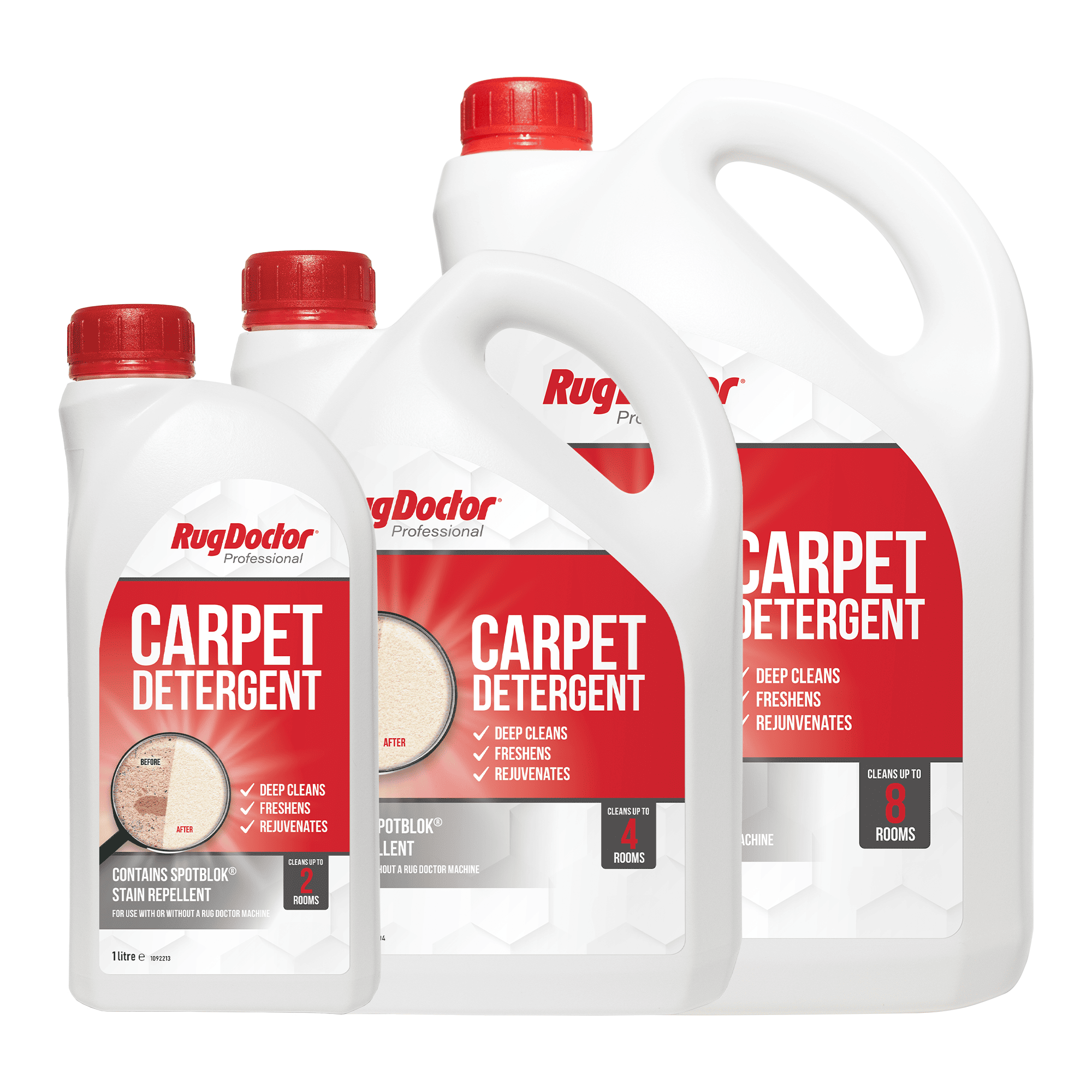
2. Rug Doctor Carpet Detergent, 4 litres
★★★☆☆ 3.2 / 5
Rug Doctor is the only one of the three machine brands whose warranty document says what it means. Clause 2.1(b) excludes defects arising from a failure to follow instructions, and then adds, in brackets, that as to the latter, for best operating efficiency and cleaning, use of only Rug Doctor cleaning products is recommended. Recommended. Not required. Clause 1.4 confirms your legal rights are unaffected and clause 2.4 declines to exclude the implied terms.
That is a company writing a warranty that would survive contact with a solicitor, and it stands in obvious contrast to a competitor telling customers in a user guide that another brand’s solution will invalidate the guarantee.
It is also the only product here that publishes coverage rather than a ratio: one litre cleans 38 square metres, which works out at £5.49 a room on the small bottle or £2.79 on the 4 litre. That at least lets you compare. Where it falls down is wool. Rug Doctor labels five of its own spot sprays wool friendly and pet safe, and pointedly does not label this flagship detergent that way, and it does not appear in the WoolSafe directory. No pH is published either, so on a wool carpet you are guessing.
Pros
- The only machine brand here whose warranty says its own products are recommended rather than required
- Confirms in its own warranty that your legal rights are unaffected and does not exclude the implied terms
- Publishes coverage, one litre to 38 square metres, so you can work out a cost per room
- £2.79 a room on the 4 litre, competitive with anything here except the 1001
- Widely available alongside the machine hire network
Cons
- Not in the WoolSafe approved directory
- Labels five of its own spot sprays wool friendly and pet safe, and does not label this detergent that way
- No pH published, so on a wool carpet you are guessing
- No ingredient list published to Annex VII standard
- £24.99 for the 4 litre is a significant outlay in one go
- Verbatim owner complaints could not be retrieved
Buy it if you hire or own a Rug Doctor, you want the brand solution, and your carpet is synthetic rather than wool.
The two machine brands with the warranty language
WoolSafe approved
Will invalidate
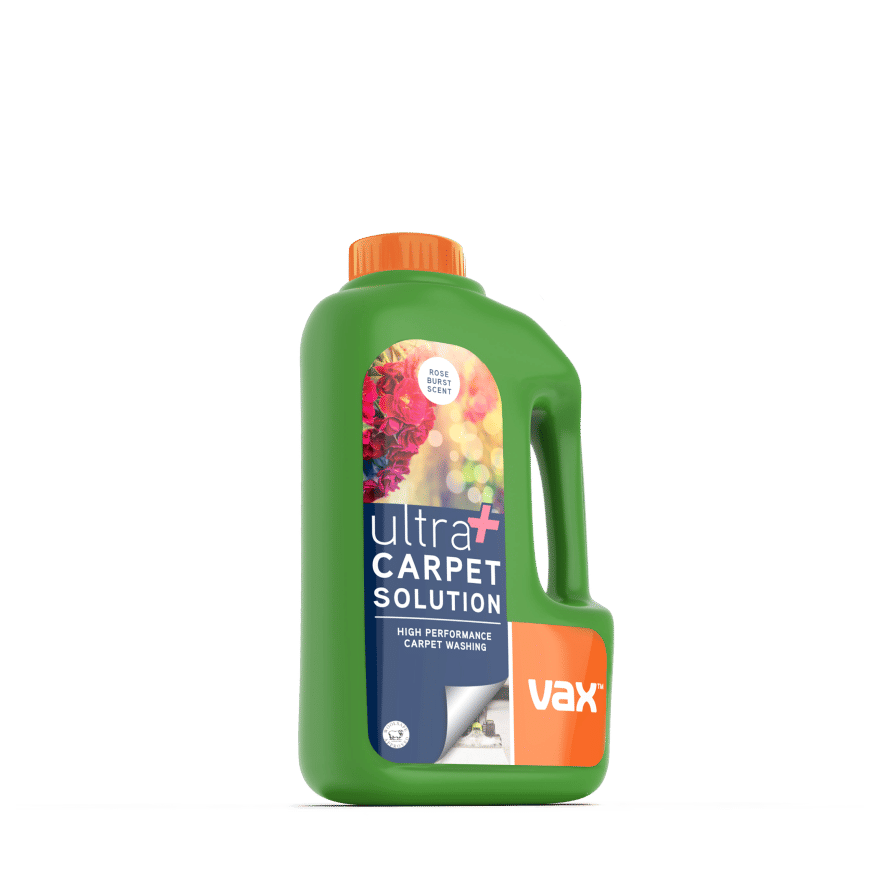
3. Vax Ultra+ Carpet Cleaning Solution, 1.5 litres
★★★☆☆ 3.0 / 5
Vax is WoolSafe approved, which is a genuine credential and one that only one other product here holds. If you have a wool carpet and you own a Vax, that counts for something real.
The warranty language is the problem, and it is worth quoting because the escalation happens inside one document. Page 2 of the CWCPV011 user guide says using other solutions may invalidate your guarantee. Page 7 of the same guide says only use Vax carpet solution, using other solutions may cause excess foaming and will invalidate your guarantee. May becomes will, five pages apart. And Vax names the mechanism itself: excess foaming. Foam is a property of the formulation and the dose, not of the badge on the bottle, so a low foam solution from another brand does not create the problem Vax has identified.
On UK law the position is straightforward. Your rights run against the retailer under the Consumer Rights Act 2015, and within the first six months a fault is presumed to have been present at purchase, so it is for the retailer to prove your solution caused it rather than for you to prove it did not. We found no independent evidence of any kind that a compatible low foam solution damages a machine. Vax also publishes no dilution ratio, no pH and no ingredient list, and at £22.99 for 1.5 litres it is the most expensive per litre here. Buy the 4 litre if you buy it at all, because it is 40 to 43 per cent cheaper per litre for the identical formulation.
Pros
- WoolSafe approved, one of only two products here that is
- Formulated as low foam specifically for Vax machines, so it does what the manual asks
- The 4 litre is 40 to 43 per cent cheaper per litre than the 1.5 litre, same formulation
- Widely available wherever Vax machines are sold
Cons
- Its own user guide escalates from may invalidate your guarantee on page 2 to will invalidate your guarantee on page 7
- The mechanism Vax names is excess foaming, which is a property of the formulation rather than the brand
- Publishes no dilution ratio, no pH and no ingredient list
- £22.99 for 1.5 litres, the most expensive per litre in this comparison
- A fill line on its own tank rather than a ratio makes cross brand cost comparison impossible
- We found no independent evidence that a compatible low foam solution damages a machine
Buy it if you own a Vax, you have a wool carpet and you want the WoolSafe approval, and you are buying the 4 litre rather than the 1.5.
Contradicts itself
One real warning
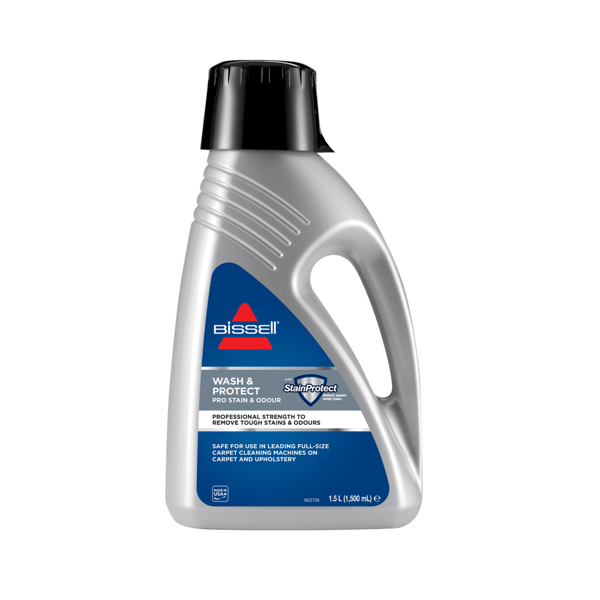
4. Bissell Wash & Protect Carpet Formula, 1.5 litres
★★★☆☆ 2.9 / 5
Bissell is the clearest example in this comparison of a brand saying two different things in two places. Its machine manuals say non Bissell cleaning solutions may harm the machine and void the warranty. Its own European website, and the retail listing for this very solution, say it is laboratory tested and safe to use in Bissell carpet cleaners and other full sized competitor carpet cleaners, including rental machines.
Both of those cannot be the company’s position. The second one is the more interesting, because it tells you that Bissell has itself tested this formula in other manufacturers’ machines and is comfortable selling it for that use.
Buried in the same manuals is the one warning in this entire category that we think is genuinely well founded and has nothing to do with branding: use of cleaning formulas which contain lemon or pine oil may damage this appliance and void the warranty, because these products may react with the plastic materials. That is real chemistry. Terpene solvents do attack ABS plastics over time. So the useful version of the warranty advice is not buy our brand, it is do not put a citrus or pine solvent through a plastic machine, and that applies whoever made the bottle.
Pros
- Bissell itself states this solution is safe in other manufacturers’ full sized machines including rental ones
- £16.00 for 1.5 litres, cheaper than the Vax equivalent
- The lemon and pine oil warning in its manuals is genuinely well founded chemistry and applies to any brand
- Widely available and well established
Cons
- Its manuals say non Bissell solutions may void the warranty while its own site says this solution works in competitor machines
- Not in the WoolSafe approved directory
- No dilution ratio, no pH and no ingredient list published
- A fill line rather than a ratio, so no cost per tank can be calculated
- We could not obtain a current UK Bissell warranty document at all after four attempts
- Verbatim owner complaints could not be retrieved
Buy it if you own a Bissell and want the brand formula, and you note that Bissell itself says it works in other machines too.
The spot treatment, and the eco one
Spot use only
Not for wool

5. Dr. Beckmann Carpet Stain Remover, 650ml
★★★☆☆ 2.7 / 5
A spot product rather than a machine solution, and useful as one. It comes with a brush head, it targets individual marks, and for the wine on the rug on a Saturday night it is the right tool. We have included it because most people who own a carpet machine also own something like this, and the two get used interchangeably when they should not be.
The reason it sits fifth is wool. It declares oxygen based bleaching agents, it is not in the WoolSafe approved directory, and it explicitly excludes silk from its usage instructions. Silk and wool are both protein fibres and they react to the same chemistry, so a product that tells you to keep it off silk is telling you something about wool as well, whether or not it says so.
On the evidence side, Robert Dyas serves its Bazaarvoice review data openly, which is more than most retailers manage, and it returned exactly one review below three stars out of 130. That is a good sign for the product and a thin evidence base at the same time.
Pros
- A genuinely useful spot product with an integrated brush head for individual marks
- £4.00 for 650ml, cheap for what it is
- Only one review below three stars out of 130 on the retailer that publishes its data openly
- Dr. Beckmann publishes ingredient information reasonably well across its range
Cons
- Declares oxygen based bleaching agents and is not WoolSafe approved
- Explicitly excludes silk, which is the other protein fibre and a strong hint about wool
- No pH published
- A spot product, so it does not replace a machine solution for a whole room
- Oxygen bleach on a coloured carpet is a real risk and needs testing on a hidden area first
- No independent test data on performance
Buy it if you want something for individual marks between machine cleans, and your carpet is synthetic rather than wool or silk.
The eco one
Least published

6. Ecozone Carpet Shampoo, 1 litre
★★☆☆☆ 2.5 / 5
The plant based option, and if that is your priority it is the one here that offers it. Ecozone’s general position on surfactants and packaging is genuine and we have given the brand credit for it elsewhere on this site.
The problem is that it publishes less than anyone. No dilution ratio, no pH, no WoolSafe listing, and no full ingredient list. In a category where the central consumer problem is that nobody tells you the ratio, being the brand that also does not tell you the ratio while charging £9.99 a litre is a difficult position. The £3 bottle from a mainstream brand publishes all four of those things.
It is worth being clear about what an eco carpet shampoo can and cannot change. The residue problem is inherent to putting surfactant into a carpet pile and not rinsing it out properly, and a plant derived surfactant leaves residue in exactly the same way a petrochemical one does. The environmental case for this product is about what happens to the water afterwards, not about what happens to your carpet.
Pros
- Plant based surfactants and a genuine environmental position at brand level
- £9.99 a litre is well below the machine brand solutions
- Recyclable packaging and a cruelty free position
Cons
- Publishes no dilution ratio, no pH, no full ingredient list and holds no WoolSafe approval
- £9.99 a litre against £3.00 for the product that publishes all four of those
- A plant derived surfactant leaves residue in a carpet pile in the same way a petrochemical one does
- Almost no independent review evidence exists
- No hazard classification published either way
- No independent performance testing of any kind
Buy it if a plant based formulation is the deciding factor for you and you accept that you will not be told the ratio, the pH or the full ingredients.
Prices checked 5 August 2026 and may have changed since.
The clean pick, and the honest catch
Our clean pick
1001 Machine Solution
The £3 bottle that publishes what the £23 one will not
Why it wins on disclosure
✓
It publishes the ratio
✓
It publishes the pH
✓
A full ingredient list and a safety data sheet
✓
WoolSafe approved, and it names the residue problem
What you give up
✕
pH 8 to 9 is at the top of the wool range
✕
The machine brands will object
✕
No performance testing exists
The catch, said plainly. Our rule is that if a category has a genuinely clean option we name it, and here there is one, but the bigger finding is about residue. The professional bodies, the IICRC and the NCCA, both confirm that surfactant left in a carpet pile attracts soil, which is why a carpet often gets dirty faster after cleaning than it did before. The NCCA specifies a final fibre pH of 5.5 to 7 achieved with an acid rinse, and no domestic carpet machine offers that step. So the honest position is that a hired or owned machine will lift the dirt and leave some of the detergent behind, and the way to limit that is to use less solution than you think, do a final pass with clean water only, and dry the carpet fast with windows open and a fan on. A carpet left damp for more than about 24 hours is a mould risk, which is the one way this whole exercise can make your home worse rather than better.
What to look for when you buy one
The warranty threat is weaker than it sounds, and the law is on your side. Under the Consumer Rights Act 2015 your claim is against the retailer who sold you the machine, not the manufacturer, and within the first six months a fault is presumed to have been present at the point of sale. That means the retailer has to prove that your third party solution caused the fault, rather than you having to prove it did not. A blanket statement that using another brand voids the guarantee does not override that. Note also what the brands themselves say: one names excess foaming as the mechanism, which is a property of the formulation rather than the badge, and another states on its own website that its solution works in competitor machines while its manual says the opposite.
The one warranty warning worth obeying has nothing to do with brands. Bissell’s manuals say that cleaning formulas containing lemon or pine oil may damage the appliance because they can react with the plastic materials. That is genuine chemistry: terpene solvents attack ABS plastics over time. So do not put a citrus or pine based cleaner through a plastic carpet machine, whoever made it. That is the useful version of the advice.
Find the dilution ratio, and treat its absence as a pricing tactic. Every one of these is a concentrate, and the bottle price is meaningless without the ratio. Four of the six publish no ratio at all, substituting a fill line on their own machine’s tank, which makes it impossible to compare a Vax solution with a Bissell one or with a supermarket one. That is not an oversight. Only one product here gives you a real ratio and one other gives coverage in square metres.
Buy the big bottle, because the formulation is identical. Across the Vax range the 4 litre works out 40 to 43 per cent cheaper per litre than the 1.5 litre for exactly the same liquid. That is the single easiest saving in this category and it takes no research at all.
If the carpet is wool, the pH matters more than anything else on the label. Wool is a protein fibre and it is damaged by alkaline solutions above roughly pH 8.5. Exactly one product in this comparison publishes a pH figure. One competitor’s safety data sheet answers the pH question with the words no information available. If you have a wool carpet and the bottle does not tell you the pH, you are guessing with something you cannot undo.
Check the WoolSafe directory yourself, because logos are not listings. WoolSafe is the wool industry’s certification body and it maintains an approved products directory. Two of the six products here appear in it. Four do not, including one machine brand and one product that labels five of its own sprays wool friendly while pointedly not labelling its flagship detergent that way. WoolSafe’s WS 1001 standard also tests for quick re-soiling, which ties the approval directly to the residue problem below. It does not publish certificate numbers for consumer products, so the directory listing is the check.
Optical brighteners do not belong on wool. They are fluorescent dyes that make fabric look whiter by re-emitting ultraviolet as blue. On a wool carpet they can cause uneven discolouration that does not come out. One product here states explicitly that it contains none. One declares oxygen based bleaching agents and excludes silk from its instructions, which tells you what you need to know about wool as well, since both are protein fibres.
Use less solution than the instructions suggest, and rinse. This is the residue problem and it is why carpets often re-soil faster after a clean. Surfactant left in the pile is sticky and attracts soil. The professional bodies confirm it, and one manufacturer in this comparison tells you in its own instructions to thoroughly rinse the spot with water to remove traces of the surfactant. The National Carpet Cleaners Association specifies a final fibre pH of 5.5 to 7 achieved with an acid rinse, which is a step no domestic machine offers. The domestic approximation is a final pass with clean water and nothing in the tank.
Dry it fast, because a damp carpet is a mould problem. Hot water extraction puts a lot of water into a carpet and underlay. Open the windows, run a fan across the floor, and do not put the furniture back until it is dry to the touch through the pile. A carpet that stays damp for more than about 24 hours, particularly over a solid floor, is how a clean turns into a mould problem, and the smell that follows is much harder to fix than the stain you started with.
And do the sums on hiring against paying someone. Machine hire plus solution plus a day of your time is not far off what a professional charges for a couple of rooms, and the professional has an acid rinse, far stronger extraction and a machine that gets the carpet properly dry. If the carpet is wool, expensive, or badly soiled rather than just tired, the professional is usually the better buy. For a general freshen up of a synthetic carpet, the hire machine and a £3 bottle of solution does the job.
Final verdict
Buy the £3 bottle, use half as much, and rinse
Three things to take away.
The first is that the warranty warnings do not stand up the way they are written. One brand escalates from may invalidate to will invalidate within five pages of the same user guide, and names excess foaming as the mechanism, which is about the formulation and not the brand. Another says in its manuals that other solutions void the warranty and says on its own website that its solution is safe in competitor machines. And under the Consumer Rights Act your claim is against the retailer, who has to prove your solution caused the fault within the first six months. The one warning worth obeying is the one about lemon and pine oil, which is real chemistry and applies to every brand.
The second is that the £3 bottle publishes more than the £22.99 one. A dilution ratio, a pH, a full ingredient list, a safety data sheet, a no optical brighteners statement and a WoolSafe listing. The expensive bottles give you a fill line on their own tank, which is a way of making comparison impossible rather than a way of helping you dose.
The third is the residue, which nobody tells you about except, to its credit, one of the makers here. Surfactant left in the pile attracts soil, which is why the carpet gets dirty faster afterwards. Use less than the bottle says, do a final pass with clean water only, and dry it fast.
Our pick is the 1001 Carpet Machine Solution at £3, and the Rug Doctor if you want a machine brand whose warranty is honestly written.