Home · Kitchen · Kettles and water
Best kettles: six compared, and what a stainless steel kettle actually means inside
Most kettles sold as stainless steel have a plastic lid, a plastic water window, a plastic spout filter, or all three, and every one of those sits in boiling water twice a day. We worked out exactly what touches the water in six kettles, and only two of them are what the front of the box implies.
By Mrs House · Updated 10 September 2026 · 14 minute read
Mrs House is independent. Nobody pays for a place in a ranking here, and no brand saw this page before it went live.
The short answer
Buy the Cosori Plastic-Free Water Contact kettle at £32.99. Body, inner lid, spout and filter are all 304 stainless, and there is no plastic sight window because there is no sight window at all.
- Best overall: Cosori Plastic-Free Water Contact, £32.99. You give up temperature control and it is noisy.
- If money is not the constraint: Aarke Kettle in steel, £200. Stainless limescale filter, variable temperature, five year registered warranty, and the materials claim is in writing.
- Fastest: Bosch Sky TWK7203GB, £100 to £105. A litre in 2 minutes 4 seconds and the most efficient here, with plastic in the water path.
Stainless steel kettle usually describes the outside. The lid, the level window and the filter frame are where the plastic hides.
How we assessed these
Six kettles, and one question the category does not want asked: which parts actually touch the water?
That took longer to answer than everything else combined, because most brands will not tell you. Bosch publish a spec sheet whose only material line is stainless steel body. Dualit describe their two water level windows as BPA free, which is a tacit admission that they are plastic and that they sit inside the kettle. Russell Hobbs do not need to say anything, because on their bestseller everything except the element plate is plastic and it is obvious.
Two brands do publish it. Aarke state in writing that no plastic contacts your drinking water, only stainless steel and a food grade silicone seal at the bottom sensor. Fellow publish a full breakdown including which face of the lid is steel and which is polypropylene. That willingness to answer is itself a ranking factor here, because on a product you use twice a day the thing you cannot check is the thing that should worry you.
We also read the actual peer reviewed research on nanoplastic release from polypropylene kettles rather than the press coverage, because the widely quoted figure and the same study’s other figure differ by three orders of magnitude, and that is worth knowing before anybody panics.
Prices checked September 2026.
The ranking, at a glance
| Kettle | Price | Capacity | Plastic in the water path | Boil time, 1L | Score | |
|---|---|---|---|---|---|---|
| 1 | Aarke Kettle (Steel) | £200 | 1.2L | None. One silicone sensor seal | About 3 min | 4.6 / 5 |
| 2 | Cosori Plastic-Free Water Contact | £32.99 | 1.7L | None declared. Lid gasket unconfirmed | About 2 min 25 s | 4.4 / 5 |
| 3 | Bosch Sky TWK7203GB | £100 to £105 | 1.7L | Lid, level window and filter frame | 2 min 4 s, measured | 4.3 / 5 |
| 4 | Fellow Stagg EKG | £119 to £165 | 0.9L | Polypropylene lid body, steel underside | Will not hold a litre | 4.2 / 5 |
| 5 | Dualit Classic 72815 | £130 to £165 | 1.7L | Two plastic windows, plus the lid assembly | 2 min 14 s, measured | 3.9 / 5 |
| 6 | Russell Hobbs Inspire 24360 | £30 to £37 | 1.7L | All of it except the element plate | 2 to 3 min for 1.7L | 3.3 / 5 |
The two we would actually buy
Best overall
Our winner
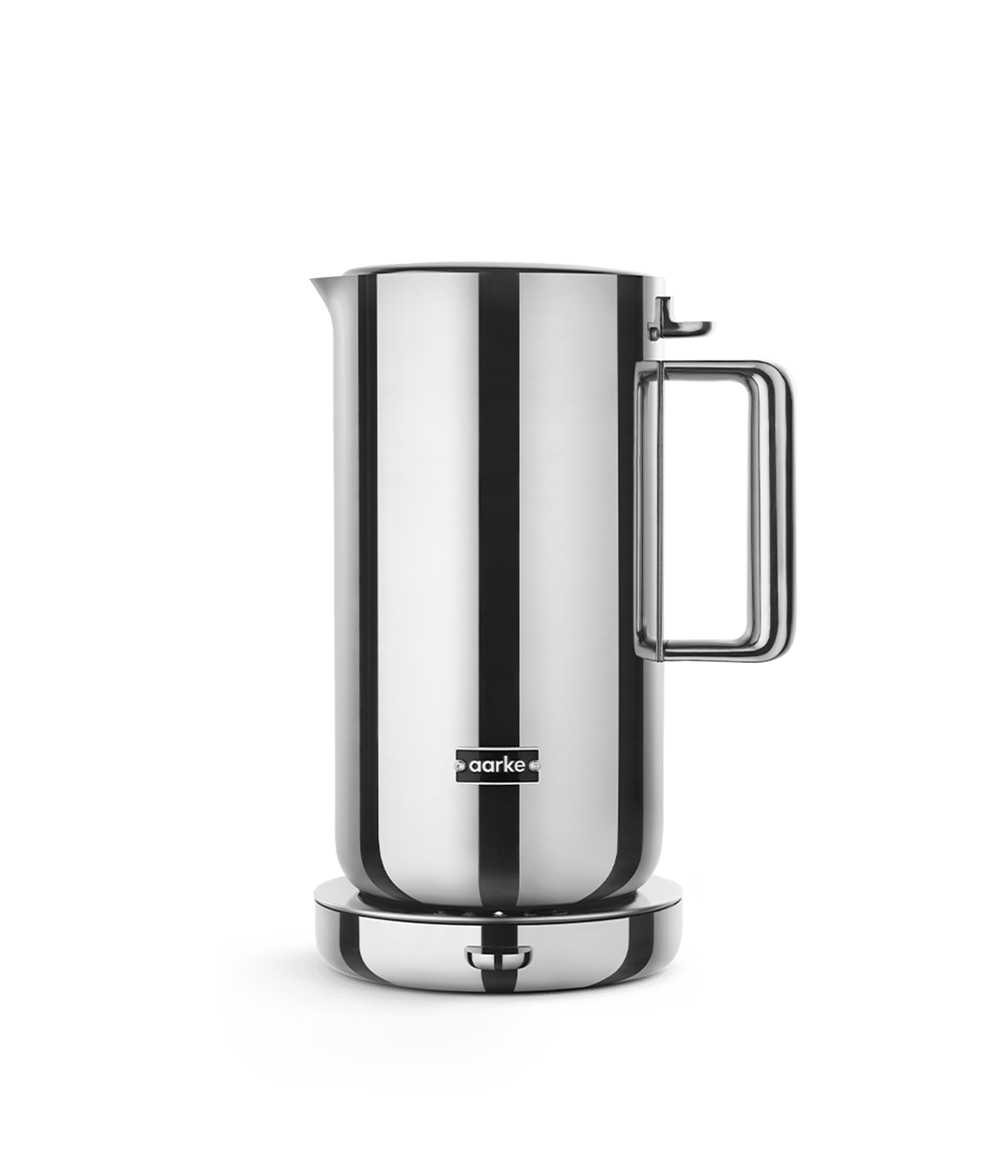
Aarke Kettle, Steel
★★★★★ 4.6 / 5
This is the only kettle here where the brand answers the materials question in writing, without being asked, on its own support pages. Their words: no plastic gets in contact with your drinking water in the Aarke Kettle, only stainless steel and food grade BPA free silicone rubber in the bottom sensor seal.
Go through it part by part and it holds up. The body and spout are SUS304 stainless. The lid is stainless with a silicone seal that Aarke say contacts vapour only. There is no sight glass at all, which matters more than it sounds, because a translucent water level window is the single most common hidden plastic on a kettle sold as stainless steel. And the limescale filter is described as plastic free, made in 100 per cent stainless steel, where almost every rival uses a plastic framed mesh.
The one polymer in the water is a food grade silicone ring around the bottom temperature sensor. Aarke are upfront about that, and being upfront about the exception is precisely why we believe the rest.
It is also, separately from all that, a good kettle. An independent tester comparing it against Balmuda and Bodum found the whole household agreed it was best for pouring, after previous kettles dribbled, and recorded it as the fastest of the three to reach a set temperature. Five presets at 40, 75, 85, 95 and 100 degrees with a memory function, a double walled body that genuinely holds heat so keep warm is not a gimmick, and a five year warranty on registration, which is the strongest durability signal in this ranking.
The reservations are real and mostly about money and size. Two hundred pounds is roughly six times the Cosori for a kettle that holds less water. It is 1.2 litres maximum, and the minimum fill is 0.5 litres, which is a high floor. If you make one mug at a time you are boiling roughly double what you need, which quietly undoes part of the energy argument.
It is also slower than a 3kW British kettle, drawing 1850 to 2200 watts for about three minutes on a full fill. And note Aarke’s own warning that the stainless body gets hot in use and should not be touched after boiling. Only the handle is heat safe, which is worth knowing in a house with children.
Pros
- No plastic in the water path, stated in writing by the brand on its own support pages
- A 100 per cent stainless limescale filter, where nearly every rival uses plastic framed mesh
- No sight glass, which removes the most common hidden plastic in the category
- Five temperature presets with memory, and a double walled body that holds heat
- Five year warranty on registration, the longest here
Cons
- Two hundred pounds, which is six times the Cosori for less capacity
- Only 1.2 litres, and a 0.5 litre minimum fill is high for a one mug household
- Slower than a British 3kW kettle, at about three minutes for a full fill
- The body gets hot and Aarke tell you not to touch it after boiling
- The controls are not self explanatory and reviewers needed the manual
Buy it if you use it every day for years and you want the materials question answered in writing. Skip it if you boil one mug at a time, or two hundred pounds for a kettle is not the world you live in.
Best value clean pick
£32.99
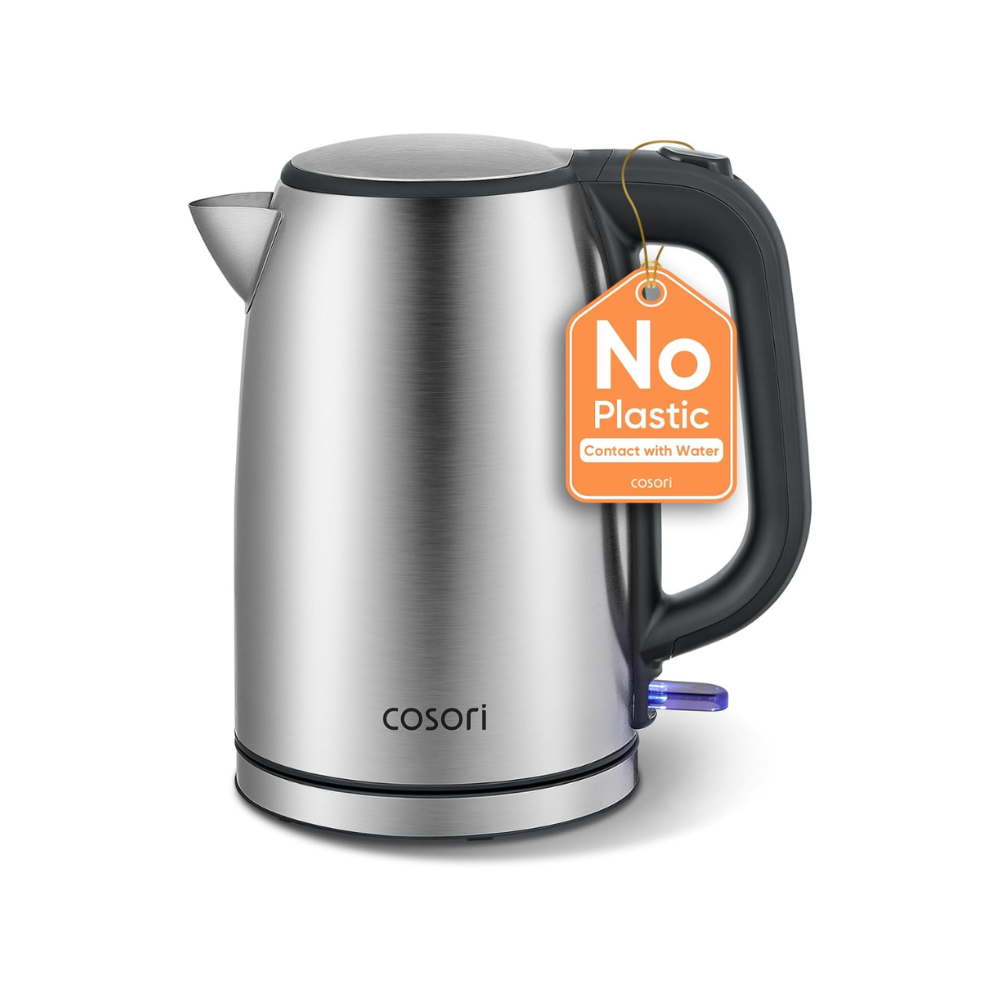
Cosori Plastic-Free Water Contact Kettle 1.7L
★★★★☆ 4.4 / 5
The same idea as the Aarke for a sixth of the money and with half a litre more capacity. Cosori state that all water contact parts are 304 food grade stainless steel including the spout, inner lid and filter, and that unlike typical plastic water level indicators, theirs is completely plastic free to prevent plastic odours. That is exactly the right thing for a brand to say, and it is why this is the recommendation most people should actually act on.
Buyers agree, and they say so in the plainest possible terms. The reviews on Cosori’s own UK store keep coming back to the same point: well made, reasonably priced kettle with no plastics in contact with water. Great kettle, light but well built, no plastic touching water. The key, no plastic lining. People are buying this specifically for the water path.
It is fast, with a British Strix thermostat and 3000 watts, and Cosori quote 250ml in 43 seconds. The two stage lid is genuinely clever: 30 degrees to pour without splashing, 70 degrees to clean and refill, and the wide opening means you can get a hand inside to scrub limescale, which you cannot do on most kettles.
Now the honest trade offs, and they follow directly from the design. There is no water window, because a water window would be plastic. You open the lid and read the internal markings. One reviewer found the lid mechanism a little stiff and said so alongside noting there was no window. That is not a fault, it is the cost of the thing you bought it for.
It is noisy, and a five star reviewer still said so. Single wall stainless with a fully exposed metal interior is usually louder than a plastic bodied kettle, and this is no exception. There is no temperature control and no keep warm at this price.
One practical tip that applies to any bare stainless kettle. Across the wider Cosori stainless range some buyers report water marks and cloudy staining inside after the first few boils that will not polish out, and a small number report a chemical or slightly bitter taste on early use. Both are consistent with residual manufacturing oils. Boil and discard two or three full loads before you drink from it.
Buy carefully. Cosori sell several visually similar stainless kettles and only some have a fully metal water path. Look for the exact phrase Plastic-Free Water Contact in the title.
Pros
- All water contact parts are 304 stainless, including the spout, inner lid and filter
- No plastic water window, because there is no window at all
- Thirty two ninety nine, which is about a sixth of the Aarke for more capacity
- A two stage lid and a wide opening, so you can actually reach in and descale it
- Three thousand watts and a British Strix thermostat, so it is properly fast
Cons
- Noisy, and even five star reviewers say so
- No water window, so you open the lid to check the level
- The lid mechanism is stiff according to more than one owner
- No temperature control and no keep warm at this price
- Boil and discard two or three loads first, to clear residual manufacturing oils
Buy it if you want the plastic out of the water path and you are not spending two hundred pounds to do it. Skip it if you need to see the water level at a glance, or noise in the kitchen bothers you.
The wool one, and the one for a child’s bed
Best performance
Most efficient
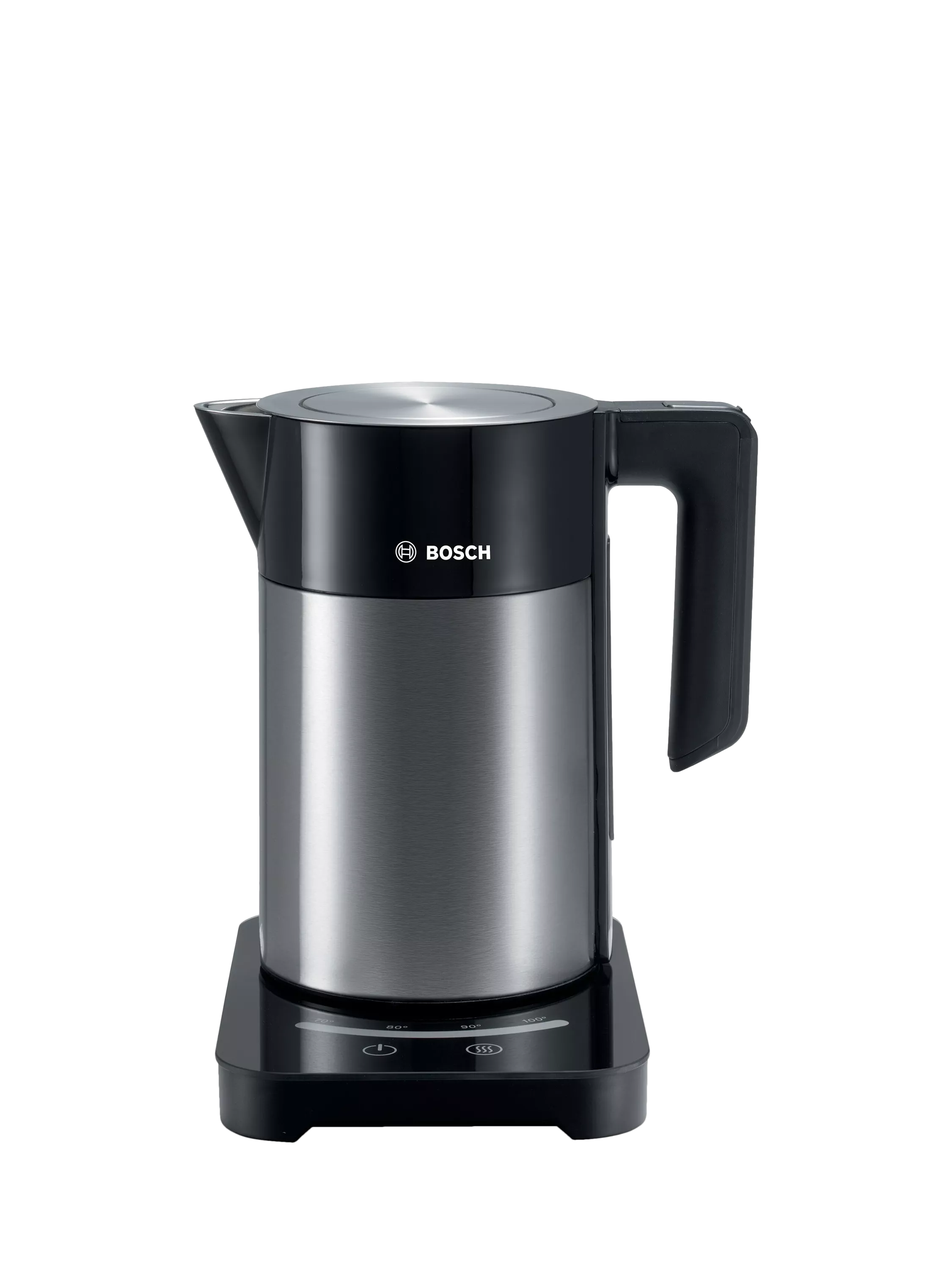
Bosch Sky TWK7203GB
★★★★☆ 4.3 / 5
Purely as a kettle, this is the best one here and it is not particularly close. Independent testing measured a litre in 2 minutes 4 seconds and the full 1.7 litres in 3 minutes 22, made it their overall best kettle, and recorded 0.106 kilowatt hours per litre, which is the most efficient figure in this group. The double wall means the outside only reached 52.7 degrees, the lowest of the mainstream fast boilers, which matters if there are small hands about.
Seven temperature settings from 70 to 100 degrees on a touch swipe display, a 30 minute keep warm, a concealed element and a 300ml minimum fill, which is genuinely low and is the single most useful energy feature on any kettle. Triple safety shut off. It is a properly good appliance and at £100, often discounted to £80, it is fairly priced.
And then you try to find out what is inside it, and you cannot. Bosch publish a spec sheet whose entire materials disclosure is the line stainless steel body. There is no lid material, no filter material and no gauge material anywhere in the GB documentation. For a page about what touches your drinking water, that is a legitimate criticism and we are going to make it.
Here is what can be established rather than assumed. The inner wall is stainless and it is double walled with an outer shell. The lid is a push button assembly with a gasket, which means a plastic mechanism sitting in the steam space and in contact with condensate. Bosch list a water level indicator, and a see through level strip on a cool touch double walled kettle is a translucent polymer window on the water side. And the removable spout filter is the giveaway: Bosch kettle spout filters sold as spares across the TWK7 range are described by spares suppliers as plastic.
So the honest verdict is this. It is a stainless steel kettle with plastic in the water path. It is not a clean pick and we are not going to pretend it is. It is in this ranking because it is the best all round kettle here and because you deserve to see what stainless steel kettle actually means on a mainstream product.
Two smaller gripes from owners. There are scattered reports of a unit that stopped heating at 80 degrees regardless of the setting, so check yours does what the display says in the first week. And the water level indicator is hard to read in some kitchen lighting, which is a familiar complaint about level windows generally.
Pros
- A litre in 2 minutes 4 seconds and the most efficient here at 0.106 kWh per litre
- Seven temperature settings from 70 to 100 degrees, plus a 30 minute keep warm
- A 300ml minimum fill, which is genuinely low and saves real money over a year
- Double walled, so the outside only reached 52.7 degrees in testing
- A hundred pounds, and frequently discounted to eighty
Cons
- Bosch publish no water path materials at all beyond stainless steel body
- The lid mechanism, the level window and the spout filter frame are all plastic
- Scattered reports of units stopping at 80 degrees regardless of the setting
- The level indicator is hard to read in some kitchen lighting
- A wide base that takes more worktop than a conventional jug kettle
Buy it if you want the best performing kettle here and the water path is not your first concern. Skip it if you are reading this page because of what touches the water.
Best for coffee
Pour control

Fellow Stagg EKG
★★★★☆ 4.2 / 5
A coffee tool rather than a household kettle, and it should be judged as one. The gooseneck spout exists so you can pour a controlled thin stream over ground coffee, and one reviewer scored it 9.5 out of 10 and wrote that the spout allows for the subtlest of dribbles to remain the stuff of intention. Temperature to the degree from 40 to 100, a hold mode selectable at 15, 30, 45 or 60 minutes, and a built in brew stopwatch. The display shows target and current temperature at the same time, which the same reviewer called the most informative they had seen.
Fellow also publish a proper materials breakdown on their support site, which puts them in a very small club. Their words: the body is high grade 304 stainless, there is a compression moulded silicone ring around the temperature probe in the water, and the lid is made with BPA free food safe polypropylene and a silicone gasket, with the underside of the lid in stainless steel.
Read that carefully, because it is a good example of a brand being precise. The face of the lid that the water and steam touch is steel. The gasket is silicone. The lid body above it is polypropylene, sitting in the steam space. That is a meaningfully better position than a plastic lid mechanism, and it is only knowable because Fellow bothered to write it down.
The problem is the size. Nine hundred millilitres, and there is no bigger version. One reviewer with a two person household said flatly that 900ml is not enough water for their normal morning coffee routine. It cannot boil a litre at all. And at 1200 watts on a UK 3kW socket it is slow, taking roughly four and a half to five minutes for a full fill.
Some design niggles. The flat lid means a slightly overfilled kettle geysers hot water out of the vent holes. The metal ring where the handle meets the body conducts heat and fingers can get uncomfortably hot. And there is no limescale filter at all, which is a real omission in a hard water area.
On durability the evidence splits. One reviewer reported three years of daily use with the dial, screen and finish all intact. A commenter under the same review reported problems inside a year. Both are worth knowing. The UK warranty is also shorter than the American one, at one year back to base from at least one stockist against Fellow’s two years standard in the US. Check what your retailer actually offers.
Pros
- A gooseneck spout with genuine pour control, which is the whole reason it exists
- Temperature to the degree from 40 to 100, with a selectable hold mode and a brew timer
- Fellow publish a full water path materials breakdown, which almost nobody does
- The wetted face of the lid is stainless, with a silicone gasket
- Owners report three years of daily use with no failures
Cons
- Nine hundred millilitres, with no larger version. It cannot boil a litre
- Twelve hundred watts, so it is slow by British standards
- No limescale filter at all, which is a real omission in a hard water area
- The flat lid geysers hot water if you overfill it, and the handle ring conducts heat
- A one year UK warranty from at least one stockist, shorter than the US cover
Buy it if you make pour over coffee and the kettle is part of the ritual. Skip it if it is the only kettle in the house and more than one person wants a hot drink.
The two we would not buy
Quietest
Repairable
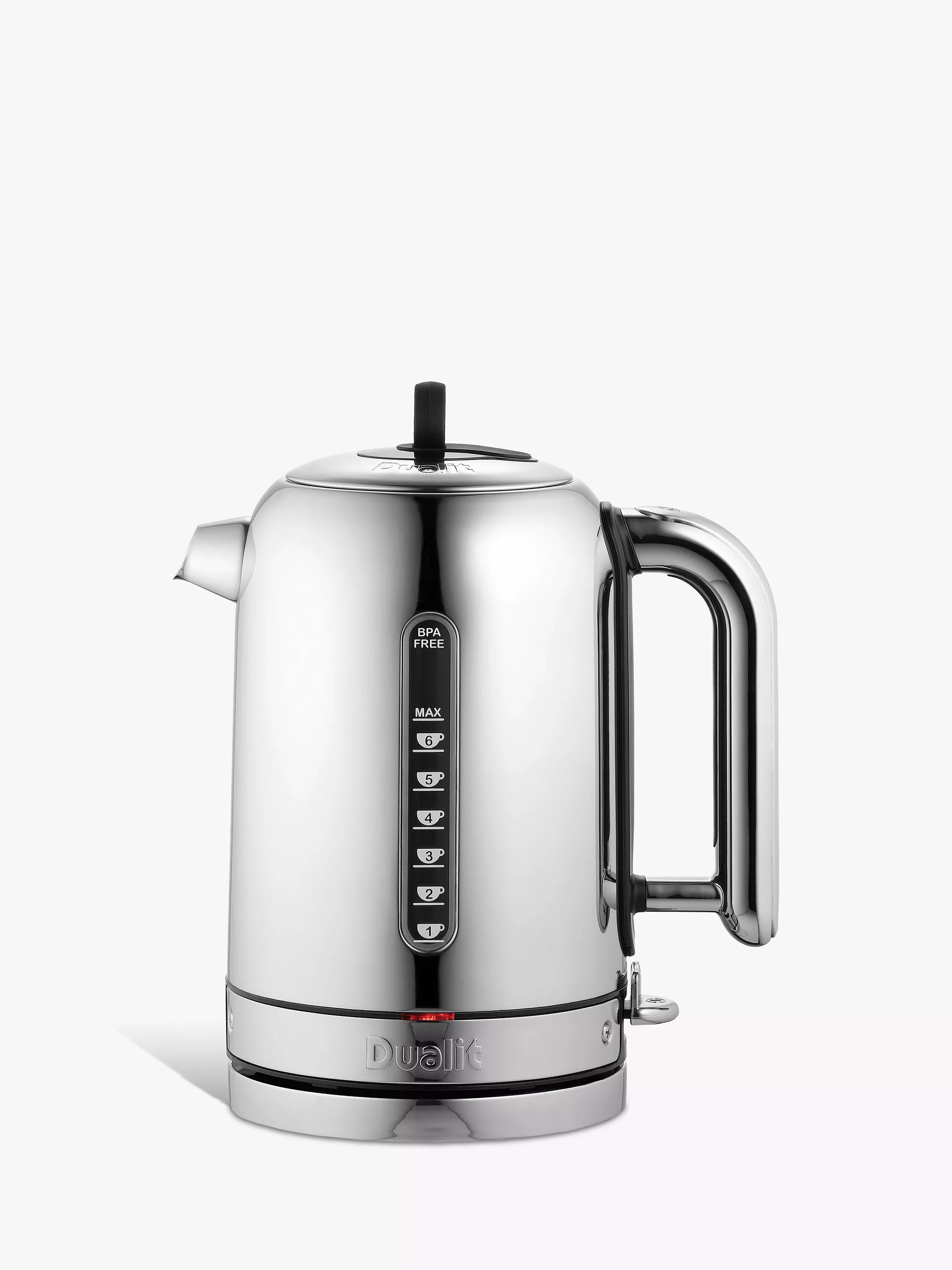
Dualit Classic Kettle 72815
★★★★☆ 3.9 / 5
This is the best teaching example in the whole article, because it looks like a solid stainless steel kettle and on the inside it is not one.
Start with what is good, because there is plenty. It is Quiet Mark certified and it is genuinely the quietest kettle here. It boils a litre in about 2 minutes 14 seconds on independent measurement. And it is properly repairable: the 3kW element is patented and replaceable, which almost nothing else in this category offers, and it is a real answer to the two to three year failure pattern that kills most kettles.
Now turn it round. There are two plastic measuring windows set into it, one in litres and one in cups, plus a small light window. Dualit describe those windows as BPA free, which is a tacit admission of exactly two things: that they are plastic, and that they are inside the kettle. Those windows are in direct contact with boiling water on every single boil.
The lid assembly and the heatproof ring are plastic too. There is a spout insert that directs the flow whose material Dualit do not publish, and a removable limescale filter whose material Dualit also do not publish, though mainstream UK kettle spout filters of this type are plastic framed mesh.
None of that makes it a bad kettle. It makes it a £165 stainless steel kettle with more plastic in the water than the £32.99 Cosori, and that is the point worth taking away from this page.
The other complaints are practical. The replaceable element is a genuine feature but the part is around £65, which is a large chunk of the kettle’s value. The illuminated window is dim and does not actually help you read the level. You cannot fully drain it because of the lip design. And at this price there is no push button lid, no variable temperature and no keep warm.
One thing to check before buying. Dualit’s own site lists a one year guarantee while John Lewis lists two years and one retailer listed three. That is confusing and it is worth knowing which you are getting. There is also a documented run of complaints about lid mechanism failures just after guarantee expiry on a different Dualit kettle, along with poor aftercare responses. Different model, so we are not laying it at this one’s door, but it is a fair note on the brand.
Pros
- Quiet Mark certified, and genuinely the quietest kettle in this comparison
- A patented replaceable element, so it is repairable rather than disposable
- A litre in about 2 minutes 14 seconds on independent measurement
- Stainless steel body, properly made, and it looks the part on a worktop
- A 250ml minimum fill, so you can boil small amounts
Cons
- Two plastic measuring windows sitting in the water on every single boil
- The lid assembly and heatproof ring are plastic, and the spout insert material is unpublished
- A replacement element costs around £65, a large share of the kettle’s value
- No push button lid, no variable temperature and no keep warm at this price
- Guarantee length is stated differently by Dualit and by its retailers
Buy it if quietness and repairability matter most to you and the water path does not. Skip it if you came to this page to get plastic out of your boiling water.
The benchmark
What most people own

Russell Hobbs Inspire Kettle 24360
★★★☆☆ 3.3 / 5
This is here as the comparison point rather than as a recommendation. It is a perennial UK bestseller and it is representative of what most people actually have on the worktop, which makes it the right thing to measure the others against.
It is genuinely fast for the money. Three thousand watts, one 235ml cup in 45 seconds on the manufacturer’s figure, and independent UK testing found one cup in under 45 seconds and a full 1.7 litres in two to three minutes. The rapid boil zone with 1, 2 and 3 cup markers is the single best energy saving feature on any kettle in this comparison, because it lets you deliberately boil a small amount. It is light to lift when full, which matters if you have weak wrists, and the fully removable lid makes filling and cleaning easier than a hinged one. Thirty pounds, five colours, available everywhere.
And the water path is all of it. The body, the lid, the spout, the level gauge and the filter are plastic. Only the element plate is metal. Every boil is water at 100 degrees sitting against polypropylene on all sides.
That is the point where we should be careful and factual rather than dramatic, because there is real research here and the headline number has been mangled. A 2025 study in npj Emerging Contaminants boiled eight polypropylene kettles repeatedly and measured nanoplastic release. Two things it found matter. The first is that release falls off very sharply with use: mass release dropped by more than 96 per cent between the first boil and boil 150, stabilising after about fifty boils. So a new plastic kettle sheds most in its first fortnight and then settles.
The second is that the widely reported figure of 11.8 million particles per litre came from one measurement technique in that study, and the same study using a different technique on the same samples got a figure three orders of magnitude lower. Both are in the paper. Anybody quoting one without the other is not telling you the whole thing, and we are not going to either.
The practical read: if you own one of these, run several boils and discard them when it is new, and consider it when you replace it rather than binning a working appliance today. On its own terms as a kettle, durability is the bigger complaint anyway. One reviewer found it feels cheap and hollow, and cites a unit bought in 2023 that stopped heating by early 2026, with a pattern of failures around two to three years. Russell Hobbs’ own spec sheet lists Quiet Boil as No.
Pros
- Fast for the money, with a cup in under 45 seconds at 3000 watts
- A rapid boil zone with 1, 2 and 3 cup markers, which genuinely saves energy
- Light to lift when full, and a fully removable lid makes filling and cleaning easy
- Around £30, in five colours, and stocked absolutely everywhere
- If you already own one, the research says shedding falls sharply after the first fifty boils
Cons
- The body, lid, spout, gauge and filter are all plastic. Only the element plate is metal
- Build feels cheap up close, and reviewers report failures around two to three years
- Russell Hobbs list Quiet Boil as No, and reviewers describe a normal boiling roar
- No temperature control and no keep warm
- The lid comes fully off to fill, which is a splash risk
Buy it if you need a cheap fast kettle today and the material is genuinely not a consideration. Skip it if you have read this far down the page.
Prices checked 5 August 2026 and may have changed since.
The clean pick, and the honest catch
Our clean pick
Aarke Kettle, Steel
And the Cosori if two hundred pounds is silly
Why it wins on the water path
✓
The brand puts it in writing
✓
A stainless filter, not a plastic framed mesh
✓
No sight glass at all
✓
It is a good kettle regardless
What you give up
✕
It is not fully plastic free
✕
Two hundred pounds, and only 1.2 litres
✕
Slower, and the body gets hot
The catch, said plainly. No kettle in this ranking is fully plastic free in the water path, and we should be precise about why rather than implying anybody is cheating. Every electric kettle needs an elastomer seal where the temperature sensor meets the body and another at the lid rim, and that seal is silicone. Silicone is a polysiloxane rather than a plastic, and it sits outside the plastics food contact regulation entirely, so calling a kettle plastic free with a silicone seal in it is fair. If your bar is genuinely no polymer anywhere near the water, the answer is a stovetop kettle. A mirror polished 18/10 stainless whistling kettle can be had for around £25 with a 25 year guarantee, and it has no element, no sensor, no gasket, no filter, no sight glass and no electronics at all. It also takes far longer and cannot hold a temperature, so it is a real trade rather than a free win.
What to look for when you buy one
How to spot the plastic on a stainless steel kettle
Four places, in order of how often they catch people out. First, the water level window. If you can see the water from outside, that window is a translucent polymer and it is on the water side. Dualit fit two of them and describe them as BPA free, which tells you exactly what they are. Second, the spout filter. Almost every mainstream kettle uses a plastic framed mesh, and spares suppliers list them as plastic even when the brand does not. Third, the lid. A push button lid mechanism is a plastic assembly sitting in the steam space and in contact with condensate. Fourth, the spout insert, a small moulded part that directs the flow, which several brands fit and none of them mention.
The quick test in a shop: if there is no sight glass and the filter looks like bare metal mesh, you are probably looking at a genuine stainless water path. If you can read the water level through the side, you are not.
What the microplastics research actually found
The best available study is Shi and colleagues, Release of nanoplastic from polypropylene kettles, published in npj Emerging Contaminants in 2025. They boiled eight polypropylene kettles repeatedly and measured what came off, confirming the polymer rather than assuming it.
Two findings matter for a normal household. The first is that release falls sharply with use. Mass release dropped by more than 96 per cent between the first boil and boil 150, and had largely stabilised after about fifty boils. A new plastic kettle sheds most of what it is ever going to shed in its first fortnight. That is a genuinely useful, actionable thing to know: if you buy one, run several boils and throw the water away.
The second is about the number you have probably seen. The widely reported figure of 11.8 million particles per litre came from one measurement technique in that study. The same study, using a different technique on the same samples, produced a figure three orders of magnitude lower. Both are in the paper. Anybody quoting the big number without the small one is not giving you the whole picture, and the honest position is that the measurement methods in this field do not yet agree with each other.
The UK Committee on Toxicity looked at microplastics in 2021 and concluded that a complete oral risk assessment is not yet possible on the available data. That is the accurate state of knowledge. It is neither reassurance nor alarm, and anybody selling you something on either basis is going beyond the evidence.
What BPA free does and does not tell you
It tells you one specific compound is absent. It tells you nothing about what replaced it. Bisphenol S and bisphenol F are the common substitutes, they are structurally similar, and they are considerably less studied than BPA. There is published work raising the same questions about them.
It is also worth knowing that BPA is used in polycarbonate and epoxy resins, not in polypropylene, which is what most plastic kettles are made from. So BPA free on a polypropylene kettle is close to meaningless as a claim. It is true, it is just not telling you anything you did not already know.
For the record, the European Food Safety Authority and the UK Committee on Toxicity currently disagree about the tolerable daily intake for BPA by a factor of roughly a thousand. When two expert bodies are that far apart, treat any confident marketing claim in either direction with suspicion.
Limescale is not a health problem
Say it plainly, because a lot of products are sold on the opposite. The white crust in a hard water kettle is calcium and magnesium carbonate. Calcium and magnesium are dietary minerals. Neither the World Health Organization nor the UK Drinking Water Inspectorate treats hard water as a health concern, and there is no evidence that swallowing bits of kettle scale does anything to you.
What scale does do is waste energy, because it insulates the element, and eventually kill the kettle. Descale with citric acid or white vinegar, rinse thoroughly, and boil and discard a couple of loads afterwards. That is the whole job.
One genuine hard water health note that people miss: if you fit a salt based water softener, it works by exchanging calcium for sodium, so softened water carries more sodium. Most guidance is to keep one tap, usually the kitchen cold, unsoftened for drinking and for making up infant formula.
Glass kettles
They look clean and the picture is more complicated than it appears. Check whether the glass is borosilicate, which handles thermal shock well, or soda lime, which does not. Then check the lid, the handle and the base, because on a lot of glass kettles those are still plastic and the lid is still sitting over the water. A glass body with a plastic lid, a plastic filter and a plastic handle is not a plastic free kettle, it is a kettle where you can see the plastic more clearly.
Capacity, and the cheapest change you can make
Look at the minimum fill rather than the maximum. Boiling more water than you need is the only real waste in this appliance, and the difference between a 300ml minimum and a 500ml minimum is money every single day if you make one mug at a time. The Bosch takes 300ml, the Aarke needs 500ml, and a rapid boil zone with cup markers, which is the one genuinely good feature on the cheap Russell Hobbs, exists precisely for this.
Temperature control, and when it is not a gimmick
Ninety five degrees is right for most black tea and for cafetiere coffee. Around 80 degrees is right for green tea, which turns bitter at boiling point. Around 40 is for baby formula preparation, though follow the current NHS guidance on that rather than a kettle preset. If you drink builder’s tea and nothing else, variable temperature is a feature you will use twice and then forget, and you should buy on speed and materials instead.
Noise
A single wall bare stainless kettle is usually louder than a plastic one, because there is nothing damping the boil. That is the direct trade off for the water path, and Cosori owners say so even in five star reviews. Double walling helps, which is why the Bosch and the Aarke are quieter. Quiet Mark certification is the thing to look for, and in this comparison only the Dualit has it.
Final verdict
Look at the filter and the window
If you take one thing from this page, make it this. Before you buy any kettle described as stainless steel, look for a water level window and look at the spout filter. A visible water level means a plastic window sitting in the water. A plastic framed filter mesh means plastic in the pour. Those two parts are on almost every mainstream stainless kettle, including ones costing well over a hundred pounds, and no brand will point them out to you.
The recommendation for most people is the Cosori at £32.99. The body, inner lid, spout and filter are all 304 stainless, there is no plastic sight window because there is no window at all, and it is fast. You accept that it is noisy and that you open the lid to check the level, and those are the direct costs of the thing you bought it for.
If you want that done properly and you will keep it for years, the Aarke at £200 adds a stainless limescale filter, temperature control, a double walled quieter body and a five year warranty, and Aarke will tell you in writing what is inside it. If you want the best kettle here purely as a kettle, the Bosch Sky is faster and more efficient than anything else and it has plastic in the water path, and now you know that rather than assuming otherwise.
And if you already own a plastic kettle, do not throw a working appliance away on the strength of this. Descale it, run a few boils and discard them when it is new, and change it when it dies. The research suggests shedding falls by more than 96 per cent after the first fifty boils anyway.