Home · Bedroom · Mattresses and toppers
Best mattress toppers: six compared, and the cleanest one is not foam
A topper is the single largest thing you press your face and skin into for eight hours a night, and most of the ones sold in Britain are polyurethane foam that has to carry flame retardant chemistry by law. We ranked six on comfort, on value, and on what they are actually made of.
By Mrs House · Updated 9 September 2026 · 14 minute read
Mrs House is independent. Nobody pays for a place in a ranking here, and no brand saw this page before it went live.
The short answer
Buy the Woolroom Deluxe if you sleep hot and want the cleanest topper on the UK market. Buy the Simba Hybrid if your mattress is genuinely too firm and you need it fixed tonight.
- Best overall: Woolroom Deluxe Wool, £289.99 for a double. 1000gsm British wool in an unbleached organic cotton cover, OEKO-TEX Class 1, no foam and nothing to air out.
- The same thing for less: Devon Duvets British Wool, around £210. Thicker at 1200gsm and materially just as clean.
- For a bad back: Simba Hybrid Topper, £349. Unambiguously petrochemical foam over microsprings, and it needs 48 hours of airing.
A topper cannot rescue a worn out mattress. It can fix one that is too firm.
How we assessed these
Six toppers, one method, applied to all of them in the same order.
We started with what is inside. Fill, cover composition, depth, weight, and whether the brand publishes a certificate number you can actually check rather than a logo you cannot. We read the certification bodies rather than the marketing pages, because CertiPUR and OEKO-TEX Standard 100 are real and useful and they do not mean what most product pages imply they mean.
Then we read the reviews properly, including the one and two star ones, which is where toppers give themselves away. Foam toppers get complaints about smell and about sinking. Fibre toppers get complaints about going flat. Wool toppers get complaints about cost and cleaning. Those patterns are consistent and they tell you more than a five star average does.
Then we looked at UK fire law, because it changes the answer here in a way it does not in most categories. The Furniture and Furnishings (Fire) (Safety) Regulations 1988 define furniture as including mattresses and pillows but expressly exclude bedding. A foam topper sold as a sleeping surface is generally treated as in scope and tested to BS 7177, and untreated commodity foam does not pass that test. A quilted wool or feather topper supplied as bedding sits outside it. That single distinction is why two of these six contain flame retardant chemistry by design and four do not.
Prices were checked in September 2026 and every one of these brands discounts, some of them constantly. Check the live price before you buy.
The ranking, at a glance
| Topper | Double | Fill | Off-gassing | Score | Best for | |
|---|---|---|---|---|---|---|
| 1 | Woolroom Deluxe Wool | £289.99 | 1000gsm British wool | None | 4.7 / 5 | Hot sleepers avoiding foam |
| 2 | Devon Duvets British Wool | £210 | 1200gsm British wool | None | 4.5 / 5 | The same thing for less |
| 3 | Simba Hybrid Topper | £349 | Foam and microsprings | Yes, air it 48 hours | 4.3 / 5 | A mattress that is too firm |
| 4 | Soak and Sleep Goose Down | £190 | Down and feather, dual chamber | None | 4.2 / 5 | Hotel softness |
| 5 | Panda Bamboo Topper | £139.95 | Gel infused memory foam | Yes, and some report days | 4.0 / 5 | Value and a washable cover |
| 6 | Silentnight Airmax | £38 | Hollowfibre polyester | Minimal | 3.5 / 5 | Guest beds and children |
The two we would actually buy
Best overall
Our winner
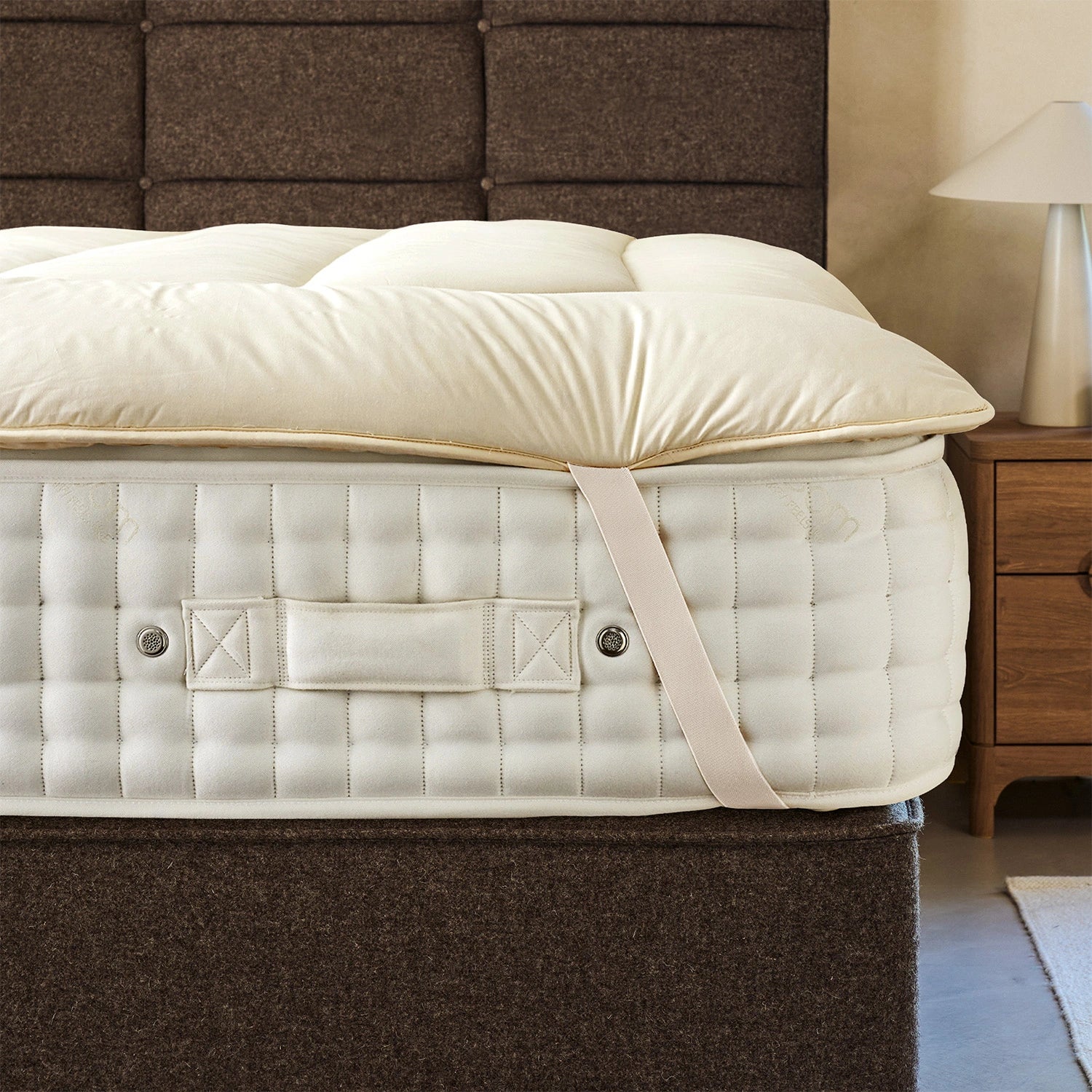
Woolroom Deluxe Wool Mattress Topper
★★★★★ 4.7 / 5
This is the one that wins on what is not in it. A thousand grams per square metre of traceable British wool, quilted inside an unbleached 200 thread count organic cotton cover, with no polyurethane, no memory foam, no latex and no synthetic interliner anywhere in the construction. There is nothing to air out because there is nothing that off-gasses. You unwrap it, you put it on the bed, you sleep on it.
Woolroom hold OEKO-TEX Standard 100 Class 1 across their entire bedding range, which is the infant class and the strictest tier of that scheme, and they publish it. They also carry the Allergy UK Seal of Approval and British Wool traceability through their Wool ID scheme. That combination is unusual. Most brands claim one certificate and publish none.
On performance, the reviewers who liked it most were hot sleepers. The Woman and Home tester, who describes herself as a chronic overheater, said her body temperature stayed more consistent through the night and she stopped waking as frequently. Worth understanding why: wool does not cool you, it moves moisture vapour away from you, which is why people who wake up damp get more out of it than they expect. The Ideal Home tester, also a hot sleeper, reported the same thing.
It also adds a genuine amount of bounce to a tired mattress without the sinking sensation foam gives you, and the elasticated corner straps hold so well that one tester said it was difficult to get off again. Trustpilot buyers repeat both points. It comes in a reusable cotton zip bag rather than a plastic sack, which sounds like a small thing and is not, once you have wrestled a vacuum packed foam topper out of its wrapper.
The catch is cleaning. It is dry clean only, with a non-toxic solvent, and both press testers flagged that as the main downside. The practical answer, which is what Woolroom and every other natural fill brand tell you, is to put a washable cotton protector over the top of it.
Pros
- No polyurethane and no memory foam, so no off-gassing at all and nothing to air out
- OEKO-TEX Standard 100 Class 1, the infant tier, published across the whole range
- Naturally flame resistant wool, so no chemical flame retardant treatment is needed or used
- Genuine temperature regulation, and the hot sleepers testing it said so specifically
- Corner straps that actually hold, and a decade of service life is normal for wool
Cons
- Dry clean only, which is both a running cost and a hassle
- At 4 to 5cm it will not rescue a mattress that has failed underneath
- Poor motion isolation, so you will feel a partner move
- Expensive at £289.99 for a double, and the 30 night trial is really a returns window
Buy it if you want the cleanest topper on the UK market, you sleep hot, and your mattress is sound but a bit hard. Skip it if you need real orthopaedic support, or you want to throw it in the machine.
Best value clean pick
Runner-up
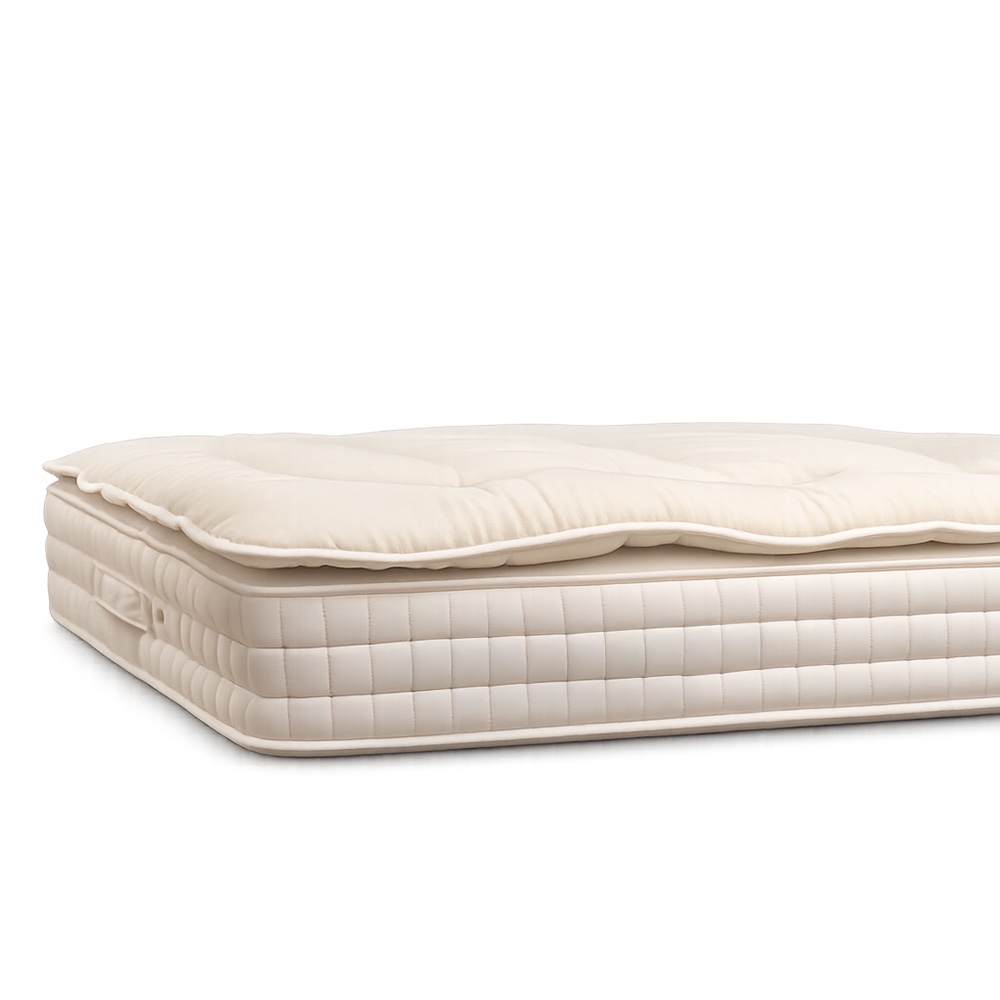
Devon Duvets 100% British Wool Mattress Topper
★★★★★ 4.5 / 5
Materially this is the same proposition as the Woolroom, with more wool in it and about £80 off the price. Twelve hundred grams per square metre of certified traceable British wool, a 100 per cent brushed cotton cover woven at an OEKO-TEX certified mill, handmade to order in Devon. Around £210 for a double against Woolroom’s £289.99.
What makes it interesting is that Devon Duvets buyers volunteer the low-tox point without being asked. Read the Feefo reviews filtered to topper purchases and the same phrase keeps coming up. One wrote that they were thrilled to find there were no strange chemical smells. Another simply said no plastic or chemicals in this mattress topper. When people who were not prompted to think about off-gassing mention it in a five star review, that tells you something a certificate cannot.
The other recurring theme is that it lasts. One buyer said their first Devon Duvets wool topper lasted over a decade before being handed down and is still going. Another bought two in 2021 and said they still look new. Several people who switched from memory foam reported that the foam was running hot or, in one case, causing allergy problems, and that the wool fixed it.
The reason it sits second rather than first is paperwork, not substance. The cotton is woven at an OEKO-TEX certified mill, which is not the same thing as a Standard 100 certificate on the finished topper, and there is no Allergy UK approval. If you want to be able to verify the claim yourself, Woolroom is the one that lets you. If you trust a small British maker on its record, this is the better buy.
Pros
- Thicker fill than the Woolroom at 1200gsm, and roughly £80 cheaper in a double
- Handmade to order in Devon from traceable British wool
- Buyers repeatedly and unprompted report no chemical smell at all
- Reported service lives of ten years and more, which no foam topper gets near
- No foam, no adhesive, no synthetic interliner, and nothing needing flame retardant treatment
Cons
- Spot clean only. Not machine washable, not tumble dryable, not even dry cleanable
- No Standard 100 certificate on the finished product, only on the mill that wove the cotton
- Heavy, and a few buyers wanted another couple of centimetres of loft
- Small maker, so delivery can stretch at busy times of year
Buy it if you want the wool option and you would rather put the difference towards something else. Skip it if you need a certificate number you can check on a register yourself.
The wool one, and the one for a child’s bed
Best for a firm mattress
Best performance

Simba Hybrid Topper
★★★★☆ 4.3 / 5
If your mattress is too firm and you want that fixed rather than softened, this is the one. Four layers, about 7cm deep. An open structure Simbatex foam comfort layer on top, up to 1,900 titanium alloy microsprings in pocketed sleeves underneath, a high resilience foam base, and a plush knitted cover that comes off and goes in the machine.
The review pool on Simba’s own site runs to 4,443 reviews at 4.8 out of 5, and the pattern in the text is consistent. People bought it because they were waking with hip or back pain on a hard mattress and it went away. One buyer described exactly that sequence, realising the mattress was too firm and the pain stopping once the topper went on. Couples notice the microsprings damping movement, which solid foam does not do as well.
It also sleeps cooler than a solid memory foam slab, because air moves through the spring layer rather than sitting in the foam. That is a mechanical solution rather than a gel or a coating, which we prefer. Temperature does not dominate the negative reviews here the way it does for the Panda.
Now the honest part. This is polyurethane foam and we are not going to dress it up. New PU foam releases volatile organic compounds from residual production chemicals, highest in the first days after unwrapping and falling away over the following weeks, so unbox it in a ventilated room and give it 48 hours before you sleep on it. Simba state the foam is CertiPUR verified, which means it has been tested against that programme’s restricted substance list by an independent lab. It does not mean zero emissions and it is not a government scheme.
On flame retardants, a foam topper sold in the UK as a sleeping surface has to meet BS 7177, and untreated commodity foam does not pass. So the flame retardant chemistry is in there somewhere, in the foam or a barrier layer or the cover. Simba do not publish which. That is not a Simba failing, it is how the whole category works, and it is the single strongest argument for buying wool if you can.
Pros
- The only topper here that will genuinely fix a mattress that is too firm
- Microsprings damp partner movement in a way solid foam does not
- Sleeps cooler than memory foam through airflow rather than a cooling gel gimmick
- Removable machine washable cover, anti-slip base, 200 night trial and a 10 year guarantee
- CertiPUR verified foam, which is a real independently tested scheme
Cons
- It is polyurethane foam, it off-gasses when new, and it contains flame retardant chemistry by law
- Too soft for some. Several reviewers say it made back pain worse rather than better
- Reports of sinking and losing bounce despite rotating
- Expensive at £349, and returns are the recurring Trustpilot complaint
Buy it if your mattress is too firm, you have hip or shoulder pressure pain, and you want it solved this week. Skip it if you are trying to keep foam out of the bedroom.
Best natural luxury
Softest

Soak and Sleep Goose Down Dual Chamber Topper
★★★★☆ 4.2 / 5
This is the hotel bed feeling, and it does it without a gram of foam. Two separate chambers: 100 per cent goose feather underneath giving a medium firm base, and 70 per cent goose down over 30 per cent feather on top giving the softness. Cassette construction with bound edges and a 233 thread count cotton percale casing. Seven centimetres deep, around £190 for a double.
The cassette build is the bit that matters. Cheap feather toppers migrate, so within a month the fill has bunched into the corners and you are lying on a cold spot. Sewn cassettes stop that, and testers specifically praise the filling distribution on this one. It is also the reason it holds its shape well enough to carry a five year guarantee.
Chemically it is about as inert as bedding gets. No polyurethane, no memory foam, no latex, no adhesive, nothing laminated. Any smell from a down topper is the natural odour of the down itself, which is organic and gets worse if it is damp, and it is not a VOC event. It is a cotton cased animal fibre product, so microplastic shedding is effectively zero.
On allergies there is a useful distinction most people miss. The fill is classed as Superclean on turbidity and oxygen ratings, which is the industry measure of how thoroughly down has been washed and how much dust protein is left in it. That is genuinely relevant to dust reactions. It does not help you at all if you are allergic to feathers, because the feathers are still feathers.
The maintenance is real and you should price it in. Soak and Sleep recommend a professional wash and dry roughly every six months, warn that residual moisture will clump the fill and make the feather odour worse, and tell you to shake it out and rotate it every time you change the sheets. Skip that and it will disappoint you.
Pros
- Hotel softness with no foam, no adhesive and no off-gassing whatsoever
- Dual chamber cassette build stops the fill migrating and creating cold spots
- Superclean rated down, which is the meaningful measure for dust reactions
- Cotton casing and animal fibre fill, so essentially no microplastic shedding
- Five year guarantee, and around £190 for a double is fair for what it is
Cons
- Professional cleaning about every six months, and it must be dried bone dry or it clumps
- No use at all if you are allergic to feathers rather than to dust
- Softness, not support. It will not correct alignment or fix a bad back
- No Standard 100, Downpass or RDS certificate published, and the down is made in China
Buy it if you want the sink-in hotel feel and you are not prepared to put foam in your bed to get it. Skip it if you will not shake it out weekly, or you need support rather than softness.
The two we would not buy
Best selling
Best budget foam

Panda Bamboo Mattress Topper
★★★★☆ 4.0 / 5
This is the default UK memory foam topper and it has the review pool to prove it. Dunelm sell it as The Topper by Panda and it sits at 4.8 out of 5 across 7,077 customer reviews, which is by a distance the largest genuine British review sample of any topper on this page. Five centimetres of gel infused memory foam at 80kg per cubic metre, a removable washable bamboo blend cover, silicone grips across the whole base plus corner straps, around £139.95 direct or £140 at Dunelm.
What it does well is soften a bed that is too hard, and buyers say so in the same words over and over. Sore hips from side sleeping, gone. Woken by a sore shoulder, stopped. The 5cm depth is deliberate and people rate it, because deep fitted sheets still go over the topper and the mattress together, which is not true of the 7 and 8cm options. Campervan owners like it because it rolls.
Two things are oversold and we are going to say so. The cooling claim does not hold for a meaningful minority of buyers, and that is the single most common criticism in the Dunelm feed. One three star reviewer put it plainly, that the claim it does not slip or heat up is false. Gel infusion is a thermal mass trick, not refrigeration, and it takes the edge off memory foam rather than solving it.
The second is the smell. Panda’s own FAQ says the topper may have a very light new foam smell that fades within a day or two with ventilation. One Dunelm buyer titled their review around not being able to sleep because of the smell, and reported it still there after five days of airing and transferred into their duvet and pillows. Both of those things are true at once. Unwrap it in a spare room or outdoors, leave it uncovered with a window open for 48 to 72 hours minimum, and do not put bedding on it until it has gone.
One last thing to know. Panda’s own site says the cover is 70 per cent bamboo and 30 per cent polyester. Dunelm’s listing for the same product says 40 per cent bamboo and 60 per cent polyester. We could not reconcile those, and it matters, because the cover is the part you are told to machine wash regularly and polyester sheds microfibres every time it goes round. Wash it cool and short, and use a fibre catching bag.
Pros
- Genuinely good at softening a too-firm bed, on the largest UK review sample here
- Removable washable cover, which most foam toppers do not have
- Only 5cm, so ordinary deep fitted sheets still go over it
- OEKO-TEX Standard 100 on the cover with a published certificate number, and CertiPUR foam
- Ten year guarantee and, bought direct, a 30 night trial
Cons
- The cooling claim does not hold for a significant minority. Plenty of buyers still sleep hot
- Off-gassing is real here. Some buyers report the smell persisting for days
- It is memory foam, so it is soft. Several people say it made their back worse
- Cover composition is stated differently by Panda and by Dunelm, and it is part polyester either way
- Reports of the foam firming up or trenching within weeks
Buy it if you want the mainstream memory foam topper at a fair price and a washable cover matters to you. Skip it if you sleep hot, or a new foam smell in the bedroom is a dealbreaker.
Best under £50
Budget pick
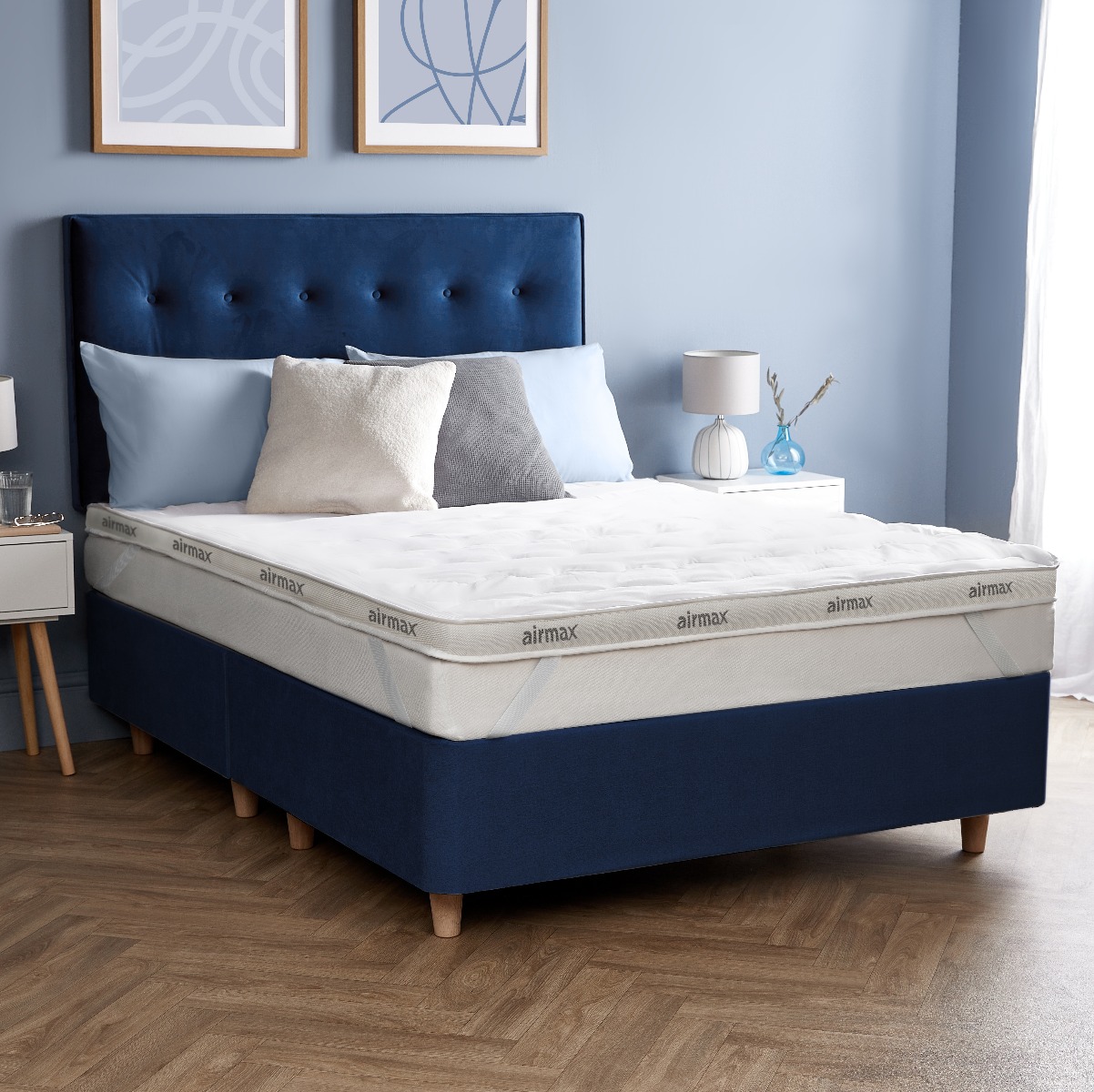
Silentnight Airmax Mattress Topper
★★★★☆ 3.5 / 5
Thirty eight pounds for a double, eight centimetres deep, hollowfibre polyester with air mesh side walls, and the only topper on this page you can put in a washing machine whole. For a guest room, a child’s bed or a student let that combination is hard to argue with.
The air mesh sides are the actual feature. They let air move through the topper rather than trapping it the way a foam slab does, and testers rate it for temperature regulation on that basis. There is no polyurethane and no memory foam in it, so there is no foam VOC event either. Any smell is packaging and fresh polyester and it airs off quickly. If you cannot afford wool but you do not want a foam slab in the bedroom, this is the answer.
What it will not do is support you. It softens a hard surface and that is the whole job. It will not correct spinal alignment and it will not rescue a mattress that has gone. And hollowfibre has one well known failure mode, which is that the crimped fibres lose their spring and the loft collapses. Two to three years is typical and owners report noticeable flattening well inside that.
The point we would rather make than calling it a bargain is this. At £38 it is a two to three year consumable made from virgin polyester, and it is polyester fill in a polyester casing that you are actively encouraged to machine wash, which makes it the biggest microfibre shedder on this page. Buy it three times and you are most of the way to a wool topper that lasts a decade. Wash it only when it needs it, cool and short, in a fibre catching bag.
Pros
- The only topper here you can machine wash whole, which matters on a child’s bed
- Air mesh side walls give real airflow, and testers rate it for temperature
- No foam, so no off-gassing and no flame retardant chemistry
- Light, easy to fit, elasticated corner straps, and £38 for a double
Cons
- Comfort, not support. It will not fix alignment or a sagging mattress
- Hollowfibre flattens. Two to three years is normal and often less
- Polyester fill in a polyester casing designed to be laundered, so the highest microfibre shed here
- No certifications published at all, and only a two year warranty
Buy it if it is for a spare room, a child or a rental and washability is the point. Skip it if you want it to last, or you are trying to reduce synthetic fibres in the house.
Prices checked 5 August 2026 and may have changed since.
The clean pick, and the honest catch
Our clean pick
Woolroom Deluxe Wool Topper
Nothing in it needs airing out
Why it wins on materials
✓
No foam, so nothing to off-gas
✓
No flame retardant chemistry, and no legal reason for any
✓
Certified to the infant tier, and published
✓
No gel, no biocide, no microfibres
What you give up
✕
Dry clean only
✕
It will not fix a bad mattress
✕
It is £289.99, and the trial is a returns window
The catch, said plainly. Our rule is that the clean pick has to be a product we would actually recommend, not just the least synthetic thing in the room, and this one clears that bar. But it is expensive, it is dry clean only, it does very little for motion transfer, and it is not vegan. If price is the obstacle, the Devon Duvets topper is the same argument for eighty pounds less and the only reason it sits second is that you cannot verify it yourself. If you want plush rather than supportive and you still want no foam, the Soak and Sleep down topper is chemically just as inert and considerably softer. And if your mattress is genuinely too firm, none of the three will fix that, and you should buy the Simba and air it properly.
What to look for when you buy one
The fill decides everything else. Depth, price, whether it off-gasses, whether it can go in a machine and how long it lasts all follow from what is inside it, so start there and work outwards.
Wool
Regulates temperature in both directions by moving moisture vapour rather than by insulating, which is why hot sleepers who wake up damp get more out of it than they expect. Naturally flame resistant so it needs no treatment. Naturally inhospitable to dust mites. Adds cushioning and a little bounce, not orthopaedic support. Almost never washable. Heavy. It is the longest lasting fill here by a distance, with owners reporting ten years and more.
Down and feather
Softness and insulation, not support. Dual chamber designs with feather underneath and down on top are much better than single chamber ones because the fill cannot migrate into the corners and leave you on a cold spot. Needs shaking out weekly and a professional clean roughly twice a year. If allergies are a concern, look for a cleanliness rating such as Superclean or a turbidity and oxygen figure, and understand that it addresses dust protein rather than feather allergy.
Memory foam
The best pressure relief per pound and the reason most people buy a topper at all. Slow sinking, which some people love and others describe as being stuck in a trench. It sleeps warmer than everything else, and gel infusion, bamboo covers and charcoal take the edge off that rather than solving it. It is polyurethane, it will off-gas when new, and in the UK it will contain flame retardant chemistry to meet BS 7177. Look for CertiPUR on the foam and OEKO-TEX Standard 100 on the cover, and understand that neither of those means chemical free.
Hybrid foam and microspring
A foam comfort layer over pocketed microsprings. Cooler and more responsive than solid memory foam, better at stopping you feeling a partner move, more supportive, and considerably more expensive. Same off-gassing and flame retardant position as memory foam, plus polyester spring pockets.
Hollowfibre and microfibre polyester
Cheap, light, washable, and hypoallergenic in the dust mite sense. It softens a hard surface and does nothing else. It compresses fast and most owners replace them inside three years. No off-gassing and no flame retardant, but the highest microfibre shed of any fill, because it is polyester throughout and you are encouraged to launder it. One warning: read the fill composition rather than the product name. Several toppers sold as wool are polyester filled with a wool face fabric.
Latex, which is worth knowing about even though none made this list
Natural latex is the other genuinely low-tox foam option. It is responsive rather than slow sinking, sleeps cooler than memory foam and lasts well, but UK availability is thin and the products that exist are expensive and lightly reviewed. Two things to know. Latex rubber foam is caught by the 1988 fire regulations in the same way polyurethane is, with its own ignitability test, so a latex topper sold as a sleeping surface is not automatically treatment free. And natural latex contains proteins that can trigger latex allergy. Check whether a product is 100 per cent natural latex or a natural and synthetic blend, because the word latex on its own tells you nothing.
Depth
Under 3cm is a protector, not a topper, whatever the listing calls it. Four to five centimetres is the practical sweet spot for wool and for memory foam, enough to change the feel of a mattress while ordinary deep fitted sheets still go over it. Six to eight centimetres is what you need if the mattress is genuinely too firm or you have hip or shoulder pressure pain, and you should budget for extra deep fitted sheets. Over 8cm is rarely necessary and increasingly likely to slide, to leave you perched above the mattress edges and to make getting in and out awkward. Check the topper’s maximum mattress depth too.
How it attaches
Elasticated corner straps are the minimum and every topper here has them. An anti-slip base is the meaningful upgrade, and Panda and Simba both have one. Even then it is not infallible. The most useful practical tip we can give you is that a well fitted deep or extra deep fitted sheet pulled tightly over both mattress and topper does more to stop movement than the straps do.
Washability, honestly
Only the polyester ones go in a machine whole. Foam toppers have a removable cover and the foam itself must never be soaked or washed. Wool is spot clean or dry clean only. Down needs a professional wash and dry, and it must come out bone dry or the fill clumps and the feather odour gets worse. For everything that cannot be washed, the answer is a washable cotton protector over the top, which is exactly what the manufacturers tell their own customers.
How long before it flattens
Hollowfibre and microfibre, two to three years and often noticeably less. Memory foam, three to five years, but expect body impressions much sooner, and note that a ten year guarantee covers manufacturing defects rather than the normal softening that foam does. Hybrid foam and spring, five years or more. Down and feather, five years plus if you shake it out weekly. Wool, the longest by a wide margin, with owners reporting a decade and more. Wool compresses a little in the first weeks and then settles. It cannot be plumped back the way down can, but it does not collapse either.
Final verdict
Buy the wool, or buy the foam on purpose
This category splits more cleanly than most. Four of these six toppers contain no foam, no adhesive and no flame retardant chemistry, and two of them do, and the two that do are the two that will actually rescue a mattress that is too hard. There is no product that is both.
So decide which problem you have. If your mattress is structurally sound and you just want a better surface to sleep on, buy wool. The Woolroom Deluxe if you want it certified to the infant tier and verifiable, the Devon Duvets if you would rather have thicker fill and eighty pounds back. Both will still be on the bed in ten years, which no foam topper will.
If your mattress is genuinely too firm, or you are waking with hip or shoulder pain on a hard surface, buy the Simba Hybrid, unwrap it in a ventilated room and give it two days before you sleep on it. It is foam, it will contain flame retardant chemistry because UK law requires that, and it is the honest answer to that problem.
And if what you actually need is a soft guest bed for forty quid, the Silentnight Airmax is fine. Just know you are buying a two or three year consumable, and that buying it three times costs about the same as buying wool once.