Home · Laundry · Machine care
Best washing machine cleaners: six compared, and Bosch and Miele say you do not need the famous one
Six products, and one question that has been argued about for twenty years: does a washing machine need a separate water softener added to every wash? We went to the appliance manufacturers’ own manuals rather than to the adverts. Bosch says descaling should not be necessary if the detergent is measured out correctly. Miele says if the correct amount of detergent is dispensed, the machine should not need to be descaled, and frames a softener as a way to use less detergent rather than to protect the machine. That is the market leader’s core claim, answered by the two manufacturers most likely to know.
By Mrs House · Updated 9 September 2026 · 15 minute read
Mrs House is independent. Nobody pays for a place in a ranking here.
The short answer
Run an empty wash at 60 degrees or above once a month with an oxidising product in the drum. That is what the published research supports, and it is most of the job.
- Best overall: Dr. Beckmann Service-it Deep Clean, £2 for 250g. It does the actual cleaning.
- Cheapest: Dri-Pak Soda Crystals, £3.99 a kilo, about £1.20 a use.
- If you want a softener: Sainsbury’s Limescale Preventer at 10.4p a tablet, rather than Calgon at 40p, because the claimed job is identical.
Calgon works out at £104 a year against £27.16 for the Sainsbury’s tablets, so read the per tablet price rather than the pack price.
How we assessed these
Six products, and the first thing to sort out is that they do two completely different jobs and the shelf does not tell you which is which.
Cleaning is about biofilm, the black mould in the door seal and the detergent scum in the drawer. That is a biological and organic problem and it is addressed by heat plus an oxidiser or a strong surfactant. Descaling is about calcium carbonate on the heating element. That is a mineral problem and it is addressed by an acid, usually citric or sulfamic. Water softening is a third thing again: it stops scale forming rather than removing what is there.
A product that softens cannot remove existing scale. A product that descales does nothing to biofilm. And one product in this comparison is sold under the shelf heading washing machine cleaner tablets while containing no oxidiser and no acid at all.
Five things decided the scores.
Which job it actually does, against what the packaging implies.
What the appliance manufacturers say, in their own manuals, about whether you need it.
Cost per use and cost per year at the maker’s own recommended frequency.
Ingredient and hazard disclosure, because two products here carry stronger labels than people expect and two publish no signal word at all.
Whether the dose scales with your water hardness, which for a softening product is the whole point.
All prices read on 9 September 2026.
The ranking, at a glance
| Product | Size and price | Job it does | Per use | Per year | Score | |
|---|---|---|---|---|---|---|
| 1 | Dr. Beckmann Service-it Deep Clean | 250g, £2.00 | Cleans | £2.00 | £12 to £24 | 3.3 |
| 2 | Sainsbury’s Limescale Preventer | 45 tabs, £4.70 | Softens | 10.4p | £27.16 | 3.2 |
| 3 | Dri-Pak Soda Crystals | 1kg, £3.99 | Cleans | £1.20 | £14.36 | 3.1 |
| 4 | HG Descaler for Appliances | 500ml, £4.43 | Descales | 89p to £1.77 | £2.66 to £5.32 | 2.9 |
| 5 | Calgon 4-in-1 Tabs | 15 tabs, £6.00 | Softens | 40.0p | £104.00 | 2.5 |
| 6 | Ecozone BIOActive Preventor | 750ml, £3.90 | Softens | 26p to 52p | £68 to £135 | 2.3 |
The two we would actually buy
Best overall
Does the real job
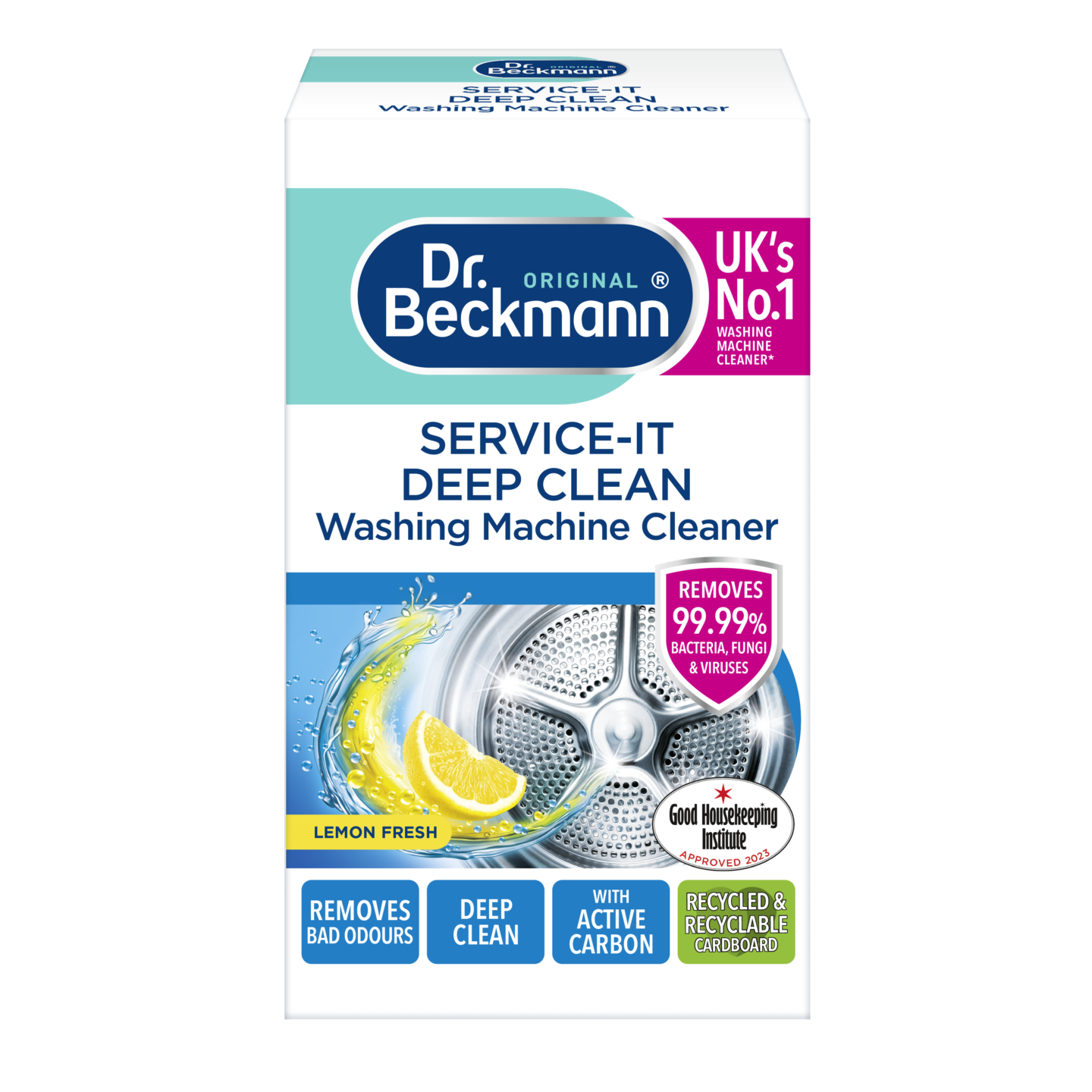
1. Dr. Beckmann Service-it Deep Clean, 250g
★★★☆☆ 3.3 / 5
£2 for a sachet that does the job that actually needs doing. The problem in a modern washing machine is not scale, it is biofilm: the black mould in the door seal, the grey sludge in the detergent drawer and the smell that transfers onto clothes. That is a biological problem caused by washing at 30 degrees, and it wants heat plus an oxidiser, which is what this is.
The research behind that is worth knowing. A 2025 paper in BMC Biology found that membrane intact bacterial load actually increased after washing, and that between 23 and 25 per cent of the bacteria on washed garments came from the machine rather than from the clothes. A 2020 study in Microorganisms found that monthly cycles at 60 degrees or above were the only factor that significantly shifted the microbial community in a machine. The consensus dose across the literature and the manufacturers is the same: empty drum, monthly, 60 degrees or hotter, with an oxidising product.
The criticism, and it is a real one, is that the recurring complaint in its reviews is that it perfumes rather than cleans. The three star cluster is consistent on that. And its 99.99 per cent claim carries no EN standard, which by now you will recognise as the pattern across this whole site. Use it in an empty 60 degree wash rather than expecting it to work at 30, and it does what it should.
Pros
- Targets biofilm and odour, which is the problem modern machines actually have
- £2.00 a use, and at monthly to quarterly that is £12 to £24 a year
- Dr. Beckmann publishes ingredient information properly on its own site
- Sold in every supermarket, so no subscription or special order
- Works with the 60 degree empty cycle that the published research supports
Cons
- The recurring review complaint is that it perfumes rather than cleans, and the three star cluster is consistent on it
- The 99.99 per cent claim names no EN standard, no contact time and no organisms
- Does nothing about limescale, so in a hard water area it is only half the answer
- £2.00 a sachet is expensive next to soda crystals at £1.20 doing a similar job
- No verbatim one or two star reviews were retrievable from any UK retailer
- The dose does not scale with water hardness
Buy it if you want to deal with the smell and the door seal mould, and you will run it empty at 60 degrees rather than in with a normal wash.
Best value
10.4p against 40p
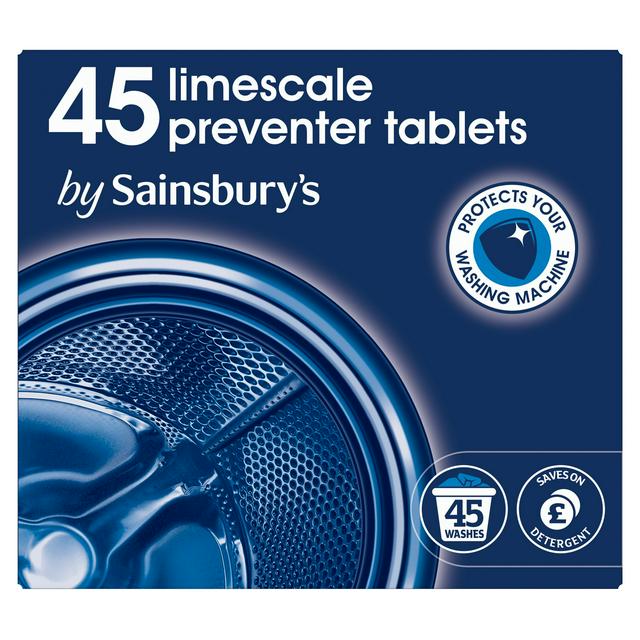
2. Sainsbury’s Limescale Preventer Tablets, 45
★★★☆☆ 3.2 / 5
If you have decided you want a water softener in every wash, this does the identical job to the market leader for a quarter of the price. 10.4p a tablet against 40p, which over a year of daily washing is £27.16 against £104. That is £76.84 a year of difference for the same claimed function.
We should be clear that we are not endorsing the function, for the reasons set out throughout this piece. What we are saying is that if you are going to buy it, there is no case for paying 3.8 times more for it. The chemistry in these products is polycarboxylates and related builders, and there is nothing proprietary about them.
The gap is disclosure. Sainsbury’s publishes no ingredient panel for this product at all, which is a Detergents Regulation shortfall and worth naming. It also publishes no signal word and no hazard classification. So you are buying the cheap version of a product whose necessity is doubtful, from a retailer that will not tell you what is in it. On value it is the clear answer. On everything else it is thin.
Pros
- 10.4p a tablet against 40p for the market leader, saving £76.84 a year at daily use
- The same claimed function and the same class of chemistry as the brand
- Available on the weekly shop with no subscription
- 45 tablets in a box, so it lasts about six weeks at daily use
Cons
- Sainsbury’s publishes no ingredient panel for it at all, which is a Detergents Regulation shortfall
- No signal word and no hazard classification published
- Does the job that Bosch and Miele both say is unnecessary if you dose detergent correctly
- Cannot remove existing scale, because it is a preventer rather than a descaler
- No hardness dependent dose published
- No independent test data and very little review evidence
Buy it if you have already decided you want a per wash softener and you object to paying four times the price for the same thing.
The control, and the one that actually descales
The clean pick
One ingredient
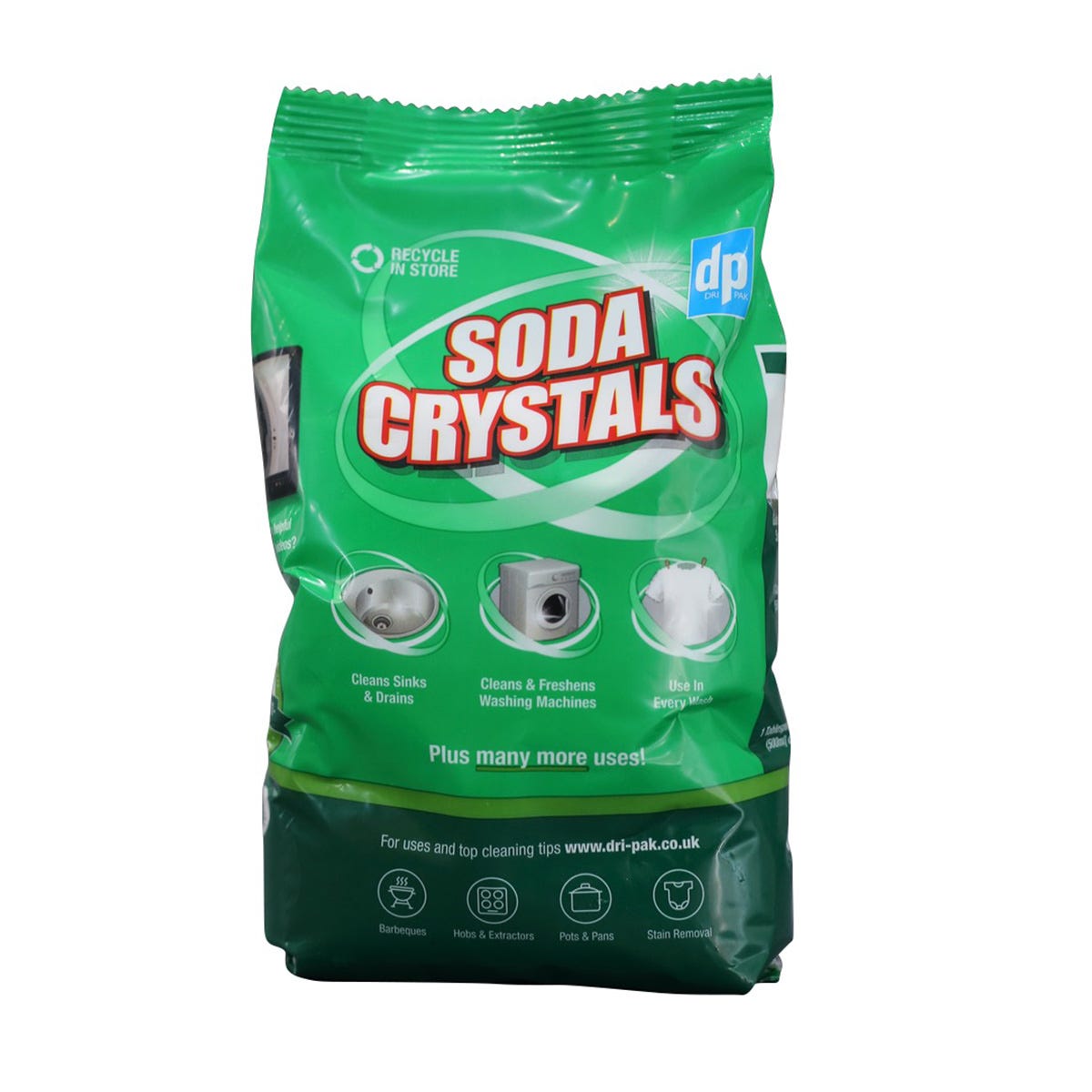
3. Dri-Pak Soda Crystals, 1kg
★★★☆☆ 3.1 / 5
Sodium carbonate. That is the whole product. One ingredient, no fragrance, no colourant, no biocide, no optical brightener, and nothing on the label you need to look up. £3.99 for a kilo, about £1.20 a use and £14.36 a year at monthly use.
Soda crystals raise the pH of the wash water, which helps lift grease and soap scum from the drum and the pipework, and they soften water by precipitating the calcium. So they do a version of both jobs the branded products split between them, and they do neither as aggressively as a dedicated product. Run a kilo through an empty machine at 60 degrees once a month and you are doing most of what any product on this page does.
What they will not do is oxidise. A percarbonate based cleaner is better on biofilm and a citric or sulfamic acid descaler is better on established scale. So this is the maintenance option rather than the rescue one, and if your machine already smells you should clear it with an oxidiser first and then keep it clear with this. Dri-Pak also publishes almost nothing beyond the obvious, and the product carries no certifications.
Pros
- One ingredient, sodium carbonate, with nothing to look up and nothing to react with
- £1.20 a use and £14.36 a year at monthly use
- Does a version of both jobs: lifts grease and scum, and softens the water
- No fragrance, no colourant, no biocide and no optical brightener
- Also useful all over the house, so it is not a single purpose purchase
Cons
- No oxidiser, so it is weaker than a percarbonate cleaner on established biofilm
- Not an acid, so it will not remove scale that has already formed on the element
- Dri-Pak publishes very little product information and no certifications
- It is an alkali, so it should not be used on aluminium parts
- Almost no independent review evidence exists
- Needs the 60 degree empty cycle to do much, so it is not a shortcut
Buy it if you want the shortest possible ingredient list and a monthly maintenance habit rather than a rescue product.
The real descaler
Danger, H314
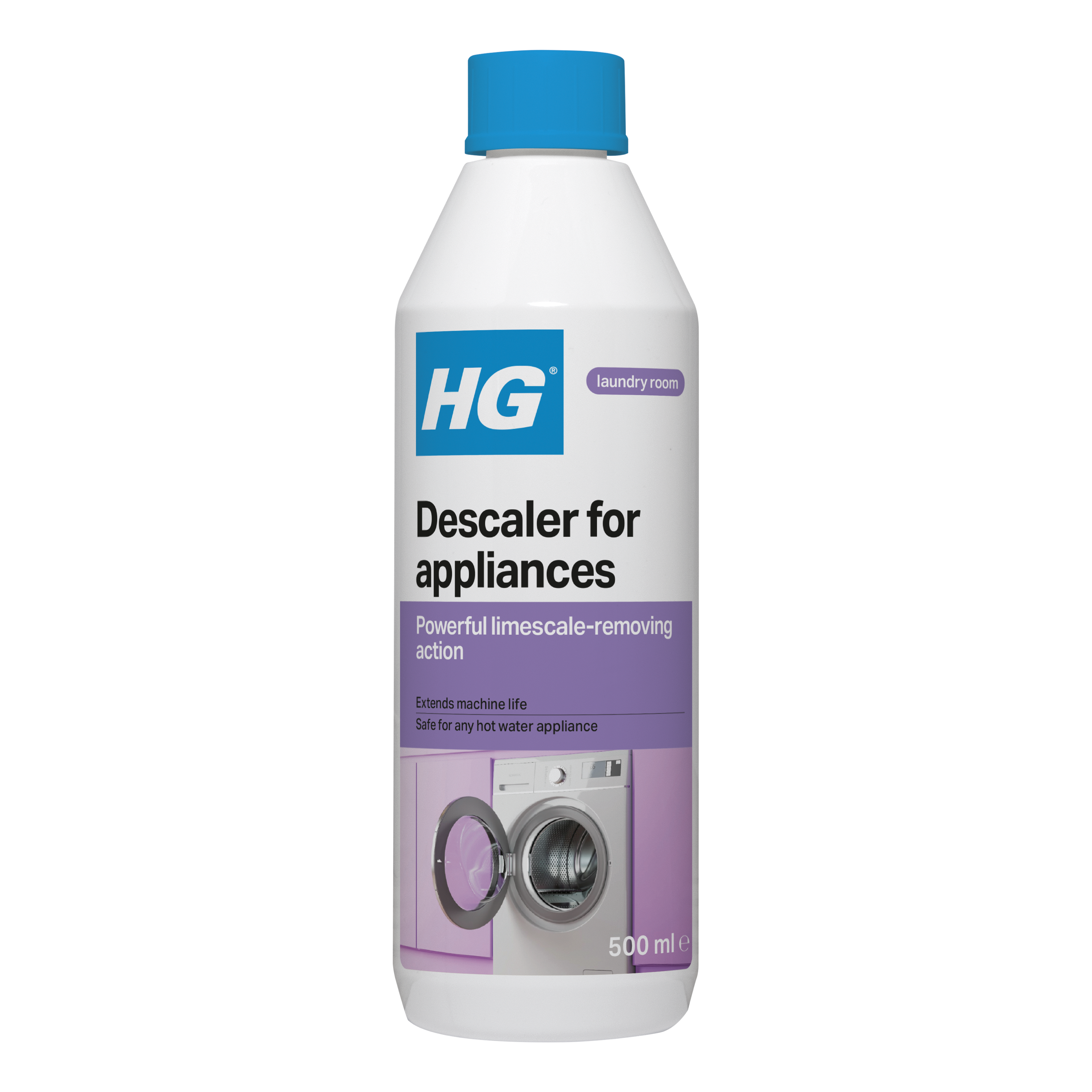
4. HG Descaler for Appliances, 500ml
★★★☆☆ 2.9 / 5
This is the only product in the comparison that will remove limescale that has already formed, because it is the only one that is an acid. If there is a visible crust on the element or the machine has been running in hard water for years without attention, nothing else on this page touches it and this does.
It is also, by some distance, the most hazardous. Signal word Danger, H314 and H318, skin corrosive category 1, and formaldehyde declared at under 0.1 per cent. That is a stronger label than the oven cleaners in most respects, on a product that lives in a utility cupboard. It is not a monthly product. Miele’s guidance, for what it is worth, specifies a natural citric acid based descaling agent if you descale at all, which this is not.
On cost it is the cheapest here per year precisely because you should hardly ever use it: 89p to £1.77 a use, and at the recommended frequency £2.66 to £5.32 a year. HG also publishes its data properly, on an unrestricted site, with a full safety data sheet, which is consistent with everything else we have found about that brand.
Pros
- The only product here that removes scale that has already formed, because it is the only acid
- £2.66 to £5.32 a year at the recommended frequency, the cheapest annual cost in the comparison
- HG publishes a full safety data sheet on an unrestricted website
- A real solution to a real problem in a genuinely hard water area
Cons
- Signal word Danger, H314 and H318, skin corrosive category 1, the strongest label in this comparison
- Formaldehyde declared at under 0.1 per cent
- Miele specifies a citric acid based descaler if you descale at all, and this is not one
- Not a maintenance product, so it does nothing for biofilm or smell
- Only five reviews available anywhere, so the owner evidence is very thin
- Needs care and gloves in a cupboard where most products do not
Buy it if your machine is in a hard water area and has visible scale, and you are treating this as an occasional job rather than a routine.
The famous one, and the eco one
The market leader
£104 a year
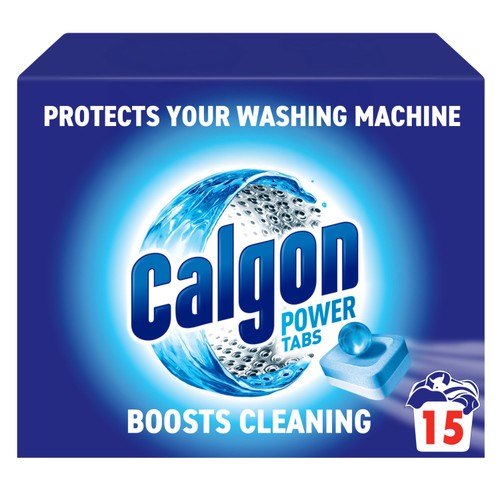
5. Calgon 4-in-1 Water Softener Tabs, 15
★★★☆☆ 2.5 / 5
Everybody knows the advert. So we went to the two appliance manufacturers most likely to know whether the machine needs this, and read what they tell their own customers in their own manuals.
Bosch, in three current model manuals with identical wording: descaling should not be necessary if the detergent is measured out correctly. Bosch nowhere instructs you to add a water softener, and its stated remedy for hard water is to dose detergent to local hardness. Miele: if the correct amount of detergent is dispensed, the machine should not need to be descaled. Miele’s own water softeners section frames a softener as a way to cut down on the use of detergents, and its website says plainly that your Miele washing machine does not need water softeners, but they can improve performance and help you use less detergent. That is a detergent saving argument, not a machine protection one. AEG does recommend a descaler, but its own table says households in soft water doing fewer than four washes a day need none at all.
The independent testers agree. Stiftung Warentest states that modern detergents contain sufficient softeners when correctly dosed. The German consumer body Verbraucherzentrale Hamburg says adding one is fundamentally unnecessary. Which? simulated three years of washing at 40 degrees in 2011 and reported that the sediment forming without Calgon was insufficient to affect the running of the machine, and put the cost at around £295 over six to eight years. Reckitt said it had supporting research and declined to publish it as commercially sensitive. Which? lodged a complaint with the Advertising Standards Authority; we searched the ASA rulings database directly and no ruling was ever published, so the question was never adjudicated either way.
Two more things. Calgon is 15 to 30 per cent polycarboxylates plus perfume, with no oxidiser and no acid, so it cannot clean an established biofilm and cannot remove existing scale, yet it is sold at three major supermarkets under the shelf heading washing machine cleaner tablets and the pack says boosts cleaning. And its tablet publishes no hardness dependent dose at all, one tablet per wash everywhere in the country, while Calgon’s own gel version does publish one. At 40p a wash it is £104 a year.
Pros
- Very widely available and the best known product in the category
- Calgon’s gel version does publish a hardness dependent dose, which is the correct approach
- Polycarboxylate builders do genuinely sequester calcium, so the chemistry works as described
- If you are in a very hard water area and under dose your detergent, it will do something
Cons
- Bosch and Miele both state in their own manuals that descaling should not be necessary if detergent is dosed correctly, and Miele frames a softener as a detergent saving rather than machine protection
- £104 a year at daily use, against £27.16 for a supermarket tablet making the identical claim
- Contains no oxidiser and no acid, so it cannot clean biofilm or remove existing scale, yet is shelved as a cleaner and says boosts cleaning
- The tablet publishes no hardness dependent dose, one tablet everywhere, while the same brand’s gel does
- Reckitt declined to publish its supporting research when Which? asked in 2011, citing commercial sensitivity
- Calgon’s ingredient route points at a portal that returns nothing, so no ingredient list is readable
- No signal word or hazard classification published
Buy it if you are in a very hard water area, you know you under dose your detergent, and the peace of mind is worth £104 a year to you.
The eco one
Magnetic claims

6. Ecozone BIOActive Limescale & Dirt Preventor, 750ml
★★☆☆☆ 2.3 / 5
Ecozone does one thing here better than the market leader: it scales its dose by water hardness, which for a softening product is the entire point and which Calgon’s tablet does not do. Credit where it is due.
Everything else is difficult. At 26p to 52p a dose it works out at £68 to £135 a year, which is in the same territory as Calgon and up to five times the supermarket tablet. It publishes no signal word and no hazard classification. And there is one review in total on some listings, so there is essentially no owner evidence in either direction.
The awkward one is elsewhere in the same range. Ecozone sells a £12.75 magnetic ball for washing machines described as scientifically proven with magnetic power. The Committee of Advertising Practice guidance on water treatment devices is specific that magnetic conditioners cannot claim equivalence to softeners. We are not saying the ball is being sold unlawfully, because we have not seen the substantiation, but a brand making that claim in the next aisle over makes it harder to take its softening claims here on trust.
Pros
- Scales its dose by water hardness, which the market leading tablet does not do
- Plant based positioning with recyclable packaging and a real environmental stance at brand level
- A liquid rather than a tablet, so you can genuinely dose it down in soft water
Cons
- £68 to £135 a year, in the same territory as Calgon and up to five times a supermarket tablet
- No signal word and no hazard classification published
- One review in total on some listings, so there is almost no owner evidence
- Its Ecolabel claim carries no licence number
- Ecozone sells a magnetic ball in the same range described as scientifically proven, against CAP guidance that magnetic conditioners cannot claim softener equivalence
- Does the job that Bosch and Miele both say is unnecessary if detergent is dosed correctly
Buy it if you want a plant based softener specifically, you have hard water, and you value the hardness dependent dosing.
Prices checked 5 August 2026 and may have changed since.
The clean pick, and the honest catch
Our clean pick
Dri-Pak Soda Crystals
Sodium carbonate, and nothing else at all
Why it wins on ingredients
✓
One ingredient
✓
It does a version of both jobs
✓
£14.36 a year
✓
It works with the cycle the research supports
What you give up
✕
No oxidiser, so it is not a rescue
✕
It will not remove existing scale
✕
Almost no evidence base
The catch, said plainly. Our rule is that if a category has a genuinely clean option we name it, and here there is one, but the more useful finding is that the free version does most of the work. The published research is consistent: a 2020 study in Microorganisms found monthly cycles at 60 degrees or above were the only factor that significantly shifted the microbial community in a machine, and a 2025 BMC Biology paper found that between 23 and 25 per cent of bacteria on washed garments came from the machine itself. Heat is the active ingredient. An empty 60 degree cycle once a month, with the door and the drawer left open to dry between washes, is the intervention, and any of these products is an addition to that rather than a substitute for it. One more thing: do not use vinegar. Which? advises against it and Miele specifies citric acid, because acetic acid at the concentrations people use is both too weak for scale and hard on rubber seals.
What to look for when you buy one
Work out whether you have a cleaning problem or a scale problem, because no product does both. If the machine smells, the door seal is going black and clothes come out less fresh than they went in, that is biofilm and it wants heat plus an oxidiser. If you are in a hard water area and there is a visible crust on the element, that is limescale and it wants an acid. A water softener is a third thing again, and it prevents rather than removes. One product in this comparison contains no oxidiser and no acid at all and is shelved as a washing machine cleaner with boosts cleaning on the pack.
Read what your appliance manufacturer actually says, because it is free and it is decisive. Bosch, in three current model manuals with identical wording: descaling should not be necessary if the detergent is measured out correctly. Miele: if the correct amount of detergent is dispensed, the machine should not need to be descaled, and its own water softeners section frames a softener as a way to cut down on the use of detergents rather than to protect the machine. AEG does recommend a descaler, and its own table says soft water households doing under four washes a day need none. Those are the people who designed and warranty the machine.
Dose your detergent to your water hardness first, because that is the actual remedy. Modern detergents already contain water softening builders: zeolites, citrates and polycarboxylates. Stiftung Warentest states that modern detergents contain sufficient softeners when correctly dosed. Almost every detergent box has a hard water dose printed on it and almost nobody reads it. Look up your hardness by postcode on your water company’s website, use the hard water dose, and the case for a separate per wash softener largely evaporates.
Heat is the active ingredient, and 30 degrees is why this category exists. A 2025 paper in BMC Biology found that membrane intact bacterial load increased after washing, and that 23 to 25 per cent of the bacteria on washed clothes came from the machine. A 2020 study in Microorganisms found that monthly cycles at 60 degrees or above were the only factor that significantly shifted the microbial community. The consensus is monthly, empty drum, 60 degrees or hotter, with a powder detergent or an oxidising cleaner. Nothing you pour in at 30 degrees substitutes for that.
Leave the door and the drawer open. This costs nothing and it is the single most effective habit in this whole article. Biofilm needs moisture. A sealed drum left damp after every wash is an incubator, and the rubber door seal is where it shows first. Wipe the seal out, pull the drawer forward, and let it dry.
Calculate the annual cost, because per tablet prices hide it. At daily use the spread here runs from £2.66 a year to £104. The market leading softener costs 3.8 times what the supermarket equivalent costs for the identical claimed function, which is £76.84 a year of difference. The most expensive product per bottle, the acid descaler, has the lowest annual cost of anything here because you should be using it roughly once a year rather than once a day.
Check whether the dose scales with hardness, because for a softener that is the entire point. A water softener that tells you to use one tablet per wash whether you live in Glasgow or Ipswich is either overdosing you or underdosing you, and it does not know which. In this comparison the market leading tablet publishes no hardness dependent dose while the same brand’s gel version does, and two of the cheaper products scale properly. Look up your hardness figure, then look for a product that asks for it.
Do not use vinegar, and be careful which acid you do use. Which? advises against vinegar in a washing machine and Miele specifically recommends a natural citric acid based descaling agent instead. Acetic acid at household concentrations is too weak to shift real scale and is hard on rubber seals and hoses over time. If you are descaling, use citric or sulfamic acid, follow the dose, and note that the strongest product in this comparison carries Danger, H314 and H318, which is a serious label for a utility cupboard.
Watch for the germ claims here too. One product in this comparison claims 99.99 per cent with no EN standard, no contact time and no organism list, which is the same pattern we have found on toilet cleaners, washing up liquids and stain removers. A machine cleaner is not a disinfectant and does not need to be. What it needs to do is remove the biofilm, and the evidence for that is about temperature and mechanical action rather than about a kill percentage.
And be sceptical of anything magnetic. The Committee of Advertising Practice guidance on water treatment devices is specific that magnetic water conditioners cannot claim equivalence to water softeners. If you see a magnetic ball or an in line magnetic device sold on the basis that it softens water or prevents limescale in the way a chemical softener does, that claim is on thin ice, whatever the packaging says about being scientifically proven.
Final verdict
Run it empty at 60 once a month, and read your own manual
Three things to take away.
The first is that the manufacturers of the machines do not agree with the advert. Bosch says descaling should not be necessary if the detergent is measured out correctly. Miele says the same and describes a water softener as a way to use less detergent rather than a way to protect the machine. Stiftung Warentest says modern detergents already contain enough softener when dosed properly. Which? simulated three years of washing and found the sediment that formed without a softener was insufficient to affect the running of the machine. When Which? asked to see the manufacturer’s supporting research, it was declined as commercially sensitive, and the complaint it lodged with the advertising regulator never produced a published ruling.
The second is that if you do want a per wash softener, you should not pay four times over for it. The supermarket tablet makes the same claim at 10.4p against 40p, which is £27 a year against £104.
The third is that the problem most people actually have is not scale at all. It is biofilm from washing at 30 degrees, and the fix is an empty drum at 60 degrees or above once a month with an oxidising product, plus leaving the door and drawer open to dry. That is what the published research supports, and the heat is doing most of the work.
Our pick is the Dr. Beckmann sachet at £2 for the monthly clean, the Dri-Pak soda crystals at £14.36 a year if you want the shortest ingredient list, and the HG descaler once if you genuinely have scale. Before any of them, look up your water hardness and read the dosing panel on your detergent.