Home · Cleaning · Damp, mould and air quality
Best mould removers: six compared, and none of them fix the actual problem
Every product here is bleach in a spray bottle, apart from one, and that one came last. The thing worth knowing before you buy any of them is that mould is a symptom of moisture, and cleaning a symptom is not a repair.
By Mrs House · Updated 12 August 2026 · 11 min read
Mrs House is independent. Nobody pays for a place in a ranking here, and no brand saw this page before it went live.
The short answer
Buy the Cillit Bang at £3.50. It has the highest concentration of the thing that works, the longest published contact time and the fullest safety data on this page.
- Best overall: Cillit Bang Black Mould, £3.50 for 750ml. 2.19 per cent sodium hypochlorite and a 15 minute contact time.
- Cheapest for a big job: Asda Just Essentials thin bleach, £1.17 for 2 litres. The same active chemistry for a fifth of the price per litre, but it runs off a vertical wall instead of clinging to it.
- Skip: Ecozone Mould Remover, £5.75. The bleach free one, with no published contact time and the weakest result here.
You are removing a stain, not fixing the cause. Unless the damp or the ventilation gets sorted it comes back, and the government, the NHS and the Housing Ombudsman all say so in those words.
How we assessed these
Six products, one method, applied to all of them equally, including a bottle of supermarket thin bleach we put in as the control.
For every product we found the safety data sheet rather than relying on the front of the bottle, because that is where the actual concentration of sodium hypochlorite is written down and where the hazard classification lives. We recorded the published contact time, the surfaces each one says it must not touch, and whether the brand claims to kill mould or only to remove the stain, in its own words, because those are two very different claims and most of these are careful never to make the first one.
We looked for a cited efficacy standard on every product, the sort of thing a professional disinfectant carries, and only one of the six cites any at all. Then we read the building science on whether bleach actually kills mould in a porous surface, which is more contested than either the brands or their critics admit, and the UK guidance on damp and mould from the NHS, the Housing Ombudsman and the Awaab’s Law statutory guidance.
Every product is scored on the same five parts: does it work (35 per cent), what it is made of (25 per cent), value (15 per cent), everyday use (15 per cent) and honesty of the claims (10 per cent). Where a brand would not publish something we asked for, we say so on the page and we mark it down for it.
The ranking, at a glance
| Product | Price | Size | Active | Contact time | Standard cited | Score | |
|---|---|---|---|---|---|---|---|
| 1 | Cillit Bang Black Mould | £3.50 | 750ml | Sodium hypochlorite 2.19% | 15 minutes | None | 3.6 |
| 2 | Dettol Mould and Mildew | £4.00 | 750ml | Sodium hypochlorite 2.59% | 5 minutes | EN 1276, 13697, 1650, 14476 | 3.5 |
| 3 | Asda Just Essentials Thin Bleach | £1.17 | 2 litres | Sodium hypochlorite, about 1.5% | Not stated | None | 3.3 |
| 4 | HG Mould Spray | About £6.50 | 500ml | Sodium hypochlorite 1 to 5% | 10 or 30 minutes, sources differ | None | 3.1 |
| 5 | Astonish Mould and Mildew Blaster | £1.49 | 750ml | Sodium hypochlorite 1 to 5% | Not published | None | 2.9 |
| 6 | Ecozone Mould Remover | £5.75 | 500ml | Benzalkonium chloride | Not published | None | 2.4 |
Five of the six are the same active chemistry at slightly different strengths. The standards Dettol cites are surface disinfection standards for bacteria, viruses and yeasts, not a mould spore kill test, which is worth knowing before the logo does its work on you.
The two we would actually buy
Best overall
£3.50
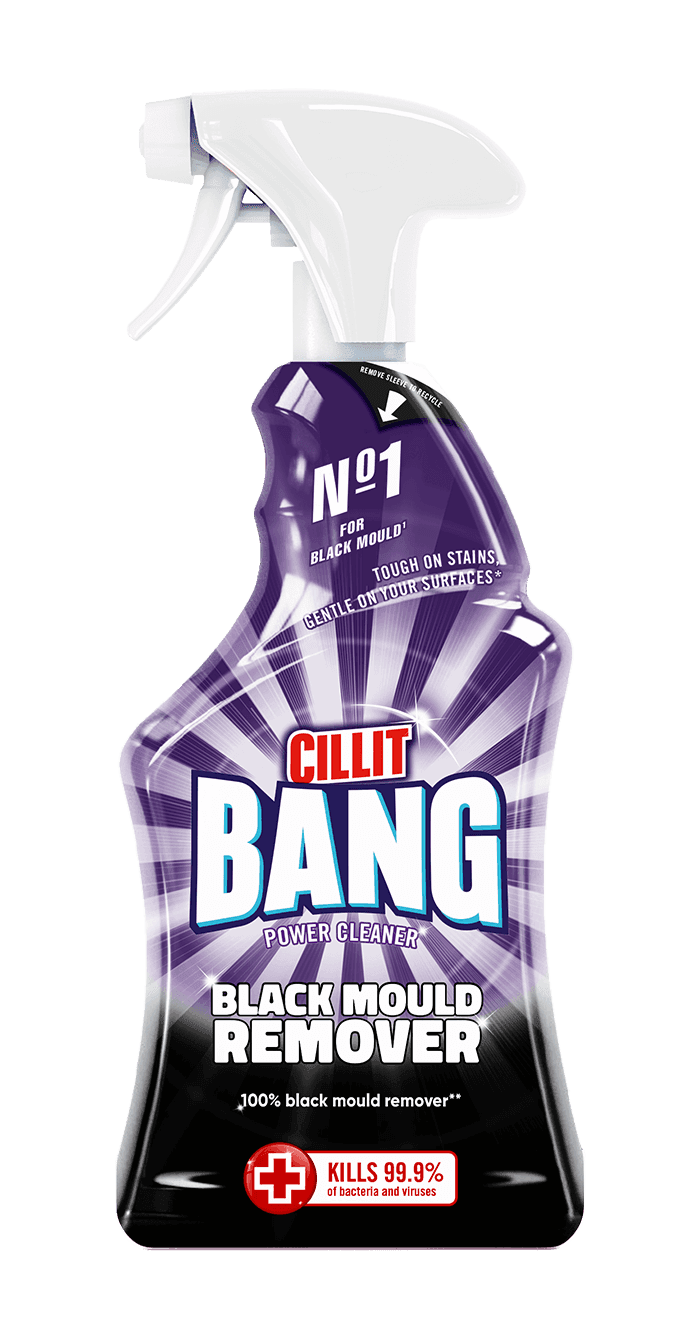
1. Cillit Bang Black Mould Remover
★★★½☆ 3.6 / 5
£3.50 for 750ml, and it wins on the boring things. The safety data sheet gives the sodium hypochlorite at 2.19 grams per 100 grams with an amine oxide surfactant at 0.18 per cent, the full CLP classification and the hazard statements. It publishes a separate contact time for black mould, 15 minutes, which is three times what Dettol asks for and is the longest here. And 4.7 from 152 reviews on Tesco is the deepest review pool on this page.
The claim wording is careful and worth reading properly. It says it removes 100 per cent of visible black mould, and separately that it kills 99.9 per cent of bacteria and viruses. Those are two claims and neither of them is a mould spore kill claim. That is not a criticism of Cillit Bang, it is the whole category, and the ones that phrase it loosely are the ones to worry about.
The list of things you must not put it on is long: textiles, carpets, wood, marble, granite, brass, copper, old porcelain and laminated plastic. It is corrosive to metals. And it carries the warning every bleach product here carries, which is do not use with other products, may release dangerous gases.
Pros
- A full safety data sheet with the exact concentration, classification and hazard statements
- A published 15 minute contact time for black mould specifically, the longest on this page
- 4.7 from 152 reviews, the deepest pool here
- £3.50 for 750ml, which is mid price for the strongest formulation
Cons
- Corrosive to metals, and the do not use on list runs to nine surfaces
- No efficacy standard cited at all
- Removes visible mould is a stain claim, not a spore kill claim, whatever the packaging suggests
- Chlorine fumes, and it must not be used with any other cleaner
Buy it if you want the strongest and best documented bottle on the shelf and you will leave it on for the full 15 minutes. Skip it if the mould is on wood, fabric or anything on the exclusion list.
Runner up
The only one citing standards

2. Dettol Mould and Mildew Remover
★★★½☆ 3.5 / 5
£4.00 for 750ml, sodium hypochlorite at 2.59 per cent, which is the highest declared concentration here, and it is the only product on this page that cites a named efficacy standard. Its own information sheet lists EN 13697, EN 1650, EN 14476 and EN 1276, with the organisms and a five minute contact time for each.
Read what those standards actually cover, though. EN 1276 and EN 13697 are bacterial surface tests. EN 14476 is viruses. EN 1650 is yeasts and one mould, Aspergillus brasiliensis, which is a laboratory reference organism rather than what is on your bathroom sealant. So Dettol has done more testing than anybody else here and none of it is a test of killing household black mould on a wall. That is still better than the four products that cite nothing at all.
It asks for a much shorter contact time than the Cillit Bang, five minutes maximum, and it tells you to patch test for three minutes first. The exclusion list is even longer, and includes coloured grout, which is where a lot of bathroom mould lives.
Pros
- The only product here that cites named efficacy standards, with organisms and contact times
- 2.59 per cent sodium hypochlorite, the highest declared concentration on this page
- Clear instructions, including a three minute patch test before you commit
- Widely stocked and £4.00
Cons
- The standards cited are bacterial, viral and yeast tests, not household mould tests
- Five minutes maximum contact, which is a third of what Cillit Bang allows
- Must not be used on coloured grout, which is where a lot of bathroom mould is
- No ratings at all on the Tesco listing we checked
- The published safety data sheet we could find still uses pre 2015 risk phrases
Buy it if the badge on the bottle matters to you and you want the highest concentration. Skip it if your grout is coloured, or you want a longer dwell time.
The control, and the one nobody documents
The control
59p a litre
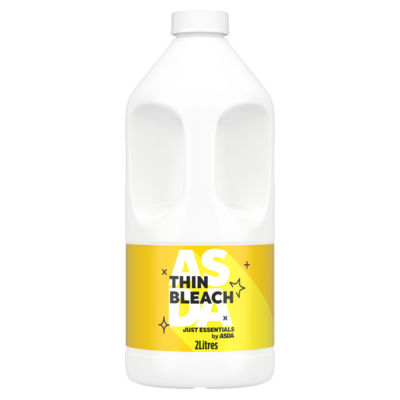
3. Asda Just Essentials Thin Bleach
★★★☆☆ 3.3 / 5
£1.17 for two litres, which is 59p a litre against £4.67 a litre for the Cillit Bang, and it is here because somebody should say it out loud. This is the same active ingredient as four of the five products above and below it. Sodium hypochlorite, at roughly 1.5 per cent, which is a little weaker than the sprays and not by much.
What you are paying the extra for in a mould spray is not really the chemistry. It is the trigger, the surfactant that makes it cling to a vertical surface for fifteen minutes instead of running down the wall, the thickener, and the instructions. On a shower ceiling that is worth paying for. On a large area, or anywhere you can lay a bleach soaked cloth or a strip of kitchen roll against the mould and leave it, thin bleach does the same job for a fifth of the money.
It scores where it scores because it is honest by default. It publishes its hazard statements, it does not claim to kill mould, and it does not claim anything else either. It is marked down because it will not stay where you spray it, there is no contact time guidance for mould, and it is the easiest product here to misuse. Never with another cleaner, never with anything acidic.
Pros
- 59p a litre, roughly a fifth of the price per litre of the sprays
- The same active chemistry as four of the other five products here
- Publishes its hazard statements and makes no claim it cannot support
- Fine on a flat surface, or held against mould with kitchen roll
Cons
- Runs straight off a vertical wall, which is most of what you actually want to treat
- No contact time or method guidance for mould at all
- About 1.5 per cent hypochlorite, weaker than the sprays
- The easiest product here to mix with something dangerous by accident
Buy it if the job is big, or flat, or you are happy to hold a soaked cloth against it. Skip it if it is a shower ceiling, where clinging is the entire point.
Works well
Tells you least
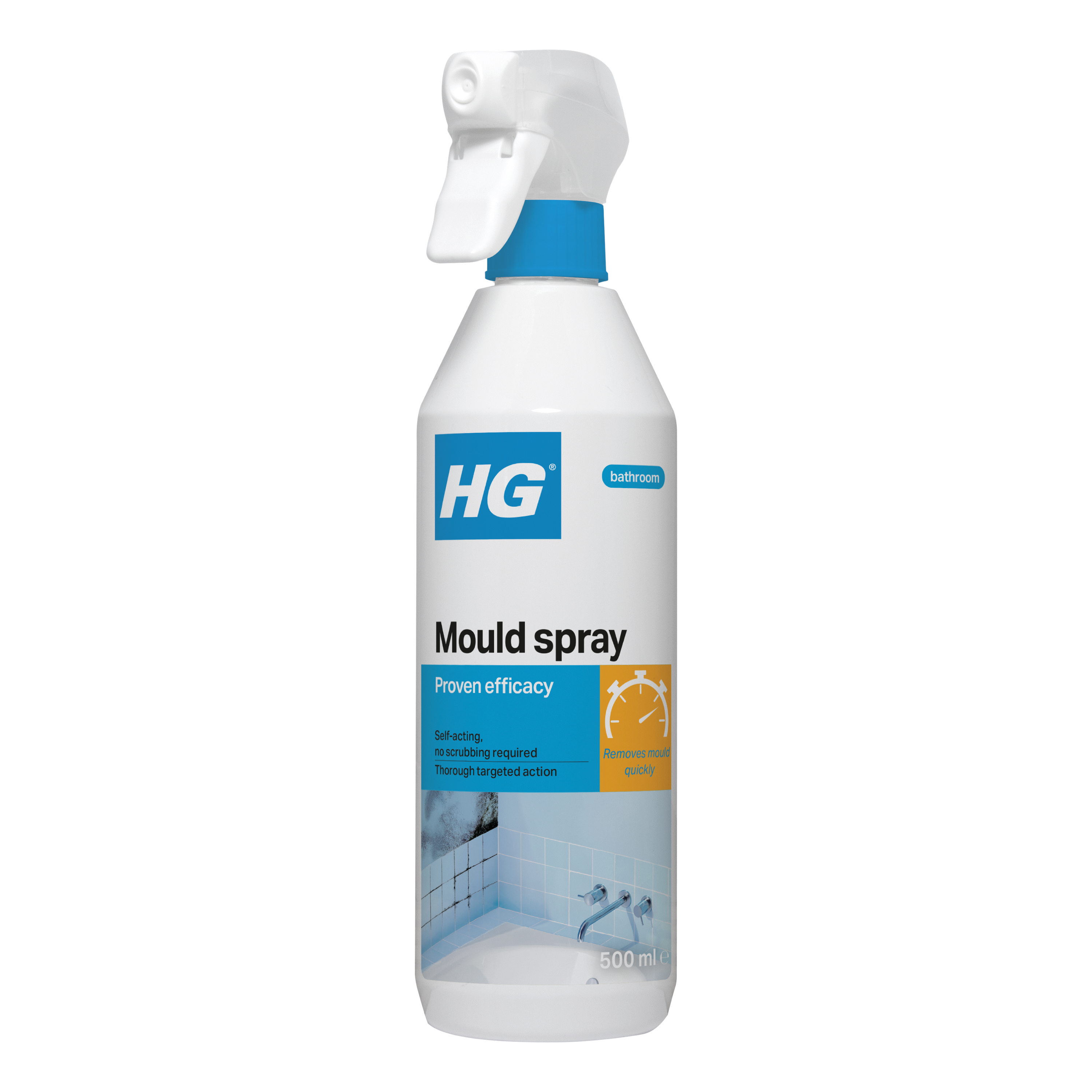
4. HG Mould Spray
★★★☆☆ 3.1 / 5
About £6.50 for 500ml depending where you buy it, and by price per litre it is the most expensive bleach on this page by a distance. The safety data sheet gives sodium hypochlorite at 1 to 5 per cent plus sodium hydroxide at 0.5 to 2 per cent, which is a caustic addition the others do not declare, and the classification includes very toxic to aquatic life.
The people who like it really like it, and several describe mould staying away for months after treatment. The problem is that HG publishes almost nothing on the consumer page: no ingredients, no efficacy standard, and two different contact times depending on which of its own retail listings you read, ten minutes on one and thirty on another. For a product this strong that is careless.
HG as a company sits at 2.2 on Trustpilot across 75 reviews, which is poor, and one of the complaints in that pool is somebody describing what the fumes did to their chest. This is not a product to use in a closed bathroom.
Pros
- Owners consistently report it works, with mould staying away for months
- A safety data sheet exists and gives the classification and the caustic content
- Does not overclaim on the pack
Cons
- The most expensive bleach here per litre, at roughly £13 a litre
- Two different contact times published on two of its own retailer listings
- No ingredients on the consumer page and no efficacy standard cited
- Contains sodium hydroxide as well, and is classified very toxic to aquatic life
- HG sits at 2.2 on Trustpilot across 75 reviews, and fumes come up in that pool
Buy it if you have used it before and it worked and you will open every window. Skip it if you want to know how long to leave it on, because HG gives two answers.
The two we would not buy
Cheapest spray
£1.49
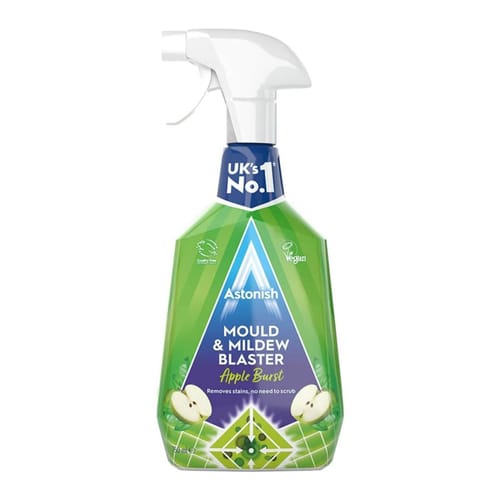
5. Astonish Mould and Mildew Blaster
★★½☆☆ 2.9 / 5
£1.49 for 750ml at Home Bargains, which is the cheapest spray on this page and less than half the Cillit Bang. The chemistry is the same family: sodium hypochlorite at 1 to 5 per cent, sodium hydroxide under 1 per cent, and an amine oxide surfactant, all from the safety data sheet.
The reason it is down here is that almost nothing else about it is published. No contact time anywhere we could find, on the pack copy or the retailer listings. No claim about whether it kills mould or removes the stain. No efficacy standard. And no product level review pool we could read, so there is no owner evidence either.
A mould spray with no stated dwell time is a real gap rather than a pedantic one. Contact time is the variable that decides whether it works, and the difference between the two products above is five minutes against fifteen. Astonish leaves you to guess.
Pros
- £1.49 for 750ml, the cheapest spray here
- A safety data sheet exists and gives the actives and the classification
- Same active family as the products that cost three times as much
Cons
- No contact time published anywhere we could find, which is the number that decides whether it works
- No claim about killing or removing, so you cannot tell what it is meant to do
- No efficacy standard cited
- No readable product level review pool at all
- Not for use on fabrics, and avoid prolonged contact with rubber and metal
Buy it if you are price led and you will leave it on for fifteen minutes anyway. Skip it if you want to be told how to use it, because nobody will.
Last place
Bleach free, and £11.50 a litre
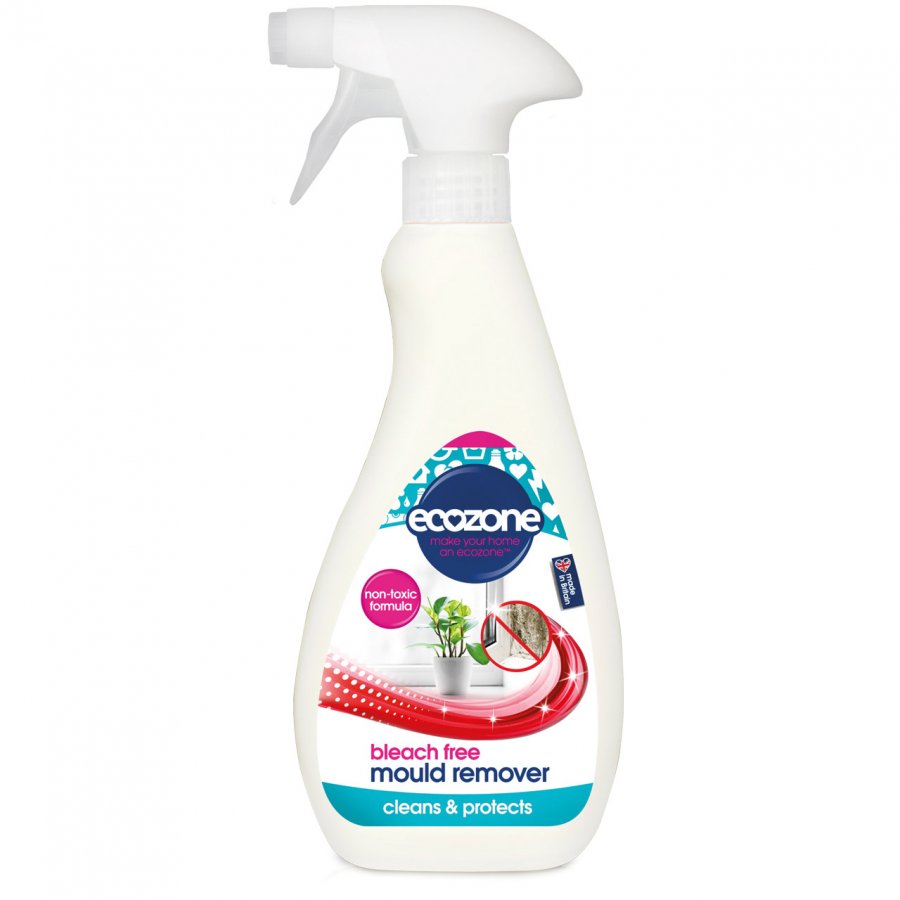
6. Ecozone Mould Remover
★★☆☆☆ 2.4 / 5
£5.75 for 500ml, which is £11.50 a litre, and it is the bleach free option that a lot of people come to this category looking for. We wanted it to be good. It is not.
The declared ingredients are water, benzalkonium chloride, citric acid and benzisothiazolinone. So the bleach free product is built on a quaternary ammonium compound, which the dermatology literature describes as both an irritant and a sensitiser, and it is preserved with an isothiazolinone, which is another recognised sensitiser. There is genuine peer reviewed evidence that benzalkonium chloride is antifungal, so this is not snake oil. It is just not gentle, and gentle is what it is bought for.
Then the documentation stops. No hazard statements published on either the brand page or the retailer listing. No safety data sheet we could find. No contact time. No list of surfaces to avoid. No efficacy standard. Eleven reviews. Ecozone lists PETA, Vegan Society, Cruelty Free International, Allergy UK and Ecolabel, and not one of those is a test of whether it kills mould.
Pros
- Declares its full ingredient list, which two of the bleach products do not
- Benzalkonium chloride does have published antifungal evidence behind it
- No chlorine, so no risk of the gas reaction that every other product here warns about
Cons
- £11.50 a litre, nearly twenty times the price of thin bleach
- Benzalkonium chloride is an irritant and a skin sensitiser, in a product bought to be gentle
- Preserved with benzisothiazolinone, another recognised sensitiser
- No hazard statements, no safety data sheet, no contact time and no surface guidance published
- Five ethical certifications and not one efficacy test
- Eleven reviews
Buy it if you cannot have chlorine in the house at all and you have read the ingredient list and are happy with it. Skip it if you assumed bleach free meant gentle, because the active here is a sensitiser too.
Prices checked 12 August 2026 and may have changed since.
The clean pick, and why there is not one
Our clean pick
There is not one here
So here is what actually works instead
What the evidence does support
✓
Fix the moisture first
The Awaab’s Law statutory guidance tells social landlords that where damp and mould come from missing ventilation or poor insulation, the landlord must install mechanical ventilation or effective insulation. That is the repair. Everything else is cleaning.
✓
Ventilate while you use it
NHS guidance says always open a window when using bleach products on mould, and wear gloves and a facemask. Asthma and Lung UK reports that four in ten people with a lung condition are triggered by sprays and aerosols.
✓
Remove it, do not just kill it
The US EPA is blunt: dead mould still causes allergic reactions, so killing it is not enough, it has to come off the surface. Wipe it away rather than spraying and leaving.
✓
Replace the sealant
On silicone that has gone black underneath the surface, no spray reaches the growth in the gap behind the bead. Cutting it out and resealing is the only thing that lasts, and it costs about five pounds.
Why no product fills the slot
✕
What works is sodium hypochlorite
Five of the six here are bleach at slightly different strengths, and it works. There is no clean version of chlorine bleach, and we are not going to promote a mild one into the slot to avoid saying that.
✕
The bleach free option is not gentle
The one product here without chlorine runs on benzalkonium chloride, an irritant and skin sensitiser, preserved with an isothiazolinone. It came last, and not for being clean.
✕
Vinegar and tea tree have no evidence here
There is real antifungal research on tea tree oil, against crop and food fungi in laboratories. We could not find one controlled trial of vinegar or tea tree oil against household black mould on a wall.
The honest absence, said plainly. This is the second of three categories in our whole plan where the clean pick rule cannot be met, and this one is the most uncomfortable. Sodium hypochlorite works. The gentle alternatives largely do not, and the one on this page that had a go at it came last on its own merits rather than because we wanted it to.
There is a second honesty worth spending a paragraph on, because both sides of this argument overstate it. Does bleach kill mould in a porous surface, or just bleach the stain while the growth survives underneath? A 2005 study in the Journal of Allergy and Clinical Immunology found dilute hypochlorite did kill Aspergillus fumigatus on a porous building board and reduced the detectable allergen. Against that, the professional remediation standard used in the trade treats biocides as the wrong tool on deeply colonised porous materials and says physical removal is the reliable method, and the EPA does not recommend biocides as routine practice. Both of those are true at once. On tile, glass and grout, bleach reaches what is there. On old plaster, chipboard or the gap behind a silicone bead, it does not, and the mould comes back because it never left.
And the largest thing, which none of these bottles will tell you. Mould is water. The Housing Ombudsman’s damp and mould report is subtitled it is not lifestyle, and its central finding was that the most common failure is treating condensation as a resident behaviour problem instead of investigating the cause. NHS guidance says the same in plainer words: if you have mould, find out why you have too much moisture. Buy the £3.50 bottle by all means. Then find the leak, or put in a fan.
What to look for when you buy one
Never mix it with anything. This is the one that actually hurts people. Chlorine bleach plus an acid, and that includes limescale remover, toilet cleaner and vinegar, releases chlorine gas. Bleach plus ammonia releases chloramine. The HSE tells workplaces never to mix cleaning substances for exactly this reason, and every single bottle in this comparison carries the same sentence on the back: do not use together with other products, may release dangerous gases. Rinse a surface before you use a different product on it.
Contact time is the number that matters. Not concentration, not price. The range on this page runs from five minutes to fifteen, and two of the six do not state one at all. Spraying and wiping straight off does very little. If a product will not tell you how long to leave it, that is a reason to buy a different one.
Read whether it says kill or remove. Removes visible black mould is a stain claim. Kills 99.9 per cent of bacteria and viruses is a claim about bacteria and viruses. Neither of those is a claim to kill mould, and the careful brands never quite make that one. Once you notice this you cannot unsee it.
Bleach free does not mean gentle. The alternative actives are benzalkonium chloride and hydrogen peroxide. The first is a recognised skin irritant and sensitiser. If you are avoiding chlorine because of fumes or because of a chest, that is a good reason, and you should still read what has replaced it.
Ventilate, properly. Open a window, run the extractor, and get anyone with asthma out of the room. NHS guidance is to open a window and wear gloves and a facemask when using bleach on mould. Asthma and Lung UK reports that four in ten people with a lung condition are triggered by sprays.
Then fix the water. Ventilation, insulation, a leaking pipe, a failed seal, drying washing indoors. If none of that changes, you are buying this bottle again in three months, and the sixth time you buy it will cost more than the fan would have.
Final verdict
£3.50 for the stain, and a fan for the problem
Five of these six products are the same chemistry. Once you know that, the choice becomes simple and quite boring: buy the one that stays on the wall longest and tells you the most about itself, which is the Cillit Bang at £3.50. If the job is large or flat, £1.17 of supermarket thin bleach is the same active for a fifth of the price per litre and the only thing you lose is the clinging.
The bleach free option came last, and it is worth being clear why, because it is not for being clean. It is because it costs £11.50 a litre, publishes no hazard information, no contact time and no surface guidance, and its active is a skin sensitiser. Five ethical certifications and not one efficacy test.
And then the part nobody selling a spray bottle wants to say. Every authority we looked at, the NHS, the Housing Ombudsman and the government’s own Awaab’s Law guidance, converges on the same point: mould is moisture, and cleaning it off without fixing the moisture is treating a symptom. The Ombudsman’s report on this is literally subtitled it is not lifestyle. If your bathroom has no extractor fan, fitting one will do more than every bottle on this page put together.