Home · Bedroom · Bedding hygiene
Best pillow protectors: five compared, and only two of them actually seal
Your pillow takes more of you than anything else in the bed. Sweat, skin, hair oil, seven or eight hours a night, every night. A protector is meant to stop that reaching the filling. Three of these five do not really try.
By Mrs House · Updated 12 August 2026 · 9 min read
Mrs House is independent. Nobody pays for a place in a ranking here, and no brand saw this page before it went live.
The short answer
Buy the Utopia at £6.99 a pair if the reason you are buying is allergies. It is the only thing here under a tenner that zips fully shut, and sealing the pillow in is the part of this with evidence behind it.
- Best overall: Utopia Bedding, £6.99 a pair. Full zip closure over a TPU film.
- Nicest to sleep on: Woolroom Washable Quilted, £35.99 each. Unbleached organic cotton over British wool, no film, no coating, nothing treated.
- Skip: Fine Bedding Allergy Defence, £30. No closure at all, at four times the price of the one that works.
Do not buy on the word hypoallergenic. Three of these five have no closure, so there is nothing for them to seal.
How we assessed these
Five protectors, one method, applied to all of them equally. We read every published specification and, for each one, established the two things the marketing tends to blur: what the fabric actually is, and whether the thing closes. A zipped encasement and a quilted cover that slips on are sold side by side under the same words and they are not doing the same job.
We checked every certification claim against the certifying body rather than the brand’s own page. Not one of the five publishes a certificate number for its OEKO-TEX or Allergy UK claim, which is worth saying out loud, because it means none of them can be verified by a reader who wants to. We also read what the Allergy UK Seal of Approval actually is, on Allergy UK’s own site, rather than treating the logo as self explanatory.
Then we read owner reviews across Amazon, the brands’ own sites and Trustpilot, weighted deliberately towards the one and two star end, because that is where zip failures, rustle, heat and shrinkage actually get described. A protector fails at the zip or after the fourth wash, and only owners will tell you that.
Every product is scored on the same five parts: does it work (35 per cent), what it is made of (25 per cent), value (15 per cent), everyday use (15 per cent) and honesty of the claims (10 per cent). Where a brand would not publish something we asked for, we say so on the page and we mark it down for it.
The ranking, at a glance
| Protector | Pair price | Seals? | Fabric | Number to check? | Score | |
|---|---|---|---|---|---|---|
| 1 | Utopia Bedding | £6.99 | Yes, full zip | Polyester jersey, TPU film | No | 3.7 |
| 2 | Woolroom Washable Quilted | £35.99 each | No, envelope flap | Organic cotton, British wool | No | 3.6 |
| 3 | Martian Made Bamboo | £15.99 | Yes, full zip | Bamboo rayon and polyester | No | 3.4 |
| 4 | Slumberdown Anti Allergy | £14.70 | No closure | Microfibre, not specified | No | 2.8 |
| 5 | Fine Bedding Allergy Defence | £30.00 | No closure | Microfibre, not specified | No | 2.5 |
Number to check means a certificate or licence number published anywhere we could find, so a reader can verify the claim themselves. Not one of the five publishes one.
The two we would actually buy
Best overall
It actually zips
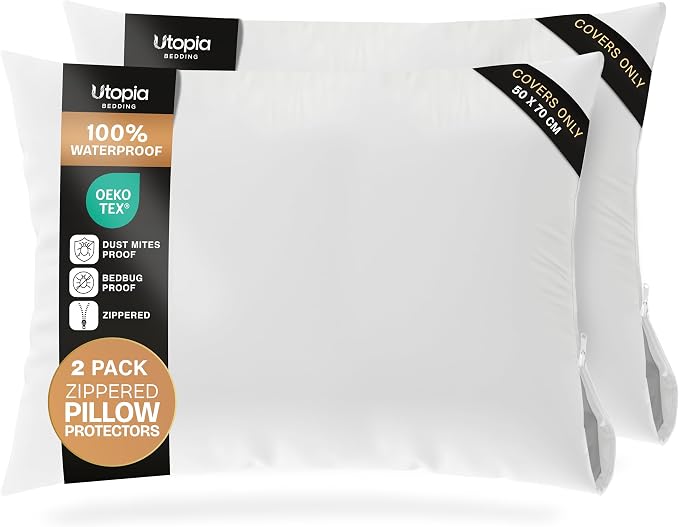
1. Utopia Bedding Waterproof Zippered Pillow Protectors
★★★★☆ 3.7 / 5
£6.99 for a pair, which is £3.50 a pillow, and it is the only thing here under a tenner that closes all the way round. That matters more than it sounds. The one part of pillow protection with real research behind it is physical exclusion: a fabric tight enough, sealed all the way round, so mite allergen cannot get out of the pillow and your skin cannot get in. A quilted cover that slips on like a pillowcase does not do that, however soft it feels.
The fabric is a polyester jersey with a TPU film bonded to the back. Utopia calls it OEKO-TEX certified in the product title and publishes no certificate number, which is a shame, because the same brand does publish one on its mattress encasement and that one checked out when we looked it up. Assume nothing here until they print a number.
The review pool is the largest on this page by an enormous margin, 41,176 ratings at 4.4, and the shape of it is consistent. Most people are happy. The unhappy five per cent are unhappy about the same four things: it rustles, it sleeps hot, water got through anyway, and the stitching round the zip let go.
Pros
- £3.50 a pillow, and a full zipped encasement rather than a cover that slips on
- 41,176 ratings at 4.4, by far the deepest pool of evidence on this page
- The film is bonded to a jersey knit, so it stretches over a fat pillow instead of fighting it
Cons
- OEKO-TEX is claimed in the product title with no certificate number published anywhere
- A plastic rustle that a minority say wakes them
- Enough one star reviews describing liquid getting through that we would not trust it against a child being sick
- Polyester and film together sleep warm
Buy it if you want the mechanism that has evidence behind it and you do not want to spend money. Skip it if noise wakes you.
The clean pick
Nothing synthetic in it

2. Woolroom Washable Quilted Wool Pillow Protector
★★★½☆ 3.6 / 5
£35.99 for one, down from £47.99, and it is the only thing here with nothing synthetic in it. Two hundred thread count unbleached organic cotton outside, traceable British wool inside, no film, no coating, no antimicrobial treatment. If what you want is a protector that keeps a good pillow clean for years without putting plastic between you and it, this is the one.
The honest catch is that it is not an encasement. It closes with an envelope flap, so it is a very good cover rather than a seal, and if you are buying for allergies specifically that distinction is the whole thing. Wool is genuinely inhospitable to dust mites by structure rather than by biocide, which is a real advantage over anything treated, but it is not the same as shutting the pillow in.
Woolroom cites OEKO-TEX Standard 100 Class 1 and the Allergy UK Seal of Approval. We could not find a certificate number for either, and Allergy UK’s own page for Woolroom names pillows, mattress protectors and toppers, not this. Ninety three per cent of its 96 reviews are five star, which is a small pool but a clean one.
Pros
- Unbleached organic cotton over traceable British wool, with no film, no coating and no treatment
- Wool resists dust mites by structure rather than by biocide, so nothing has to be added to it
- 93 per cent five star across 96 reviews on Woolroom’s own site
Cons
- An envelope closure, not a zip, so it covers the pillow rather than sealing it
- £35.99 for one, against £3.50 a pillow for the Utopia
- Neither the OEKO-TEX nor the Allergy UK claim comes with a number we could check
- Wool cycle at 30 degrees and no tumble drying ever, which is slower than most people want
Buy it if you want the best materials on the page and a protector that will outlast the pillow. Skip it if the reason you are buying is allergies, because it does not seal.
The quiet zip, and the cheap pair
The quiet one
Zips, silently

3. Martian Made Bamboo Pillow Protectors
★★★½☆ 3.4 / 5
£15.99 for two, and it zips, which puts it in a group of two on this page. The fabric is a 280gsm bamboo rayon and polyester jacquard, quilted, and it is noticeably nicer against the face than the Utopia. It is also completely silent, because there is no film in it at all.
That last part is the trade. No film means no rustle and no sweating, and it also means no waterproofing. This is a barrier against skin, dust and hair oil, not against liquid. Read the listing carefully and it never claims otherwise, which is more than some things here manage.
On the fibre: bamboo rayon is wood pulp put through a chemical regeneration, not a natural fibre in the way cotton is, and one of the one star reviews is somebody who worked that out after buying. They have a point. It is also blended with polyester and the listing does not say in what proportion. OEKO-TEX is claimed with no number, same as everything else here. It scores 4.8 from 1,683 ratings, and the complaint that recurs is the zip.
Pros
- Zips shut, so it seals in the way the quilted covers here do not
- Completely silent, because there is no film in it to crinkle
- 4.8 out of 5 from 1,683 ratings, the highest average on this page
- Considerably nicer to lie on than the Utopia
Cons
- The most common one star complaint is the zip failing
- Bamboo rayon is wood pulp put through a chemical process, and the polyester share is not published
- Not waterproof at all, which the listing is honest about but buyers still miss
- OEKO-TEX claimed with no certificate number
Buy it if you want a seal you cannot hear. Skip it if you need it to stop liquid.
Cheapest pair
No seal
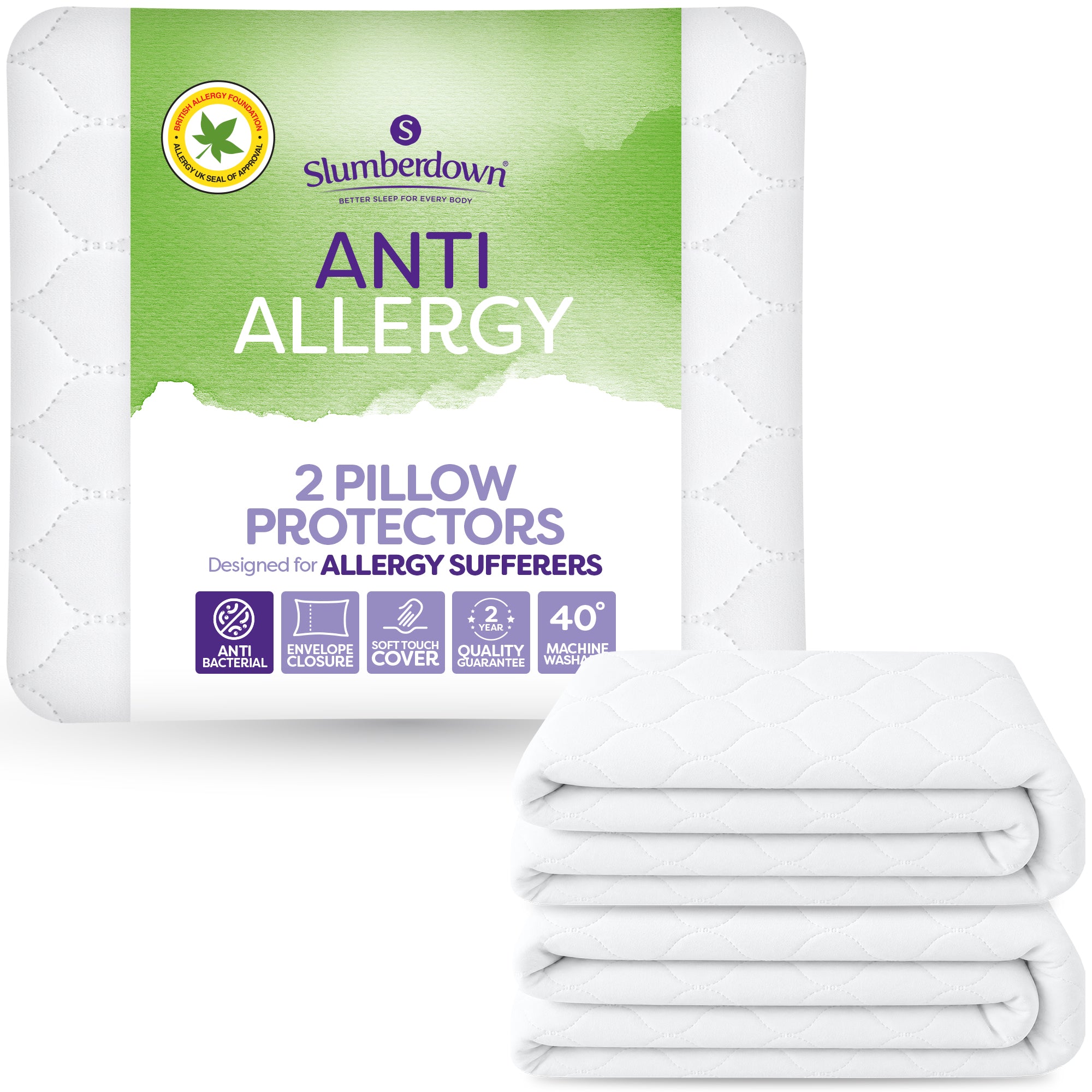
4. Slumberdown Anti Allergy Pillow Protector
★★★☆☆ 2.8 / 5
£14.70 a pair from Slumberdown, or £12.75 on Amazon, for a quilted microfibre cover that slips on like a pillowcase. It carries the Allergy UK Seal of Approval, and that is worth understanding properly rather than taking as a badge. Allergy UK does not test anything itself. A brand applies, pays, an independent laboratory runs a protocol, and on passing the brand licenses the logo on an annual renewal. It is a real test followed by a commercial licence. It is not a British Standard.
What Slumberdown will not tell you is what it is made of. Amazon lists the fabric as microfibre and that is as far as anybody goes. No fibre breakdown, nothing about the filling, and no named technology behind the anti bacterial claim on the front of the pack.
Forty three ratings at 4.3 is too small a pool to lean on, and the complaints in it are about the thing being thin.
Pros
- The Allergy UK Seal is a real independent laboratory test rather than a self declaration
- £14.70 a pair, and it washes and tumble dries at 40 degrees without ceremony
Cons
- Quilted with no closure, so it does not seal the pillow in
- No fibre composition published anywhere, on Slumberdown’s own site or on Amazon
- The anti bacterial claim names no technology and cites no test
- 43 ratings is too small a pool to read anything into
Buy it if you want something cheap and washable and you are not buying for allergies. Skip it if you expected the Allergy UK logo to mean it seals.
The one we would not buy
Last place
£30, nothing published
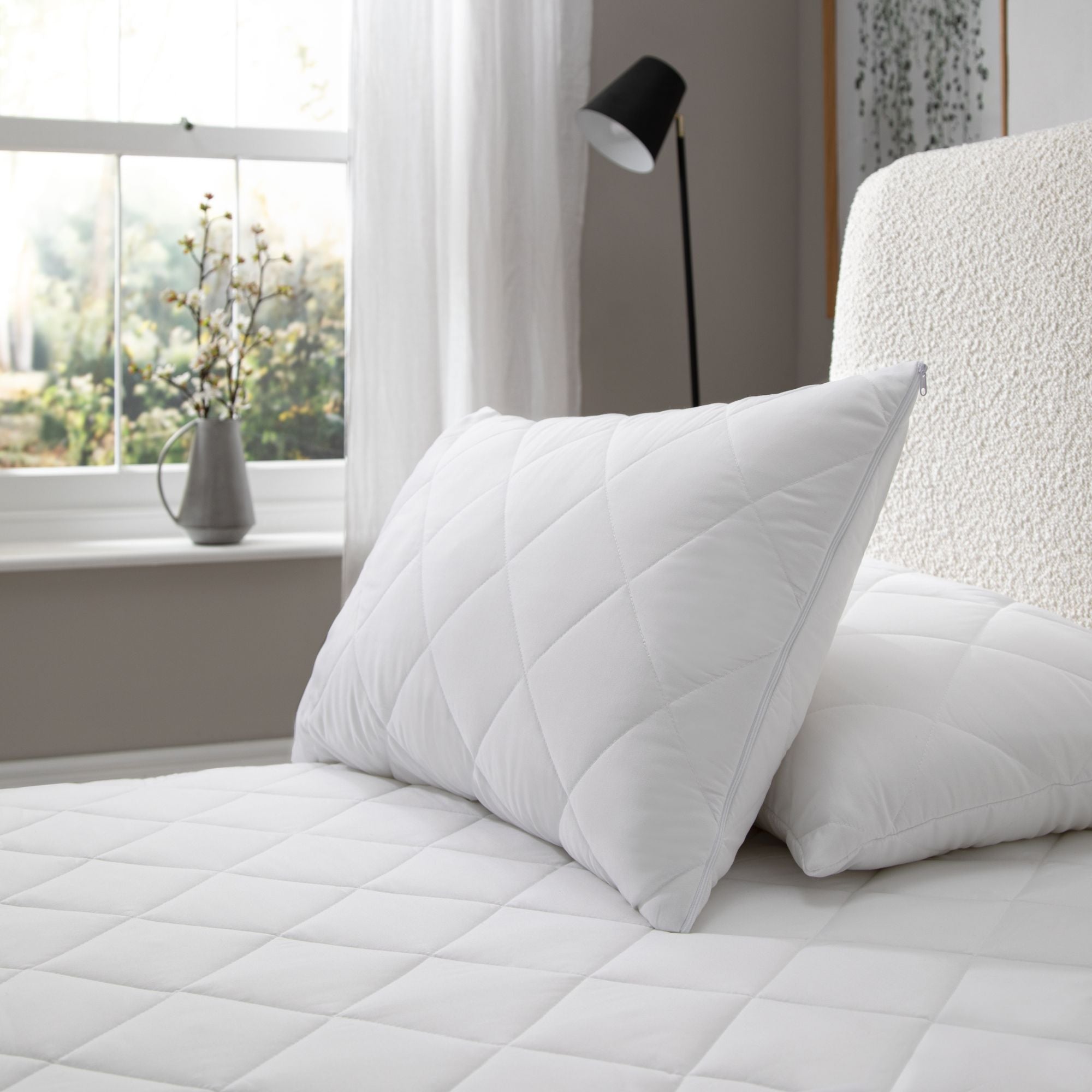
5. The Fine Bedding Company Allergy Defence Pillow Protector
★★½☆☆ 2.5 / 5
£30 a pair, the second most expensive thing here, for a quilted microfibre cover with a treatment on it. The treatment is HeiQ Allergen Tech, described as a hundred per cent biobased, patent pending system of active probiotics that break down allergen matter from pollen, dust mites and pets, and claimed to survive more than twenty washes.
We have no way of checking any of that. The Fine Bedding Company publishes no fibre composition for this product, no certification, no test report and no reference number, and there is no rating or review count on the page at all. The company’s Trustpilot score is excellent, 4.8 from 12,681 reviews, but that is the company and not this product.
The deeper problem is the approach. The thing with evidence behind it in this category is physical exclusion, a tight fabric sealed all the way round. This is an open quilted cover relying on a chemistry we cannot see the data for, at more than four times the price of the one that closes.
Pros
- Genuinely soft, and the diamond quilting is the best looking thing on this page
Cons
- No fibre composition, no certification, no test report and no reference number published
- No rating or review count on the product page at all
- An open quilted cover, so no seal
- £30 a pair, against £6.99 for the one that actually closes
- The probiotic allergen claim is exactly the kind nobody independent has checked
Buy it if you already trust the brand and you want the nicest looking one. Skip it if you want to know what you are buying.
Prices checked 12 August 2026 and may have changed since.
The clean pick, and the honest catch
Our clean pick
Woolroom Washable Quilted Wool
Cotton and wool, and nothing else
Why it wins on materials
✓
Nothing synthetic touches you
Two hundred thread count unbleached organic cotton over traceable British wool. No film, no coating, no antimicrobial finish anywhere in it.
✓
It resists mites by structure, not by biocide
Wool is inhospitable to dust mites because of what it is, so nothing has to be added to make it so. Every other route on this page is either a plastic film or a treatment.
✓
Washable, which wool rarely is
Wool cycle at 30 degrees with wool detergent, spun under 800rpm. Most wool bedding says dry clean only and then quietly becomes a problem.
✓
British wool with a traceable source
Woolroom publishes where the wool comes from under its Wool ID scheme. Nobody else here says anything about origin at all.
What you give up
✕
It does not seal
An envelope flap, not a zip. For keeping a pillow clean that is fine. For shutting mite allergen inside a pillow it is not the same thing, and the difference matters if allergies are your reason.
✕
£35.99 for one
Against £3.50 a pillow for the Utopia. You are paying roughly ten times as much per pillow for the materials.
✕
Two badges, neither with a number
OEKO-TEX Standard 100 Class 1 and Allergy UK are both claimed, and neither comes with a certificate number. Allergy UK’s own page for Woolroom does not name this product.
The catch, said plainly. Our rule is that every comparison names one genuinely clean option, and here it is a good one. But it is not the winner, and pretending otherwise would be dishonest. If you are buying a pillow protector because of allergies, the thing that has research behind it is a sealed encasement with a tight enough weave, and the Woolroom does not seal.
That research, for the record, is a 1999 study in the Journal of Allergy and Clinical Immunology which found fabrics with a pore size under ten microns blocked dust mite allergen below detectable limits. There is no British or European standard for it. Any brand can print anti dust mite on a bag without being tested against anything, and most of them do.
And a caveat that cuts against the whole category. The Cochrane review of house dust mite control measures for asthma pooled 37 trials of physical methods, including encasements, and concluded that chemical and physical methods aimed at reducing exposure to house dust mite allergens cannot be recommended. Reducing allergen in a bed is measurable. Improving somebody’s asthma by doing it has not been demonstrated. Those are two different claims and shops routinely sell you the first while implying the second.
What to look for when you buy one
Does it close. This is the whole question and it is the one the packaging works hardest to avoid. A zipped encasement shuts the pillow in on all six sides. A quilted protector slips over the top like a pillowcase and leaves the ends open. Both are sold as protectors, both carry the same allergy language, and only one of them is a barrier. If the listing does not say zip, it does not zip.
Anti allergy and hypoallergenic mean nothing on their own. Neither word is regulated. There is no British or European standard for pore size in bedding, so a manufacturer can print anti dust mite on a bag without having tested against anything. What you can check is the closure and, occasionally, a stated pore size in microns. Under ten is the number from the research.
A treatment is not a barrier. Several protectors now sell an antimicrobial or probiotic finish instead of a tight fabric. There is no independent published data behind any of the ones on this page, and a finish has to survive washing to keep doing anything. Given the choice between a fabric that physically excludes and a chemistry you cannot see the test for, take the fabric.
Look for the certificate number, not the logo. OEKO-TEX certificates have numbers and they can be checked in about a minute on the OEKO-TEX website. Allergy UK licences have holders. If a brand prints the badge and no number, you cannot verify it, and every one of the five protectors on this page fell into exactly that gap.
Know what the Allergy UK Seal is. It is a genuine independent laboratory test, run for Allergy UK by its commercial arm, followed by an annually renewed paid licence to use the logo. That is a real hurdle and it is more than most brands do. It is not a government standard and it does not tell you the product seals.
Then do the boring things. The evidence for washing pillowcases and protectors at 60 degrees is better than the evidence for anything you can spray or buy, and keeping bedroom humidity under 50 per cent does more than a treated fabric will. A protector is worth having. It is not the main event.
Final verdict
Spend £7, or spend £36 knowingly
This category has a strange shape. The cheapest thing on the page is the one doing the job properly, and the two most expensive quilted covers are doing almost nothing except feeling nice. £6.99 buys two Utopia encasements that zip shut. £30 buys two Fine Bedding covers that do not close, from a brand that will not tell you what they are made of.
So there are two honest answers. If you are buying because of allergies, buy the Utopia, accept the rustle, and put the £23 you saved towards washing everything at 60 degrees more often. If you are buying because you have a good pillow and want it to last, buy the Woolroom, and buy it knowing it is a cover rather than a seal.
What you should not do is buy the middle of this page. Paying £14 or £30 for a quilted microfibre cover with an unverifiable badge on it is the worst value here, and it is where most of the money in this category goes.